Clan OMaolagain
– 3 min read


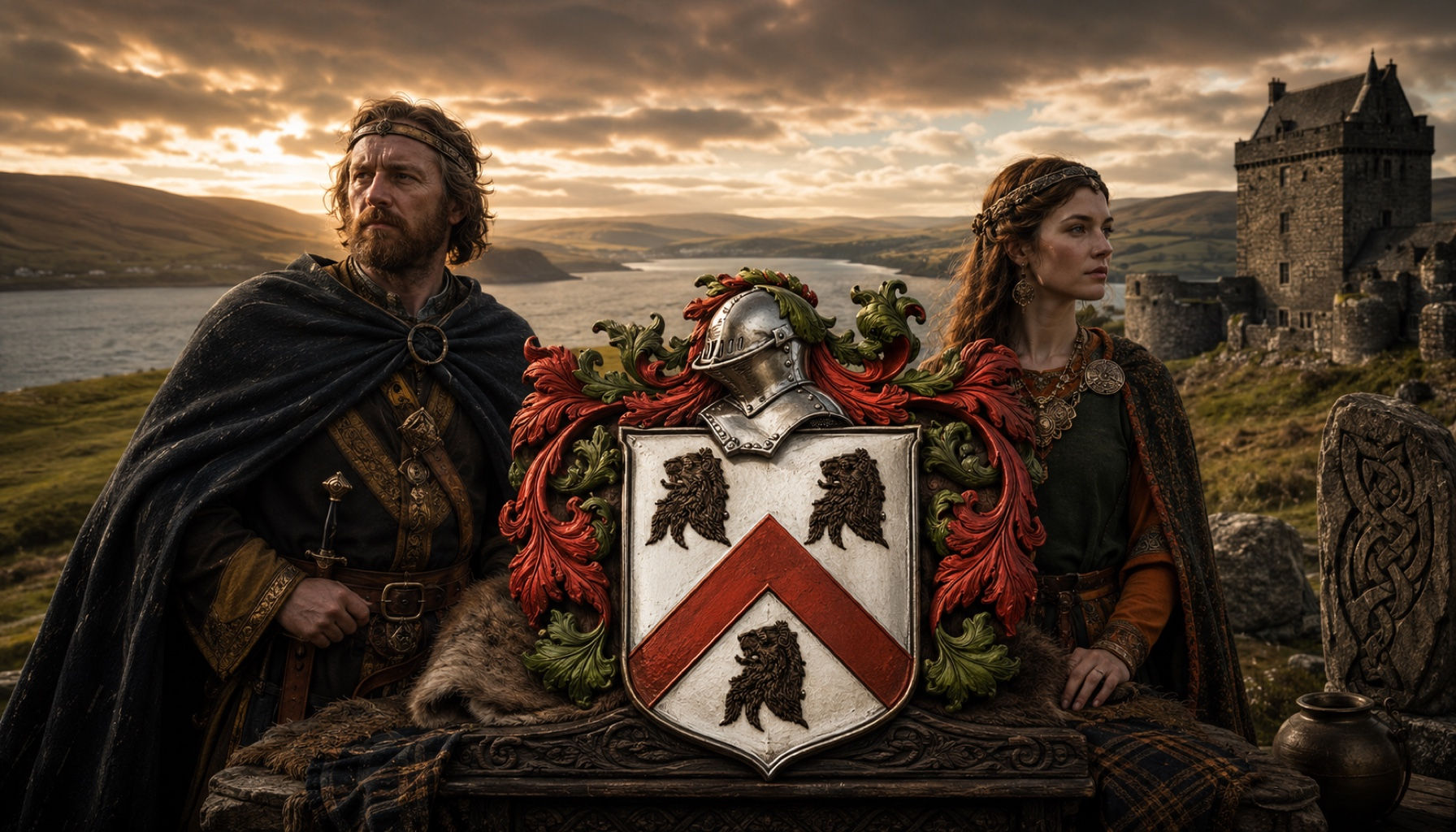
Clann OMaolagain was a Gaelic Irish family of the old kin-based world, a surname group shaped by descent, memory, service, and place. In that sense, they belong very firmly to the historic naming culture of Ireland, where a family name was not just a label but a declaration of ancestry and belonging. The clan is linked here with the haplogroup R1b1a1b1a1a2c1a1a1a1a1a1a5, presented as the primary family haplogroup, a lineage well suited to the wider paternal landscape long associated with Gaelic Ireland.
The OMaolagain name endured through the upheavals that transformed Ireland: lordship struggles, the encroachment of outside power, the collapse of older legal orders, anglicisation, and migration. Yet the surname kept its recognisably Gaelic form and identity. Clann OMaolagain therefore stands as a rather fine example of Irish continuity: not continuity in the sense that every later bearer can be neatly marched back to one proven medieval man, but continuity of tradition, regional memory, and the stubborn survival of a family name across centuries. In historical tradition the family is associated with Tirkeeran in the north-west, and with the world of the Chiefs of Tir MacCarthainn, which places them inside a landscape of local power, church influence, and interlocking Gaelic lordships.
Read more about Clan ODomhnaill
Tirkeeran, the clan's location anchor, lies in what is now County Londonderry, one of the historic baronies of Ulster. It stretches across a striking bit of north-western Ireland, including ground near the River Foyle and territory not far from modern Derry. Historically this was a meaningful frontier and corridor rather than some sleepy edge of the map. Tirkeeran sat within a larger Gaelic political landscape where church lands, dynastic claims, and local lordships overlapped in endlessly interesting ways. A family associated with this district would have lived in a world where identity was rooted in territory, kin, and service, and where names preserved the memory of founding ancestors long after political conditions had changed. The district can still be visited today through the wider Derry and north-west Ulster landscape, and that matters, because one of the pleasures of Irish history is that the old territorial framework has not entirely vanished. You can still stand in the region, look across its fields and waterways, and sense why a clan name could remain attached to place for so long.
As for named figures, the surviving record for smaller Gaelic families is not always generous, and that in itself is part of the story. The reference to the Chiefs of Tir MacCarthainn ties the family to a recognised local chiefly tradition rather than to one single celebrity ancestor preserved in perfect detail. That is often how Gaelic history works: fragments, territorial titles, and hereditary memory surviving in annals, genealogies, and later surname tradition. The important point is not to invent grandeur where the evidence is thin, but to see clearly what is there: a genuine Gaelic clan identity embedded in the political geography of Ulster.
From an ancient-DNA point of view, the haplogroup tag R1b1a1b1a1a2c1a1a1a1a1a1a5 connects the OMaolagain story to a wider medieval North Atlantic and Irish genetic world rather than proving direct descent from any one excavated individual. Related or linked samples include a substantial cluster from Medieval Ireland at Ballyhanna, County Donegal, among them Sk197an, Sk197y, Sk197q, Sk197am, Sk197s, Sk197ab, Sk197u, Sk197t, Sk197r, Sk197ad, Sk197x, Sk197n, Sk197aa, Sk197z, Sk197ak, Sk197w, Sk197ai, Sk197m, Sk197ah, Sk197ag, Sk197v, Sk197ac, Sk197al, Sk197af, Sk197ae, Sk197o, Sk197aj, HAN197x, Sk197a, Sk197b, Sk197c, Sk197d, Sk197e, Sk197f, Sk197g, Sk197h, Sk197i, Sk197j, Sk197k, Sk197l, Sk197p, and HAN197. Other linked examples include Kilteasheen in Roscommon, such as KIL041, KIL044, KIL033, KIL037, KIL009, and KIL014, alongside more distant but still informative North Atlantic comparanda like Viking Age Hofstadir Iceland VK95 and Medieval Age Faroe Islands Sandoy Church VK44. None of these should be treated as a documented OMaolagain pedigree line. What they offer instead is context: the sort of paternal and population background in which Gaelic Irish surname groups emerged, persisted, and spread.
Read more about Clan MacCarthy
If you carry the OMaolagain name, or think your family may belong to this wider Gaelic tradition, DNA can add another layer to the story. Upload your DNA to MyTrueAncestry to see whether you match Clann OMaolagain, the primary haplogroup R1b1a1b1a1a2c1a1a1a1a1a1a5, or related ancient Irish and North Atlantic samples from sites like Ballyhanna and Kilteasheen.
Comments