Clan ODuibhgeannain
– 2 min read


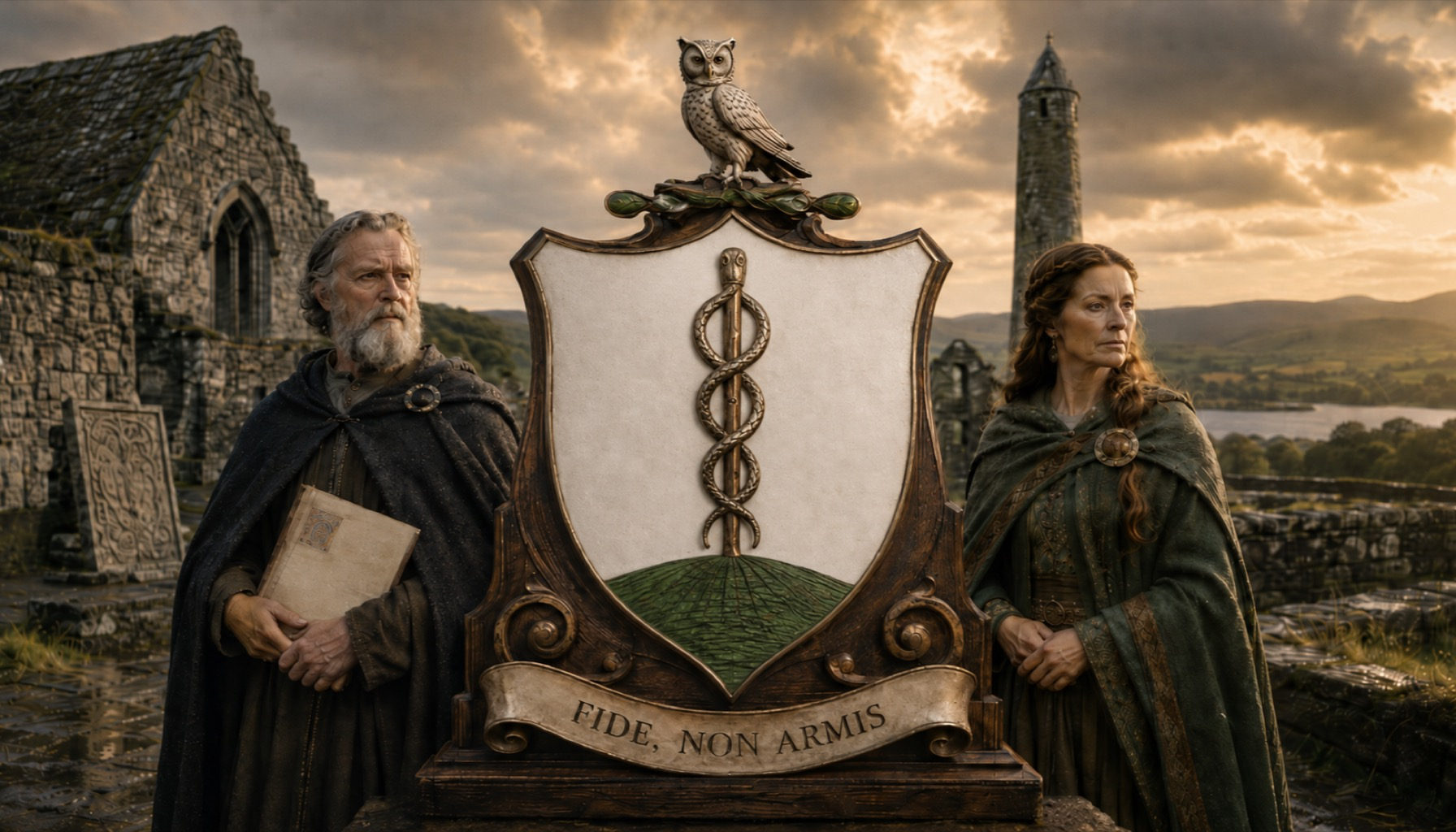
Clann ODuibhgeannain were not remembered as warlords first, but as something in many ways just as powerful in Gaelic Ireland: hereditary historians, scribes, and genealogists. They belonged to that remarkable class of learned families whose work held society together through memory. In a world where descent, land-rights, alliances, and status all depended on who could prove what, the ODuibhgeannains preserved lineages, copied manuscripts, recorded annals, and carried the cultural memory of dynasties across generations. The primary family haplogroup linked here is R1a1a1b2a2a1d9c2a.
The family is especially associated with the historic kingdom of Breifne, in the northwest midlands of Ireland, in a landscape shared with ruling families such as the O'Rourkes and closely connected learned kindreds. This was a part of Gaelic Ireland where scholarship was not a hobby tucked away in a monastery library, but a public duty woven into politics and identity. Figures connected with the wider family tradition include Maine of Tethba, remembered in early genealogical context, and Maelpeter ODuigennan, Archdeacon of Breifny, who shows how the family's learned standing could also overlap with the ecclesiastical world. The ODuibhgeannain name belongs squarely to the professional scholarly culture that helped Irish history survive repeated centuries of upheaval.
The great location anchor for the ODuibhgeannains is the Breifne region, especially around modern County Leitrim and neighboring parts of Cavan and Roscommon, where learned families served Gaelic lordships with an almost institutional continuity. This is the sort of place where history feels stubbornly close to the surface: ruined churches, old territorial boundaries, ringfort-dotted fields, and the memory of schools and manuscript culture that once mattered as much as any fortress. In medieval Ireland, a learned family was often attached to a ruling house in a fairly formal way, acting as custodians of genealogy, legal tradition, and historical narrative. That is the world in which the ODuibhgeannains flourished. Much of this broader Breifne landscape can still be visited today, and for anyone interested in Irish learned families it remains one of the best places to grasp how scholarship, lordship, and place were tied together.
The haplogroup tag connected here, R1a1a1b2a2a1d9c2a, belongs to a wider paternal branch with an intriguing ancient footprint across parts of Eurasia. Related or linked ancient samples include Late Roman Empire Viminacium, Serbia, Vise Grobalja Necropolis (I15520), King Ladislaus I of Hungary (SZTL), Prince Andras of the Arpad Dynasty (HU52), King Bela III of the Arpad Dynasty (BelaIII), a Gepidic era sample from Hajdunanas-Furj-halom-dulo, Hungary (A181028), Bronze Age Szolad, Hungary (SZ1), Andronovo Culture Pavlodar (I10111), and steppe-linked Sarmatian context sample tem003. These do not prove direct descent from any one ancient individual to the ODuibhgeannains. Rather, they show the broader deep-time pathways of related paternal lineages, stretching from Bronze Age steppe horizons through late antique and medieval eastern and central Europe. It is a reminder that a Gaelic learned family of Ireland sits, genetically speaking, within a much older Eurasian human story.
If your family carries the ODuibhgeannain name, one of its later forms, or simply roots in the old Breifne world, DNA can add an unexpected extra layer to the paper trail. Upload your DNA to MyTrueAncestry and see whether you match the family story of Clan ODuibhgeannain or show connections to related ancient DNA samples tied to haplogroup R1a1a1b2a2a1d9c2a.
Comments