Clan OLachtna
– 3 min read


Primary family haplogroup: R1b1a1b1a1a2c1a1a1a1a1a1a
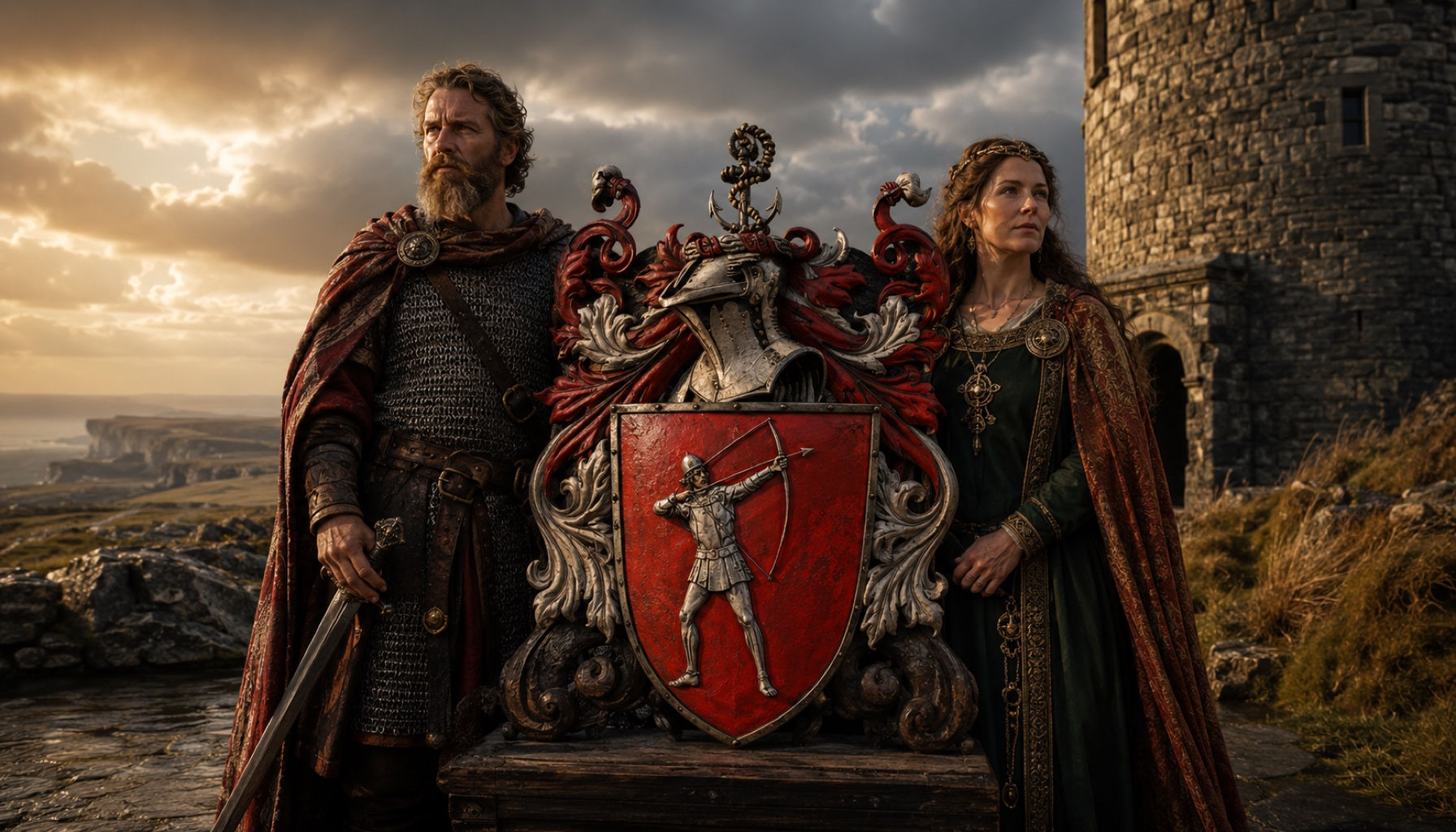
Clann OLachtna was a Gaelic Irish kin-group rooted in the old world of hereditary surnames, local lordship, and remembered descent, a family identity carried through generations in the way Irish clans so often were. In that sense, the name belongs to a very old Irish pattern indeed: a people defined not simply by blood in the modern sense, but by ancestry, territory, loyalty, and the public memory of who their forebears were. Linked here with the Y-DNA haplogroup R1b1a1b1a1a2c1a1a1a1a1a1a, the family stands within the long continuity of Gaelic paternal line tradition, the sort of lineage that survived political upheaval, conquest, anglicization, and migration without quite losing its sense of itself.
Historically, Clann OLachtna sits in the wider orbit of Connacht and the old Ui Fiachrach world, where descent from notable ancestors was not mere ornament but a social fact with political consequences. That is why figures such as Eochaidh Muighmheadhoin, remembered as King of Ireland around 350 AD, matter in the storytelling of such lineages: they anchor clan memory in the deep genealogical imagination of early Ireland. The same world produced the Ui Fiachrach chiefs of the Two Bats and Glen Nephin, a reminder that these were not abstract pedigrees but families tied to real landscapes in the west. Later, we encounter Conghalach OLoughlin, Bishop of Corcomroe in 1281, showing how Gaelic kindreds also moved through ecclesiastical office, local influence, and learned culture as well as kingship and lordship.
Read more about Clan OFlaherty
The family's location anchor lies in the north Mayo and wider Ui Fiachrach territory associated with Glen Nephin and the old districts remembered in connection with the chiefs of the Two Bats. This is one of those western Irish landscapes where genealogy and geography still seem to speak to each other: mountain, bog, valley, ruined church, and old routeway all folded into the history of local families. Glen Nephin itself, below Nephin mountain in County Mayo, belongs to a striking and ancient terrain that once formed part of a Gaelic lordship network rather than a neat modern map. The region preserves the feel of an older Ireland, where kin-groups held influence through control of land, alliances, church patronage, and inherited reputation. Yes, it can still be visited today, and that is part of its charm: this is not a lost, book-only landscape, but a real place in Mayo where the physical setting still helps explain how a clan identity could endure for centuries.
From a DNA perspective, the OLachtna story is best understood through related and haplogroup-linked ancient samples rather than any claim of direct descent from named burials. The haplogroup R1b1a1b1a1a2c1a1a1a1a1a1a appears in a fascinating spread of medieval and earlier contexts across northern and western Europe, including Medieval Ireland Kilteasheen Roscommon Bishops Seat samples KIL033, KIL037, KIL043, and KIL009, as well as Viking Age Dublin sample VK545, Viking Age Hofstadir Iceland VK95, Medieval Sandoy Church in the Faroe Islands VK44, Anglo-Saxon Norfolk SED005, Alt-Inden in North Rhine-Westphalia IND007, Deersheim in Saxony-Anhalt DRH026, Groningen GRO005, Vor Frue Kirkegard in Aalborg CGG100512, and even older or later linked contexts such as Pech-Maho in France PECH8 and the Calvert coffins in Maryland I2097 and 2099. These do not prove that the OLachtna family descends from any one of them. What they do show is that this paternal line belongs to a deep and widely distributed historical network, one that turns up in Gaelic Irish, Viking Age, Anglo-Saxon, continental Germanic, and later Atlantic-world settings. That is precisely what makes haplogroups so intriguing: they do not replace family history, but they give it a broader archaeological horizon.
Read more about Clan MacDiarmada
If Clann OLachtna is part of your family story, the most exciting next step is to test that story against the evidence of both surname history and ancient DNA. Upload your DNA to MyTrueAncestry to see whether you match the OLachtna family profile or any of the related ancient samples linked to this wider Gaelic and Atlantic world.
Comments