Clan ODea
– 3 min read


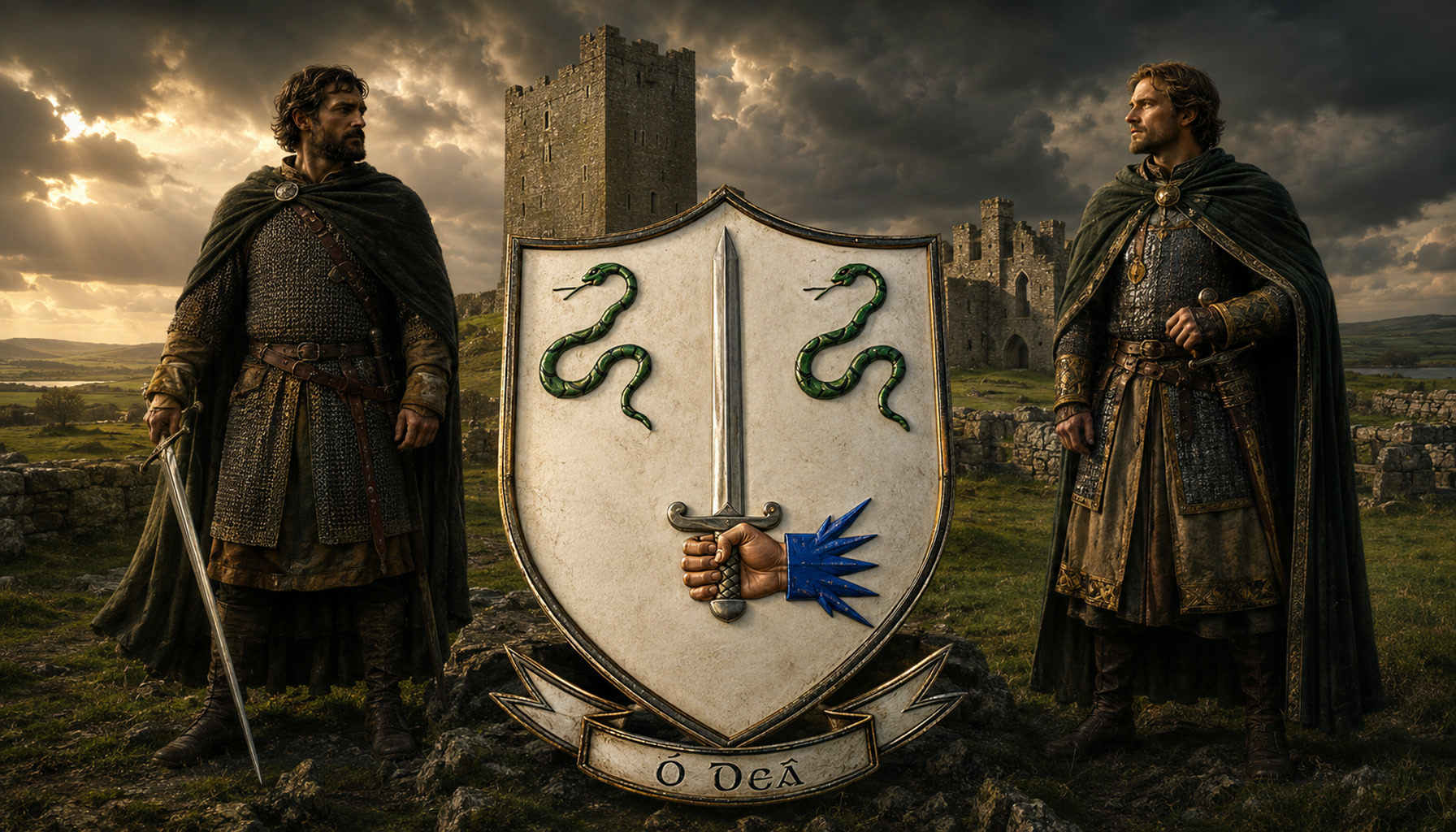
Clan ODea, or O Deaghaidh, was a Gaelic Irish family of County Clare, rooted in the Dalcassian world of Thomond in western Ireland. Their story belongs to that recognisably Irish pattern of kin-group, territory, fighting strength, and inherited memory: a family that mattered because it held land, served in war, and remained tied to a particular landscape over centuries. The primary haplogroup linked here is R1b1a1b1a1a2c1a4b2a1c, a lineage often associated in broad terms with parts of Atlantic and Celtic Europe. Haplogroups: R1b1a1b1a1a2c1a4b2a1c.
The ODeas emerged in a region where politics was never simple and rarely tidy. Medieval Clare was part of Thomond, the kingdom dominated by the O Briens after the age of Brian Boru, and it was a world shaped by shifting loyalties, rival branches of powerful families, church patronage, cattle wealth, local lordship, and the constant need to defend status. In that setting, the ODeas built and preserved family identity through descent, landholding, and martial reputation. Named figures such as Conchobhar O Deaghaidh, recorded in 1350, remind us that this was not an abstract clan label but a living lineage active in the history of Gaelic Munster. Their legacy also survives in stone, above all at Desert ODea Castle, one of the strongest anchors of family memory in County Clare.
ODea Castle, near Corofin in County Clare, is the great geographical calling card of the clan. The surviving tower house, generally dated to the late fifteenth century, stands in the parish of Dysert O Dea, a place-name that effectively preserves the family claim on the landscape. This was not just a residence in the modern sense but a statement in masonry: a defended lordly home in a region where status, inheritance, and security were inseparable. The site is also associated with a much longer history, including the nearby Romanesque monastery and high cross at Dysert O Dea, which give the area an unusually rich historical texture. The castle itself was damaged during the Confederate Wars in the seventeenth century, later fell into ruin, and in modern times was restored. Happily, it can still be visited, and for anyone interested in the ODeas it offers that rare thing in family history: not merely a surname in a list, but a real place where the clan's past still feels physically present.
From a DNA perspective, the ODea story sits within a much wider network of R1b1a1b1a1a2c1a4b2a1c-linked ancient samples across Britain and Europe. These include multiple Celtic Durotriges individuals from Duropolis, Winterborne Kingston in England such as WBK12, WBK20, WBK29, WBK41, WBK05, WBK30, WBK43, WBK06, WBK08, WBK18, and WBK191, along with related samples from Iron Age Worlebury in Somerset, Battlesbury Bowl, Hinxton, Bell Beaker and Bronze Age Wiltshire, Bedfordshire, South Lanarkshire, Orkney, and even Rathlin in Copper Age Ireland. Further linked examples appear in Roman, post-Roman, and medieval contexts from Cambridge, Zadar, Conimbriga, Belgium, Germany, Austria, France, and Dorset. None of this proves direct descent from any one ancient person, and it would be quite wrong to pretend otherwise. But it does place the clan's associated haplogroup within a deep and fascinating archaeological spread: from Bronze Age and Iron Age communities of Britain and Ireland to later Roman and medieval populations across western Europe.
Read more about Clan OSullivan
If you carry the ODea name, have Clare roots, or simply want to see how your own DNA connects with Gaelic Irish families and ancient samples linked to R1b1a1b1a1a2c1a4b2a1c, you can explore it for yourself. Upload your DNA to MyTrueAncestry and see whether you match the family story of Clan ODea or related ancient individuals from Ireland, Britain, and the wider Celtic world.
Comments