Clan Menzies
– 3 min read


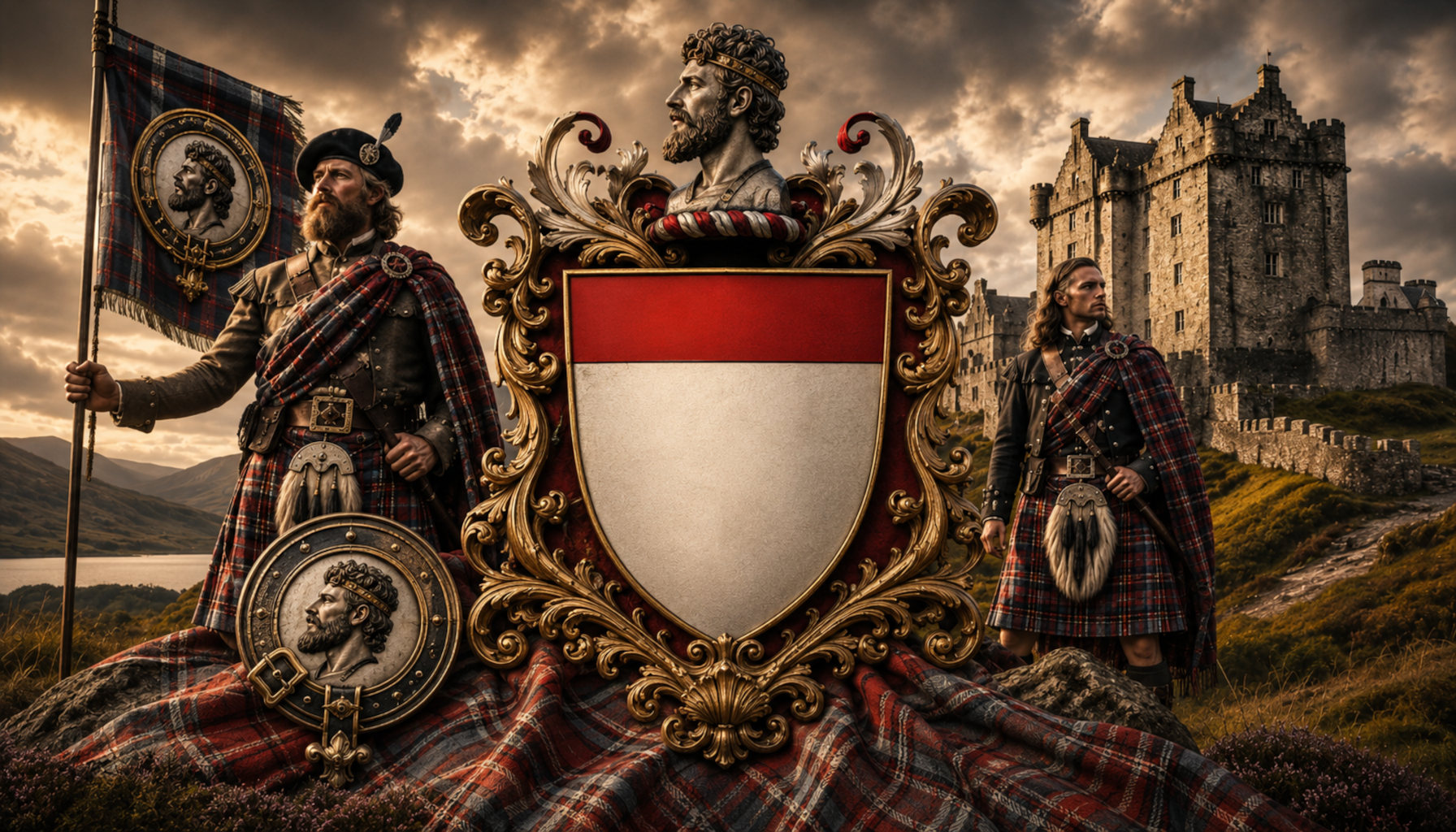
Clan Menzies was a Highland Scottish kindred of Perthshire, long rooted around Weem and Aberfeldy, with its historic center at Castle Menzies. In family tradition and documentary history alike, the clan is usually traced to Norman origins, through names such as de Meyners or Mesnieres, before becoming thoroughly part of the political and military world of medieval Scotland. For DNA enthusiasts, the primary family haplogroup associated here is R1b1a1b1a1a2c1a6, a branch within the great western European R1b line that appears again and again across Britain and neighboring regions in ancient remains.
What makes the Menzies story so characteristically Scottish is that mixture of foreign beginning and local loyalty. By the 13th century we find Sir Robert de Myneris, recorded in 1237, already established as a notable figure in Scotland. From there the family rose through royal service, landholding, and support for Robert the Bruce during the Wars of Scottish Independence. Their heraldry is famously bold in its simplicity, argent with a chief gules, the white and red that echo the clan identity and war cry. Their motto, Vil God I Zal, usually rendered "God willing I shall," and the crest badge showing a savage head erased proper are tied to later tradition about Teba and the recovery of the heart of Robert the Bruce. Whether one begins with charter evidence, heraldry, or legend, Clan Menzies stands as a Highland house of Norman origin that became unmistakably Scottish in allegiance and memory.
The real anchor of the clan landscape is Castle Menzies near Weem, close to Aberfeldy in Highland Perthshire. Earlier known as the Palace of Weem, it developed into the chief seat of the Menzies family and remains one of the most important survivals of its kind in Scotland. The present building is notable for its Z-plan form and for the way it preserves the look of a fortified lairdly residence that was also meant to project status, hospitality, and control over the surrounding country. Its history touches several of the great upheavals of Scotland: Cromwell's forces were associated with the site in the 17th century, and during the Jacobite rising of 1745 Bonnie Prince Charlie is linked with a stay there. In more recent times the castle fell into decline before being rescued and restored through the work of the Menzies Clan Society, which turned it from a near ruin back into a visible emblem of clan continuity. It can still be visited, which is rather marvelous, because it allows people to stand not in an abstract family legend but in the actual architectural setting where that story unfolded.
Read more about Clan Mackenzie
From an ancient-DNA perspective, the haplogroup R1b1a1b1a1a2c1a6 links Clan Menzies into a much deeper and wider western European story. It appears in related or linked ancient samples from Iron Age, Roman, Pictish, early medieval, and medieval contexts, not as proof of direct descent from any one excavated individual, but as part of a broader paternal backdrop from which later families emerged. Particularly striking are linked examples from Britain, including Celtic Durotriges burials at Duropolis, Winterborne Kingston such as WBK12, WBK20, WBK29, WBK41, WBK05, WBK30, WBK43, WBK06, WBK08, WBK18, and WBK191; Roman Era Cambridge Vicars Farm VIC016; Bronze Age and Pict-era Orkney samples including KD061 and KD004 series individuals from Knowe of Skea; Pict-era Mine Howe CGG018915; Iron Age Highland Applecross I3567 and I3566; Iron Age Hillfort Broxmouth I16504 and I2695; and Late Bronze Age Covesea Caves in Moray I2859x. Beyond Britain, linked examples also turn up in northern Spain at Las Gobas, in Belgium, France, Italy, Croatia, Ireland, Germany, Sweden, and elsewhere, suggesting a lineage that sits comfortably within the old population networks of Atlantic and northwestern Europe. In other words, the Menzies DNA signature belongs to a very old world of movement, settlement, and continuity that long predates the surname itself.
If Clan Menzies is part of your family story, or if Perthshire, Weem, Aberfeldy, and the old Highland nobility keep tugging at your curiosity, DNA can add another layer to the picture. Upload your DNA to MyTrueAncestry to see whether you match Clan Menzies, the primary haplogroup R1b1a1b1a1a2c1a6, or related ancient DNA samples from Pictish, Iron Age, Roman, and medieval Britain and Europe.
Comments