Clan MacPhee
– 3 min read


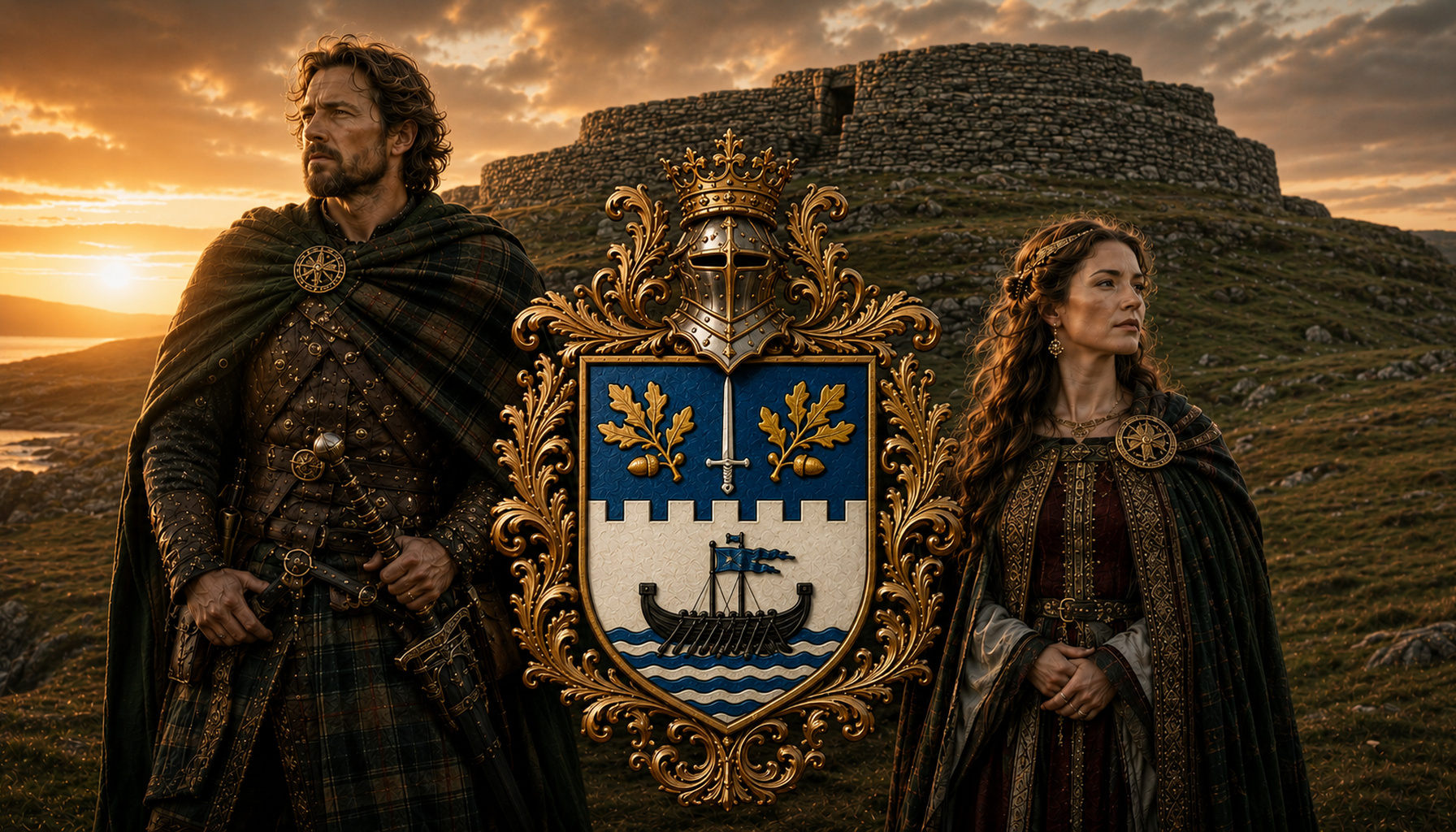
Clan MacPhee, also found as Macfie, MacDuffie, and several related spellings, was one of the old Gaelic kindreds of the western Highlands and Isles, most closely tied to Colonsay and the wider Hebridean sea world. Their name is usually traced to a Gaelic origin meaning son of Dubhshithe, often rendered as son of the dark fairy or son of the dark man of peace, depending on how one unpacks the older language. In historical terms, the MacPhees belonged to that salt-edged society where power was measured not just in acres, but in boats, kin, cattle, harbours, and the ability to hold one's own among neighbours who were very often relatives, rivals, or both. Primary family haplogroup tag: R1b1a1b1a1a2c1a4d1.
The clan moved in the orbit of the Lords of the Isles and the great maritime sphere of Clan Donald, yet they kept a distinct identity of their own. This is important, because smaller island clans are often flattened out in later storytelling, as if they were merely passengers in somebody else's history. They were not. Families like the MacPhees helped make the political texture of the Hebrides: seafaring chiefs, fighting men, local alliances, oral memory, and territorial anchors on islands where every bay and rocky height mattered. By the early modern period, pressure from stronger neighbours and shifting power in the western seaways led to loss, dispersal, and fragmentation, but the name endured. A recorded figure such as Malcolm Macfie of Colonsay in 1615 reminds us that this was not a legend floating in mist, but a family rooted in a real and contested landscape.
Read more about Clan MacDonald
The great location anchor for Clan MacPhee is Dun Eibhinn, usually anglicised as Fort of Eyvind, on Colonsay. It stands on a dramatic rocky crag above the surrounding ground, exactly the sort of place that tells you at once why Iron Age and later island communities prized defensible heights. The site is an ancient dun or fortified enclosure, with stone walls built to command views and approaches, and in later tradition it became strongly associated with the MacPhees as their stronghold. There is a certain Hebridean grandeur to it: not a sprawling castle in the mainland sense, but a compact, stern, sea-facing power place where watchfulness and local authority came together. The name itself hints at Norse-Gaelic layers in the islands' past, which is entirely fitting in a region shaped by both Scandinavian and Gaelic worlds. Dun Eibhinn can still be visited on Colonsay, and for anyone interested in clan history it offers something rare: not just a name in a genealogy, but an actual piece of lived terrain where the old island order can still be felt underfoot.
From the DNA side, the MacPhee story is tagged here with R1b1a1b1a1a2c1a4d1, a lineage linked broadly to ancient populations across Atlantic and western Europe rather than to one single clan founder preserved in a neat laboratory tube. Related or linked ancient samples associated with this branch include a notable cluster from Celtic Durotriges burials at Duropolis, Winterborne Kingston in England such as WBK12, WBK20, WBK29, WBK41, WBK05, WBK30, WBK43, WBK06, WBK08, WBK18 and WBK191, alongside other linked individuals from Iron Age and later Europe, including Iron Age Worlebury Somerset I11991, Iron Age Hillfort Battlesbury Bowl I21309, Post Roman Worth Matravers I11580, Bronze Age Orkney Links of Noltland KD061, Bronze Age Boatbridge Quarry South Lanarkshire I5473, Bell Beaker Upavon I4950, Bronze Age Amesbury Down I2417, Bronze Age Trumpington Meadows I3256, Early Bronze Age Thames I5377, Rathlin2B from Copper Age Ireland, and further linked samples from Roman, early medieval, and medieval contexts in Croatia, Belgium, France, Germany, Austria, Portugal, and Italy. None of these should be taken as direct ancestors of Clan MacPhee without specific evidence, but they do place this haplogroup within a long and fascinating arc of western European population history that stretches from Bronze Age Britain and Ireland into the Celtic and post-Roman worlds.
Read more about Clan MacKinnon
If the MacPhee story speaks to you, the next step is a practical one as well as a romantic one: upload your DNA to MyTrueAncestry and see whether you match Clan MacPhee, related western Highland families, or any of the ancient DNA samples linked with haplogroup R1b1a1b1a1a2c1a4d1. That is where family tradition, archaeology, and genetics begin to talk to one another in the most interesting way.
Comments