Clan MacCrimmon
– 3 min read


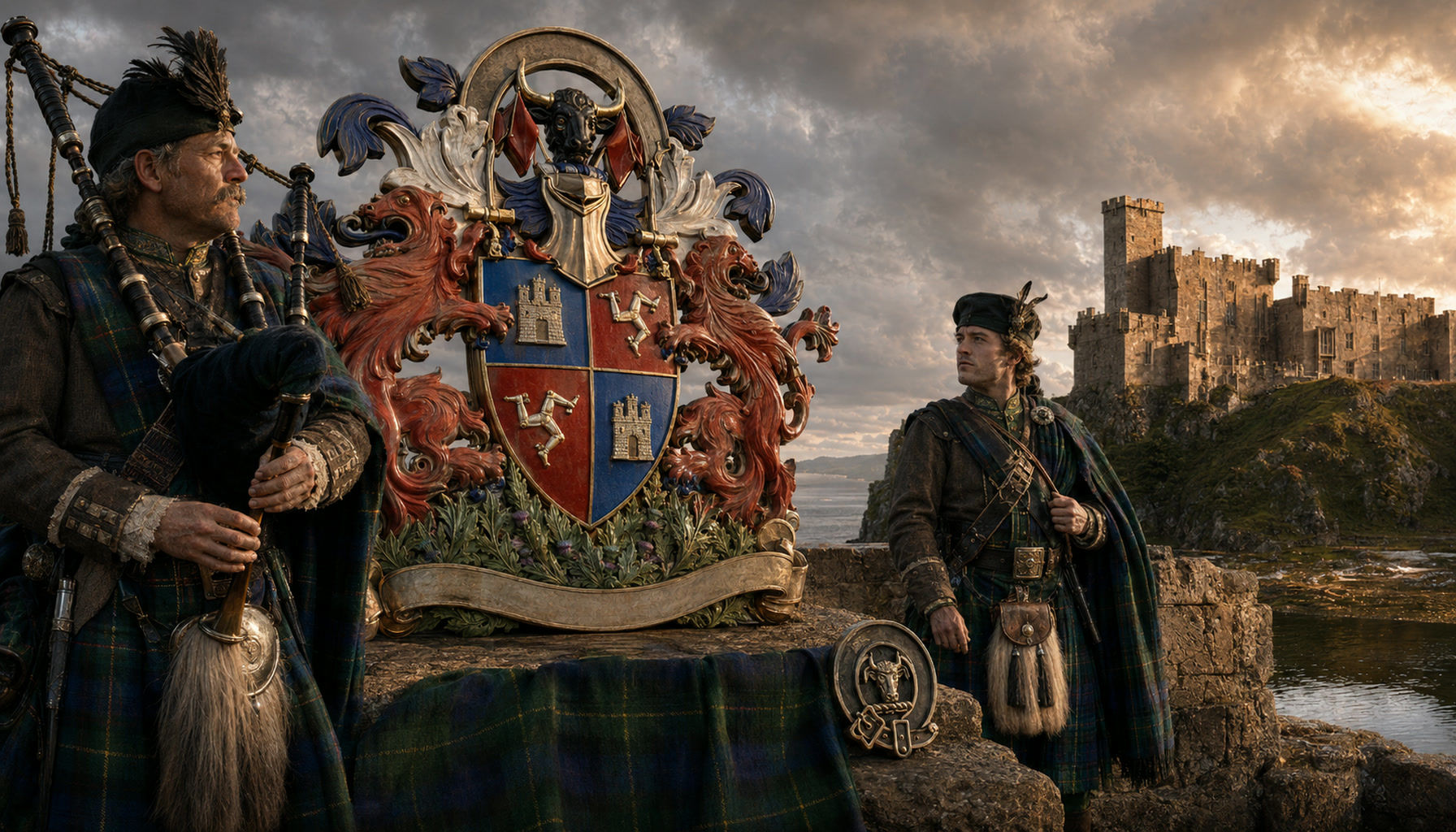
Clan MacCrimmon was a Highland family of hereditary pipers, most closely associated with the Isle of Skye and with the chiefs of Clan MacLeod. If many Scottish clans are remembered for swords, cattle, and feuds, the MacCrimmons are remembered for something just as important in Highland society: prestige carried in music, memory, and ceremony. Their primary family haplogroup is linked here with I1a5a, a paternal line with a deep northern European story behind it.
The family is usually placed in the world of Gaelic Skye, especially in service to the MacLeods of Dunvegan, where the MacCrimmons became famous as masters of piobaireachd, the great classical music of the Highland bagpipe. Tradition long embroidered their beginnings, sometimes with romantic claims of distant continental roots, and names such as Giuseppe Bruno of Cremona (1475) appear in that imaginative orbit of origin stories. But whatever the precise beginnings, the historical MacCrimmons belong firmly to the learned families of the Highlands: specialists whose authority came not from holding the biggest estate, but from preserving a discipline, teaching it, and passing it down generation after generation. Even into later memory, figures such as Black John MacCrimmon (1822) kept the name alive as a symbol of Highland piping distinction.
The great location anchor for MacCrimmon history is Dunvegan Castle on the Isle of Skye, the long-standing seat of the chiefs of Clan MacLeod. Set on a rocky outcrop beside a sea loch, Dunvegan is often described as the oldest continuously inhabited castle in Scotland, and that sense of continuity matters here. The building grew over many centuries, from a medieval stronghold into a layered Highland residence, with curtain walls, later ranges, and famous clan treasures including the Fairy Flag. For the MacCrimmons, Dunvegan was not just a picturesque backdrop but the center of patronage, ceremony, and performance: the sort of place where music marked arrivals, laments, victories, funerals, and the public theatre of lordship. In other words, if you want to understand why hereditary pipers mattered, Dunvegan explains it. And yes, the castle remains a major heritage site and can still be visited today, which gives modern visitors the rare chance to stand in the landscape where clan power and Gaelic art were so closely intertwined.
Explore nearby Hebridean ties in Clan MacKinnon
The MacCrimmon association with I1a5a does not prove direct descent from any excavated individual, and it should not be read that way. What it does offer is a wider genetic neighborhood. Related or linked I1a5a samples appear across a striking spread of time and place: Nordic Bronze Age Sweden at Falkoping 5 with NEO220, NEO223, and NEO227; Battle Axe Sweden at Falkoping 5 with NEO228; Nordic Bronze Age Denmark at Bybjerg (NEO563), Sjaelland Stroby Ladeplads (NEO93), Magleo (NEO590), Toftum Mose (NEO875), Vasagard (NEO815), and Lollikehuse (NEO857); Iron Age and Gothic associated contexts in Poland such as PL082, PCA0488, PCA0483, PCA0035, PCA0378, PCA0396, and PCA0498; Roman and post-Roman finds including NWC010 from Roman era England, I15531 from imperial Roman Viminacium, and Kem1 from late Roman Germany; early medieval and Viking world examples such as A017-003 from Skanninge, VK519 from Nordland Norway, VK248 from the Faroe Islands, VK163 and VK144 from the St. Brice context at Oxford, and urm035 from Viking Age Sigtuna. There are also medieval English linked samples from Cambridge and elsewhere, including ATP_PSN_344, ATP_PSN_351, ATP_PSN_120, ATP_PSN_20, ATP_PSN_53, ATP_PSN_115, ATP_PSN_511, ATP_PSN_519, and ATP_PSN_1238, as well as the colonial-era Sir Ferdinando Wainman Jamestown Colony of Virginia sample I2096. Taken together, these do not map a single family tree. They do, however, place I1a5a within a long northern and northwestern European arc, stretching from Bronze Age Scandinavia through the Germanic, Anglo-Saxon, Viking, medieval, and Atlantic worlds that ultimately formed part of the background to later Highland populations.
The MacCrimmons remind us that clan history was never only about chiefs and battles. It was also about the men and families who carried culture in their heads, hands, and breath: pipers, poets, judges, and learned specialists whose art could outlast stone walls. If you have Scottish Highland roots, Hebridean ancestry, or a curiosity about haplogroup I1a5a, upload your DNA to MyTrueAncestry and see whether you match Clan MacCrimmon or any of the related ancient DNA samples that sit in this wider historical network.






Comments