Clan Gillon
– 2 min read


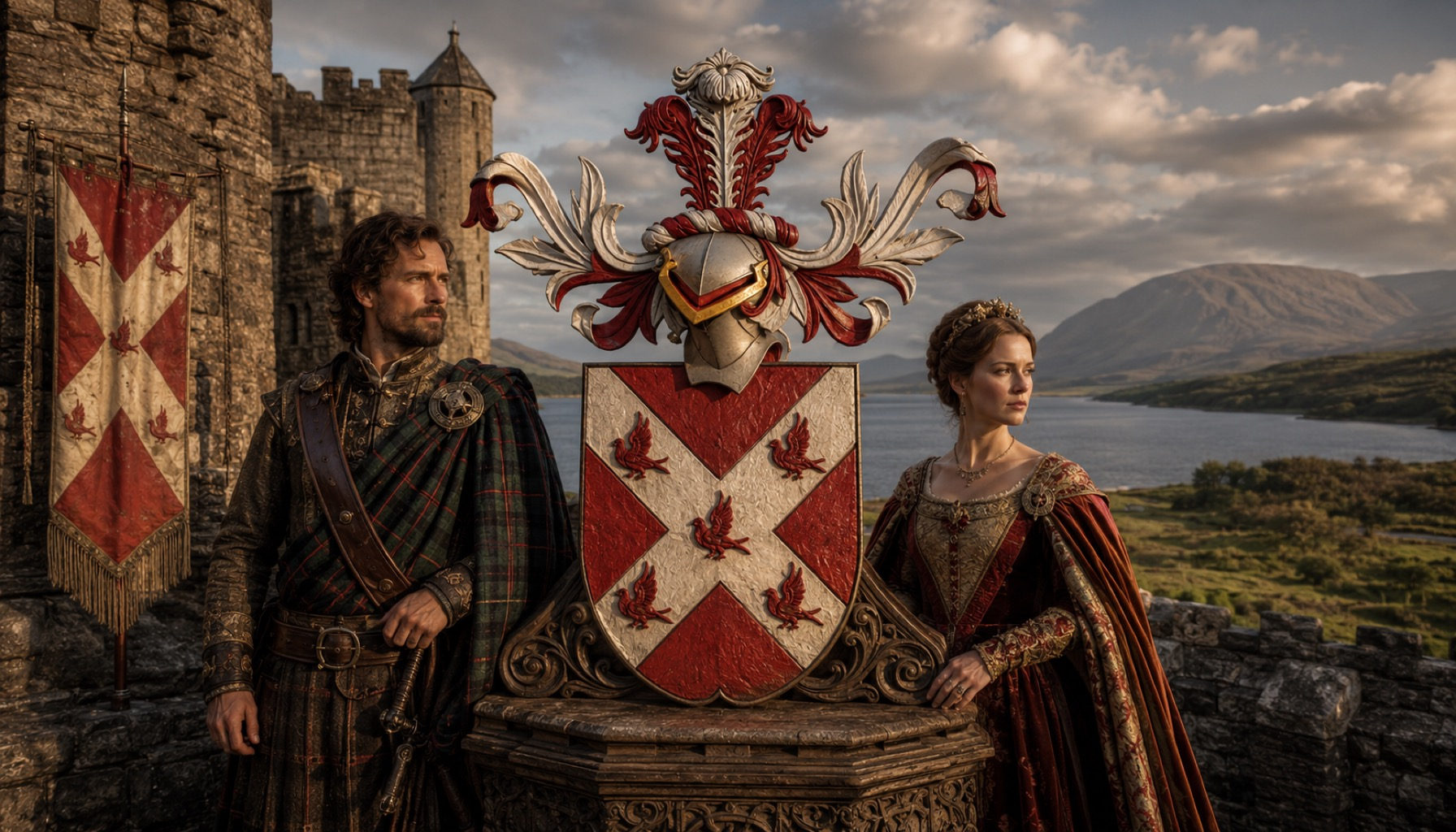
Clan Gillon belongs to that recognisably Scottish-Irish world of Gaelic family names shaped less by crowns and courtly grandeur than by kinship, locality, memory, and survival. The name sits within the western British Isles tradition in which families were anchored by service, neighbourhood, inherited naming patterns, and movement across the narrow seas between Scotland and Ireland. In genetic tagging terms, the primary family haplogroup linked here is R1b1a1b1a1a2a1b1a1a, a branch within the broader Atlantic-facing paternal landscape long associated with western Europe and the Gaelic world.
The Gillon story is best understood not as a tale of princely rank, but of continuity. Gaelic-rooted surnames often endured because families endured: through political upheaval, shifting lordships, church networks, local obligations, migration, and the stubborn habit of remembering who your people were. Clan Gillon reflects exactly that pattern. It is a family tradition tied to Scotland and Ireland alike, with later echoes in diaspora communities overseas. A named historical figure associated with this tradition is Gilbert McGillelane, active in the years 1324 to 1371, whose name preserves that very medieval Gaelic texture of identity, devotion, and lineage.
A useful location anchor for the Gillon heritage tradition is Tyrconnell, the historic lordship in the northwest of Ireland broadly corresponding to much of modern County Donegal. Historically, Tyrconnell was the land of the Cenel Conaill, one of the great northern Gaelic kindreds, and for centuries it stood as one of the most important strongholds of Gaelic political and cultural life. This was no sleepy fringe. It was a region of lordship, church patronage, learned families, seasonal movement, maritime contact with western Scotland, and recurring contest with outside power, especially during the late medieval and early modern periods. In other words, exactly the kind of place where a surname tradition such as Gillon could be formed, carried, and reshaped over generations. And yes, Tyrconnell can certainly still be visited today through the landscapes of Donegal, where its coasts, glens, old ecclesiastical sites, and ruined strongholds still make the historic setting vividly real.
Read more about Clan Gallagher
Ancient DNA does not let us simply point to a medieval or modern Gillon family and declare direct descent from named excavated individuals, and it is important not to pretend otherwise. What it can do is show a wider web of related or linked paternal lines under haplogroup R1b1a1b1a1a2a1b1a1a across time and space. Samples associated with this branch include Dark Ages Northern Spain Las Gobas (ldo057), Medieval Northern Spain Las Gobas (ldo058 and ldo055), Roman Era England Knobbs Farm Somersham (KNF014), Historic St. Mary City Chapel Field Cemetery Maryland (I35265 and I15286), Medieval Denmark Zeeland Ahlgade Holbaek (CGG101873), Carolingian Belgium Sint-Truiden Groenmarkt (ST2964), Medieval Belgium Sint-Truiden Groenmarkt (ST2666), Iron Age Hill Fort Suddern Farm Hampshire England (I20982), Gallic Chemin de Coupetz Marne France (I21399), Viking Hesselbjergmarken Denmark (VK87), and Carolingian Settlement Barcelona (I7672). What is striking here is the sheer range: Iron Age, Roman, Viking, medieval, and colonial-era contexts, from Iberia to England, France, Belgium, Denmark, and early Maryland. That does not make them Gillons, but it does place the family haplogroup in a broad and historically mobile Atlantic-European story.
That, really, is the fascination of Clan Gillon: a surname tradition rooted in Gaelic society, tied to places like Tyrconnell, shaped by movement between Scotland and Ireland, and still legible today through family memory and genetic clues. If you want to go further, you can upload your DNA to MyTrueAncestry and see whether you match the Gillon family tradition or any of these related ancient DNA samples.
Comments