Clan Gilchrist

– 3 min read


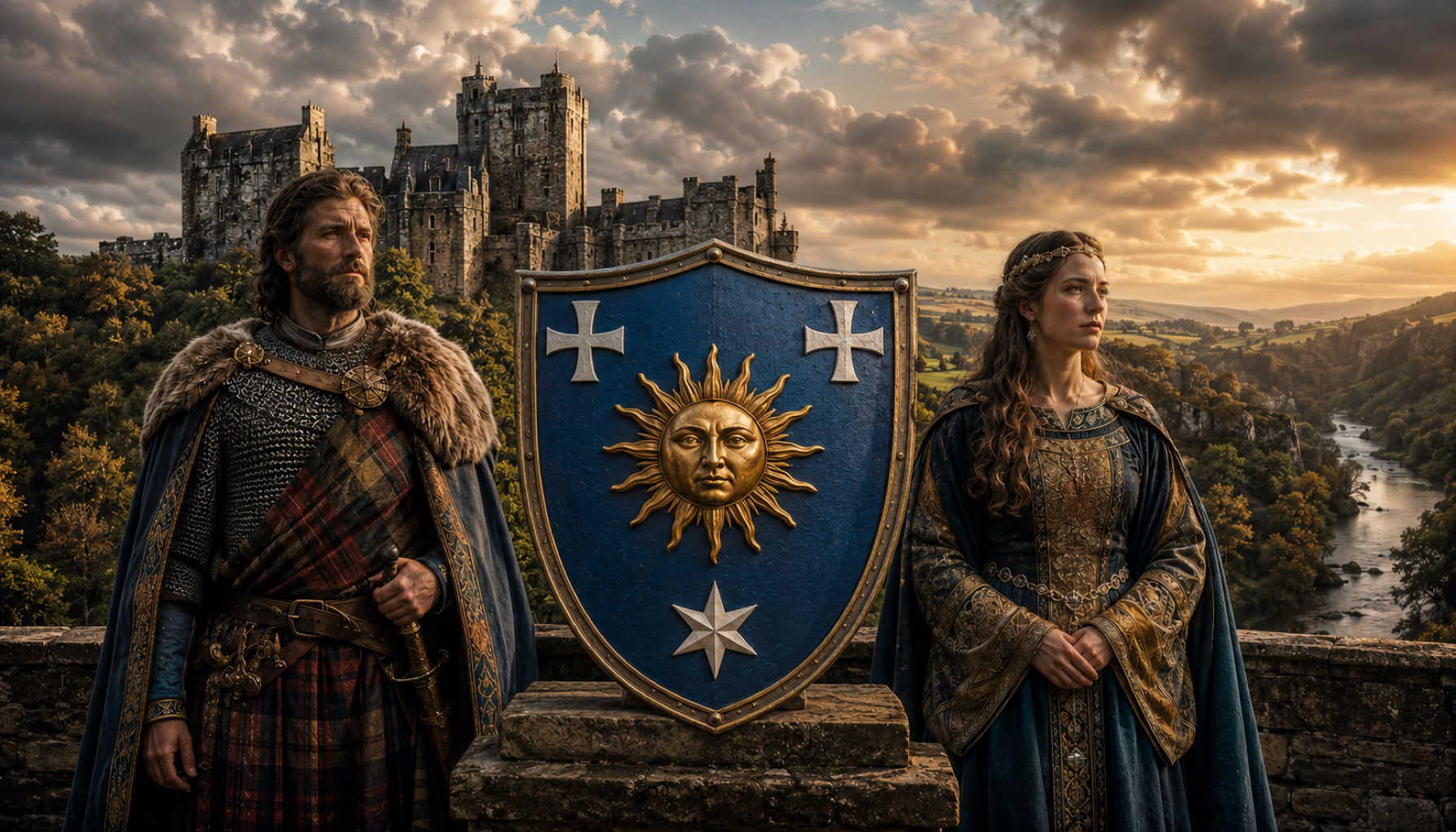
Clan Gilchrist belongs to the old Scottish world of Gaelic naming, Christian devotion, and family memory. The name comes from the Gaelic Gille Chriosd, usually understood as "servant of Christ", and that tells you quite a lot at once: this was a surname born in a landscape where language, religion, and kinship were tightly bound together. Gilchrist families appear across different parts of Scotland rather than from one single tightly bounded lordship, with both Highland and Lowland patterns shaping how the name survived. In genetic tagging terms, the primary family haplogroup linked here is R1b1a1b1a1a2a, a branch within the great western European paternal line that turns up again and again in ancient remains from Celtic, Roman, and medieval contexts.
Historically, Gilchrist is less the story of one vast territorial super-clan than of a durable surname tradition with deep Gaelic roots. That matters, because many Scottish identities were built not simply on conquest and castles, but on remembered names carried through generations, on local standing, and later on heraldic recognition. The family sits within that broad Scottish armorial and clan-style tradition: a name with sacred meaning, carried by real communities in real places. One early named figure is Gilchrist MacNachtan, recorded in 1246, a reminder that the surname-world of medieval western Scotland was intertwined, with Gaelic families, kindreds, and neighboring houses overlapping in a web of alliance, service, and locality rather than behaving like neat boxes in a textbook.
Read more about Clan MacNaughten
A useful location anchor for the wider Gilchrist story is Old Castle Lachlan on the eastern shore of Loch Fyne in Argyll, one of those west Highland sites where landscape and lineage seem to talk to each other. The ruined tower-house, associated with the chiefs of Clan MacLachlan, stands near the water in a setting that captures the maritime character of medieval Argyll, where sea routes were often more important than rough inland travel. The castle largely dates to the 15th century and later fell into ruin after being damaged in the 18th century. What makes it especially evocative is that it is not a polished palace but a proper fragment of lived history: a place of stone walls, clan politics, coastal watching, and the long afterlife of memory. For families like the Gilchrists, whose name belongs to the Gaelic-Christian world of western Scotland, this is exactly the sort of setting that helps make sense of how surnames, loyalties, and regional identity endured. Yes, it can still be visited, and as a visible ruin in Argyll it remains one of those places where the past feels physically close.
The R1b1a1b1a1a2a tag linked with Clan Gilchrist belongs to a very broad and time-deep paternal landscape across Atlantic and Celtic Europe, so ancient DNA gives us context rather than a claim of direct descent. Related or linked samples appear in Iron Age and later Britain, including Celtic Durotriges individuals from Duropolis at Winterborne Kingston such as WBK103, WBK106, WBK17, WBK36, WBK192, WBK10, WBK105, and WBK23, as well as Roman-era England samples like NWC009 from Eddington, FEN008 from Fenstanton, ARB003 from the Arbury wooden coffin burial, and DUX003 from Duxford. Particularly striking for a Scottish frame are Pict-era and early medieval Scottish examples from Rosemarkie Cave on the Black Isle, including KD001 and related individuals KD001_2, KD001_3, KD001_4, KD001_6a, and KD001_6b, alongside the Lundin Links cemetery sample group such as LUN004. Beyond Britain, the same wider branch is also represented in elite Celtic burials in Germany, including Magdalenenberg MBG013, Asperg-Grafenbuehl APG001 and APG003, and Hochdorf HOC001. There are also medieval linked examples from northern Spain at Las Gobas, including ldo066, ldo037, ldo046, ldo048, ldo040, and ldo062. None of these individuals should be presented as ancestral Gilchrists in a literal documentary sense, but together they sketch the larger prehistoric and historic paternal world from which later Scottish Gaelic surname traditions emerged.
If your family carries the Gilchrist name, or if your own results point toward R1b1a1b1a1a2a, this is where history becomes wonderfully tangible. A surname like Gilchrist preserves a memory of faith, language, and kin-group identity; DNA can sometimes place that memory into a much older map of movement stretching from Bronze Age Europe to Pictish and medieval Britain. You can also explore related Scottish stories and neighboring clan worlds to see how these lineages overlap in place and time.
Upload your DNA to MyTrueAncestry to see whether you match Clan Gilchrist, the R1b1a1b1a1a2a branch, or related ancient DNA samples from Pictish Scotland, Roman Britain, and Celtic Europe.
Comments