Clan Galloway
– 3 min read


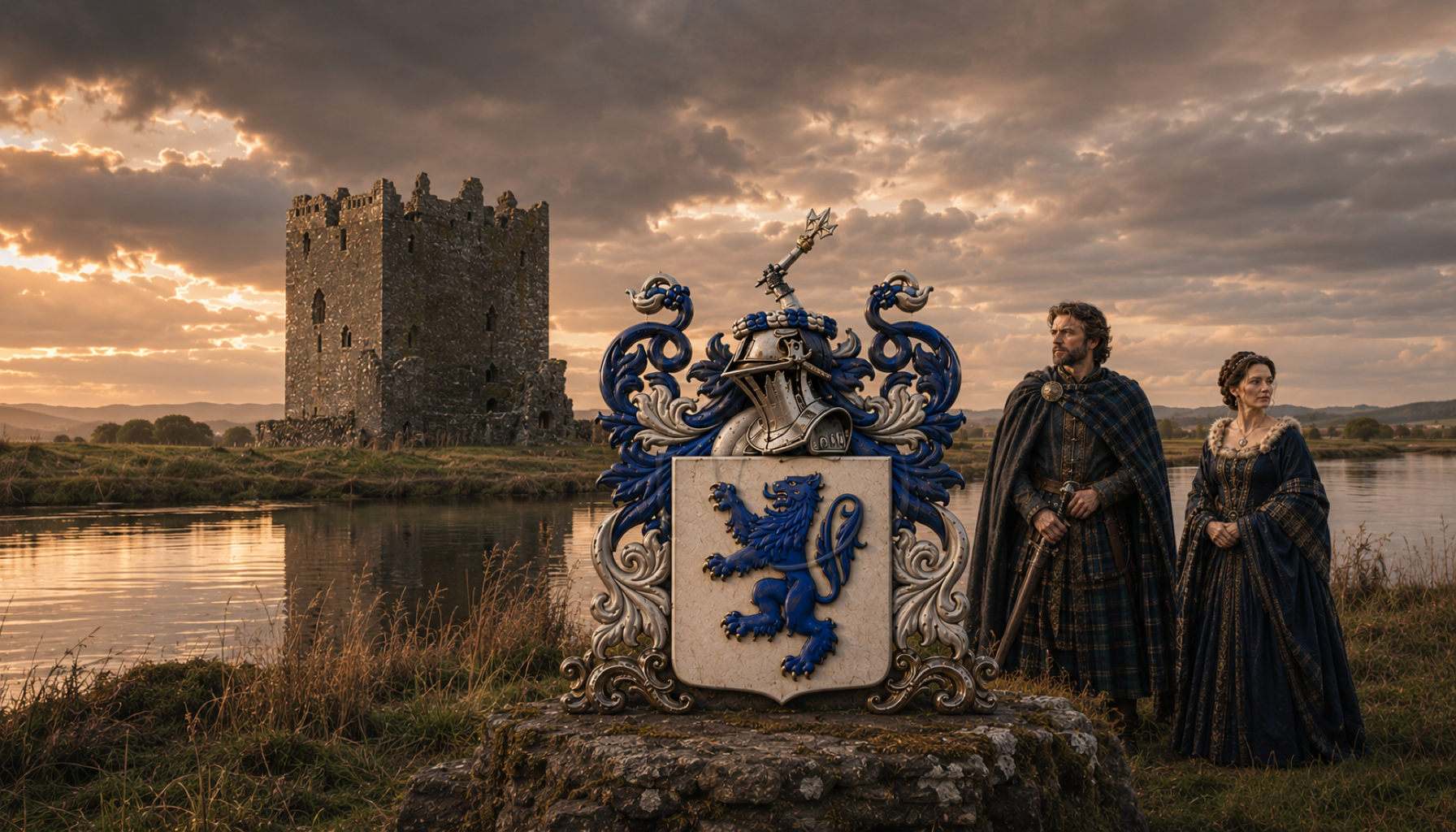
Clan Galloway is best understood as a Scottish clan-style identity rooted first and foremost in place: the old region of Galloway in south-west Scotland. Families bearing the name draw their heritage from a landscape of estuaries, rough pasture, sea routes, hill country, and frontier loyalties, where Gaelic lordship met Norse influence, later Scots speech, and the hard political weather of the Border world. The primary family haplogroup linked here is I2a1b1a2b1a2, a lineage tag that adds a genetic thread to a story already rich with regional memory. Haplogroups associated with this family context include I2a1b1a2b1a2 and the broader I2 family background in ancient Europe.
The surname itself signals origin from locality and identity rather than from a single neatly bounded chiefdom. That is very much the point with Galloway: this was a region with its own character, sometimes fiercely so, and medieval people knew it. In records we catch glimpses of the name across centuries, including Michael de Galewath in 1230, Sande Galowey in 1495, and Patrick Galloway, who died in 1626 and became known as a royal chaplain and prominent churchman. These figures do not make a tidy dynastic parade, but they do show what family history often really looks like: not one grand uninterrupted line marching through time, but a name persisting through documents, offices, communities, and changing political worlds.
A particularly fitting location anchor for Clan Galloway is Threave Castle, on an island in the River Dee near Castle Douglas. Built in the later 14th century by Archibald the Grim, Lord of Galloway and later Earl of Douglas, it became one of the great strongholds of south-west Scotland. It is the sort of place that instantly reminds you that medieval lordship was not abstract. It sat in stone, on water, behind thick walls, in a landscape that could be watched, taxed, defended, and symbolically possessed. Threave was later besieged in 1455 during the fall of the Black Douglases, and its massive tower house still speaks of that age of regional power, shifting allegiance, and military display. The setting matters as much as the masonry: Galloway was never just a map label, but a lived territory of control, movement, and memory. Threave Castle can still be visited today, with access typically involving a short boat crossing, which makes the whole experience pleasingly dramatic in exactly the right medieval way.
From an ancient-DNA point of view, the haplogroup I2a1b1a2b1a2 connects Clan Galloway to a very wide and deep European backdrop rather than to any provable single medieval ancestor. Related or linked samples carrying this lineage or closely associated branches appear across strikingly different places and periods: Mesolithic Vlasac in the Iron Gates of Serbia such as I4881, I4880, and I4882; Neolithic Britain and nearby islands including Rattar East in Scotland (I36019) and the Orkney Islands (I2650x); Chalcolithic and Neolithic Romania at Urziceni with samples I7135, I15617, and I18114; and later early medieval and migration-era contexts such as Altheim in Bavaria (Alh_80), Bruecken in Saxony-Anhalt (BRC029x), Alt-Inden in North Rhine-Westphalia (IND006), Buckland Dover (BUK037), Sedgeford (SED017), Lakenheath (LAK004), Hedeby (SWG010), Sint-Truiden in Belgium (ST0552), and multiple Scandinavian-linked finds from Denmark and Sweden including CGG107441, CGG107415, CGG106726, CGG107532, CGG017609, CGG019212, CGG107480, and snb010. There are also linked post-Roman and Gothic or Lombard era examples in Hungary such as MFC007, SZL027, A181014, A181019, and SZ3, as well as Viking Age and related finds like VK150 and VK582. None of this proves direct descent from any one sample, of course, but it does show that the lineage belongs to a long, mobile, and thoroughly entangled European human story, which suits Galloway rather well.
If Clan Galloway speaks to your own family story, the next step is to test that connection against both history and ancient DNA. Upload your DNA to MyTrueAncestry to see whether you match the Galloway family profile, the primary haplogroup I2a1b1a2b1a2, or related ancient samples from Scotland, Britain, Scandinavia, and the wider European past.






Comments