Clan Kennedy
– 3 min read


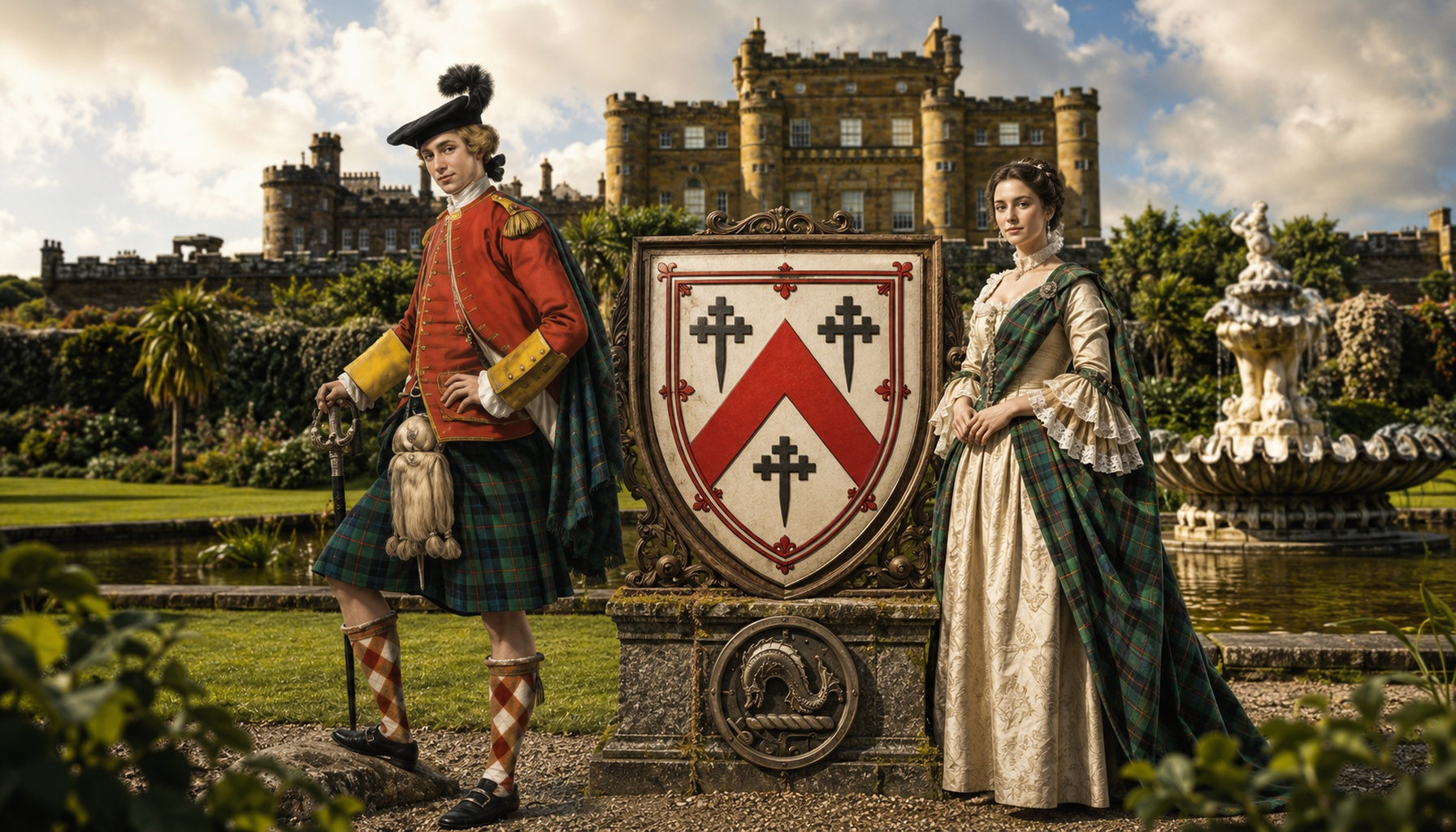
Clan Kennedy was one of the great power families of southwestern Scotland, rooted above all in Carrick in Ayrshire, and remembered as a clan that turned local strength into national importance. Their story is not simply one of tartan nostalgia or castle romance. It is the very Scottish business of land, lordship, marriage strategy, royal favor, military service, and the steady accumulation of prestige. In genetic tagging terms, the primary family haplogroup linked here is R1b1a1b1a1a2c1a2a2a, a branch within the wide and historically important R1b world so often associated with western European paternal lines.
The Kennedys emerged from the political landscape of medieval Carrick, a region where geography and authority were bound tightly together. This was a coast of harbors, cliffs, farms, sea routes, rival lordships, and opportunities for ambitious families who could hold land and keep followers. Over time the Kennedys built exactly that sort of durable regional base. Their rise reflects the classic Scottish noble-clan pattern: local chiefship expanding into titled rank, influence at court, control of estates, heraldic identity, and a long afterlife in public memory. One early named figure is John Kennedy of Dunure, recorded in 1372, a reminder that by the later 14th century the family was already established enough to be tied to one of its most famous strongholds.
Dunure Castle is the place where Kennedy history becomes wonderfully tangible. Set on the coast south of Ayr, the castle stands on a rocky headland above the Firth of Clyde, the sort of site that makes medieval sense the moment you see it. It was a defensive and lordly perch, commanding sea views and projecting status as much as security. The surviving ruins are chiefly late medieval, with a massive tower house and courtyard remains, and the site became strongly associated with the Kennedys of Carrick. It also sits in a landscape thick with the politics of southwest Scotland, where control of shore, estate, and access routes mattered enormously. There is even the darker famous tale of the murder of the Commendator of Crossraguel in 1570, tied to Gilbert Kennedy, 4th Earl of Cassilis, which tells you at once that this was no sleepy romantic relic but a live stage for hard-edged power. Yes, Dunure Castle can still be visited as a ruin, and it remains one of the most evocative Kennedy anchors in Scotland.
For readers interested in deeper ancestry, the Kennedy haplogroup tag here is R1b1a1b1a1a2c1a2a2a, and there are related or linked ancient DNA samples carrying comparable paternal signatures across a strikingly broad historical map. These include Celtic Durotriges burials from Duropolis at Winterborne Kingston in England such as WBK12, WBK20, WBK29, WBK41, WBK05, WBK30, WBK43, WBK06, WBK08, WBK18, and WBK191; Celtic Briton East Kent sample I13730; Iron Age samples from Worlebury in Somerset I11991, Battlesbury Bowl I21309, and Bu in Orkney I2982; Bronze Age examples such as KD061 from Westray Links of Noltland in Orkney, I5473 from Boatbridge Quarry in South Lanarkshire, I3256 from Trumpington Meadows, I2417 from Amesbury Down, I4950 from Bell Beaker Upavon, I7576 and I7577 from Bedfordshire, I5377 from the Early Bronze Age Thames, and Rathlin2B from Copper Age Ireland. Later linked examples include I11580 from post-Roman Dorset, I26776 from imperial Roman Zadar in Croatia, R10656 from late Roman Klosterneuburg, R10488 from late Roman Conimbriga, IND013 from Merovingian Germany, ST2025 and ST1308 from medieval Belgium, CGG023699 from Gallic France Parancot, VK27 from medieval Sandoy in the Faroe Islands, and GMO015 from Bronze Age Calabria. None of this proves direct descent from any one ancient person, of course. What it does show is that the Kennedy-linked paternal branch belongs to a deep and very widespread Atlantic and European story, stretching from Bronze Age Britain and Ireland through Iron Age Celtic communities and into Roman and medieval populations.
If you have Kennedy roots, or simply suspect your family belongs to this wider Scottish and northwestern European story, the interesting question is not whether legend sounds grand, but what your DNA may reveal. Upload your DNA to MyTrueAncestry to see whether you match Clan Kennedy, the haplogroup R1b1a1b1a1a2c1a2a2a, or related ancient DNA samples from Celtic, Bronze Age, Roman, and medieval sites across Britain and Europe.
Comments