Clan Cogan
– 3 min read


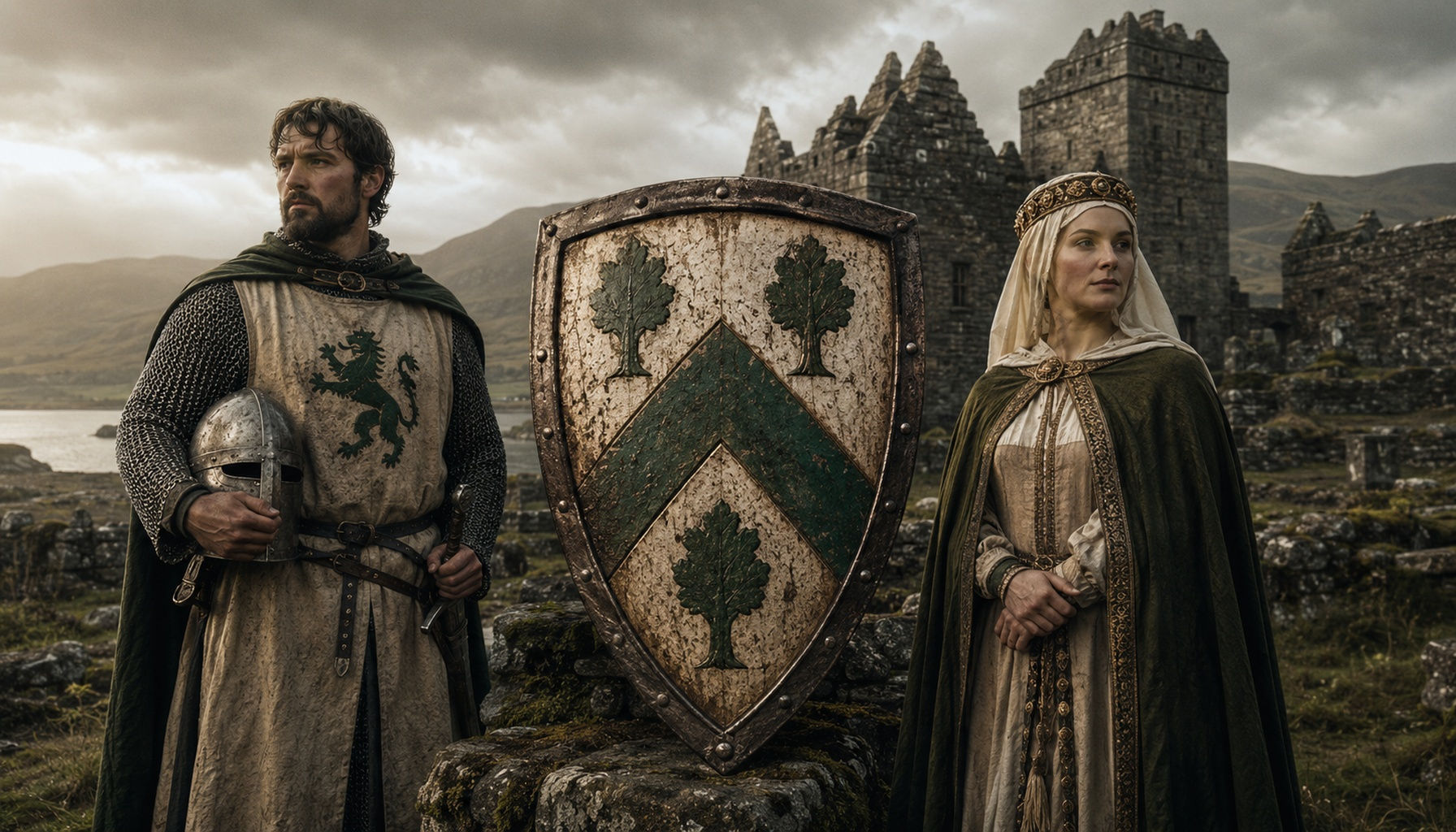
Clan Cogan belongs to that very recognisable chapter of Irish history when families of Anglo-Norman origin crossed into Ireland and, over time, became not just conquerors or colonists on paper, but part of the lived fabric of the island. The Cogans are remembered as an Anglo-Norman and Irish family tradition associated with medieval settlement, military service, lordship, and the gradual shaping of Norman-Irish society. Their story begins in the world created by the Norman expansion after 1066 and the later invasion of Ireland in the 12th century, when ambitious families from Norman, Welsh, and English marcher backgrounds sought land, power, and opportunity across the Irish Sea. The primary family haplogroup linked here is R1b1a1b1a1a2c1a1a1a1a1a1a1a1a, a paternal line placed within the broad and very widespread western European R1b family.
What makes the Cogan story especially interesting is that it is not simply a tale of arrival. It is a tale of staying. Like many Norman-origin families in Ireland, the Cogans could become deeply rooted in Irish conditions while still preserving memories of feudal, continental, and marcher-world origins. They appear in the medieval record as people connected with landholding, warfare, local authority, and the hard practical business of surviving in a politically fractured country. Over generations, this kind of family often ceased to be merely "foreign" in any simple sense. They became part of the hybrid Norman-Irish pattern: settlement, service, adaptation, marriage alliances, regional influence, and the steady inheritance of a surname that carried both memory and status. One of the best-known figures associated with the family is Milo de Cogan, who died in 1182, a major Anglo-Norman leader in the early conquest of Ireland and a name that still stands near the beginning of the family's Irish historical profile.
Read more about the House of Barry
The Cogan name is especially anchored in the south of Ireland, above all in Munster and most famously in County Cork, where the early Anglo-Norman conquest left some of its deepest marks. That is the world in which Milo de Cogan and his relatives are usually placed: not in a neat, tidy "founding home" as later family lore sometimes prefers, but in a frontier landscape of grants, castles, contested territories, church lands, and new boroughs. In historical terms, the Cogan footprint belongs to the same geography as the first great Norman advances into Cork and its surrounding districts. These places can still be visited today, and that matters because Norman-Irish history is wonderfully physical. Earthworks, ruined towers, old ecclesiastical sites, river crossings, and settlement landscapes still survive across Munster, giving a real sense of how families like the Cogans operated. One can stand in these places and grasp that this was not abstract genealogy. It was about controlling roads, securing harbours, holding estates, negotiating with Gaelic neighbours, and building a dynasty that could endure in Irish conditions.
From a DNA point of view, the Cogan story sits comfortably within a wider medieval Irish and northwestern European landscape rather than a single provable line from one named knight to one present-day bearer of the surname. The haplogroup linked here, R1b1a1b1a1a2c1a1a1a1a1a1a1a1a, also appears in related or linked ancient samples from medieval Ireland, including individuals from Ballyhanna, County Donegal, such as Sk197an, Sk197y, Sk197q, Sk197am, Sk197s, Sk197ab, Sk197u, Sk197t, Sk197r, Sk197ad, Sk197x, Sk197n, Sk197aa, Sk197z, Sk197ak, Sk197w, Sk197ai, Sk197m, Sk197ah, Sk197ag, Sk197v, Sk197ac, Sk197al, Sk197af, Sk197ae, Sk197o, Sk197aj, HAN197x, Sk197a, Sk197b, Sk197c, Sk197d, Sk197e, Sk197f, Sk197g, Sk197h, Sk197i, Sk197j, Sk197k, Sk197l, Sk197p, and HAN197, as well as Kilteasheen, Roscommon samples KIL041, KIL044, and KIL014. These should not be described as direct ancestors of the Cogan family without specific evidence. Rather, they are useful comparators: medieval Irish men who carried related paternal signatures in the same broad historical world in which Norman and Irish populations mixed, settled, fought, intermarried, and passed lineages forward.
Read more about Clan Fitzgerald
If you carry the Cogan surname, or believe your family may connect to this Anglo-Norman and Irish heritage, DNA can add another layer to the archive. Uploading your results can help you explore whether you match the family tradition or show links to related medieval Irish samples and the wider Norman-Irish world that shaped surnames like Cogan. History, after all, is rarely a straight line. It is a web of arrivals, alliances, and local reinventions - and that is exactly what makes families like the Cogans so fascinating.


Comments