The House of Barry
– 3 min read


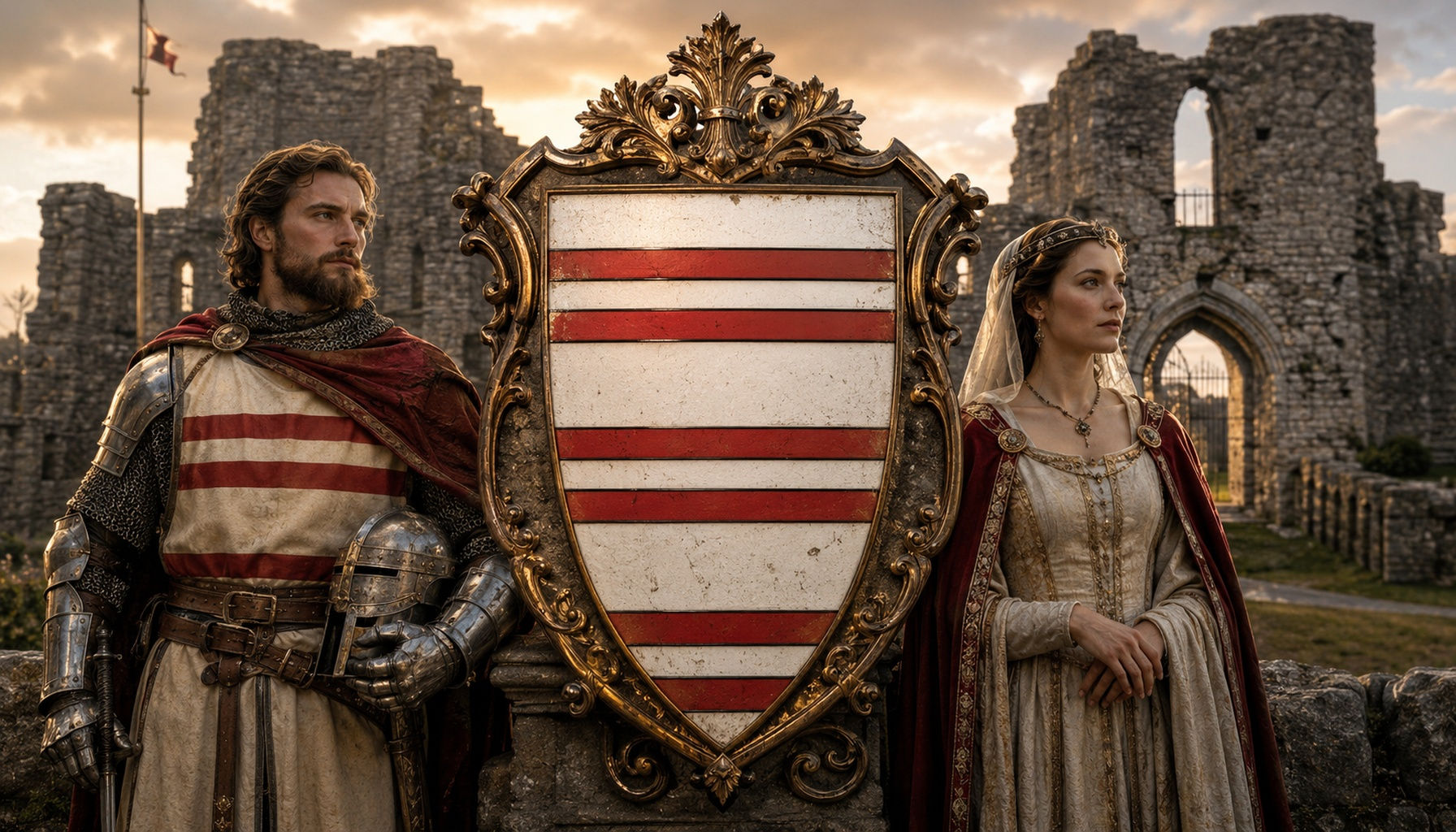
The House of Barry was one of the great Anglo-Norman families of medieval Ireland, especially rooted in Munster, with a history shaped by conquest, landholding, lordship, and long survival in a changing political world. Associated here with the haplogroup I1a1b1a4a2f1a1a6, the Barrys began as part of the Norman expansion that followed the conquest of England and then the settlement of Ireland in the late 12th century. Their deeper family background lies in the marcher world of Wales, where Norman, Welsh, and Irish frontiers met in a hard, militarised landscape that produced many of the adventurers who crossed the Irish Sea.
Once in Ireland, the Barrys did what successful frontier nobles tended to do: they fought, acquired grants, built castles, married well, and turned military opportunity into regional power. Over generations they became one of the most important aristocratic houses in south Munster, while still preserving a distinctly Anglo-Norman identity in name, title, and lineage. Figures such as Odo de Barry and Philip de Barry (1137-1200) belong to that first energetic era of expansion, while James de Barry, 4th Viscount Buttevant (1520-1581), shows the family still navigating the pressures of Tudor Ireland centuries later. In historical terms, the Barrys are a classic Norman-Irish dynasty: imported lords who became deeply entangled with Irish society without ever entirely ceasing to be themselves.
Read more about The House of de Clare
If one place anchors the Barry story, it is Barryscourt Castle in County Cork, east of Cork Harbour, near Carrigtwohill. This was a Barry stronghold and remains one of the most striking survivals of their world. The present tower house is generally dated to the later 15th or early 16th century, though it stands on a site with earlier medieval associations to the family. What makes Barryscourt so vivid is that it is not just a ruined shell but a substantial fortified residence, with battlements, mural chambers, and an enclosed bawn that still gives a real sense of how a late medieval lordly household in Munster worked. It was both defensive and domestic, a place for authority, display, and administration as much as for security. The castle has undergone major conservation and is known as a heritage site that can be visited, which means the Barry past is not merely something in charters and pedigrees but something you can still walk around in stone.
From a DNA perspective, the Barry-linked haplogroup I1a1b1a4a2f1a1a6 sits within a wider northern European paternal story, and related ancient DNA samples help sketch the longer backdrop. Linked or nearby examples include Viking Age Norway Lund (CGG107010), Late Viking Age Vasterhus, Jamtland, Sweden (wes005), Pre-Vendel Age Romback in Vasternorrland, Sweden (rtp001 and rtp004), Vendel Age Oland, Sweden (VK382), Vendel Age Salme II-VIII on Saaremaa (VK488), Viking Age warrior from Nordland, Norway (VK529), a Viking-Gaelic mixed individual from Iceland (SSG-A3), and a Norwegian Viking from Iceland (HSJ-A1B). These are not evidence of direct descent from the House of Barry, and it would be quite wrong to pretend otherwise. What they do offer is a useful sense of the broader paternal networks and deep-time population history connected with this lineage, stretching through Scandinavia, the North Atlantic, and the Viking-Gaelic world that also formed part of the medieval backdrop to the Irish Sea zone.
The House of Barry is a reminder that family history is rarely simple. It is conquest and adaptation, castles and marriage alliances, local loyalties and wider European connections, all layered into one lineage. If your own family story touches Barry, de Barry, Buttevant, Munster, or the wider Anglo-Norman world, you can upload your DNA to MyTrueAncestry and see whether you match the family story or related ancient DNA samples linked to haplogroup I1a1b1a4a2f1a1a6.
Comments