Clan Ui Eidersceoil
– 2 min read


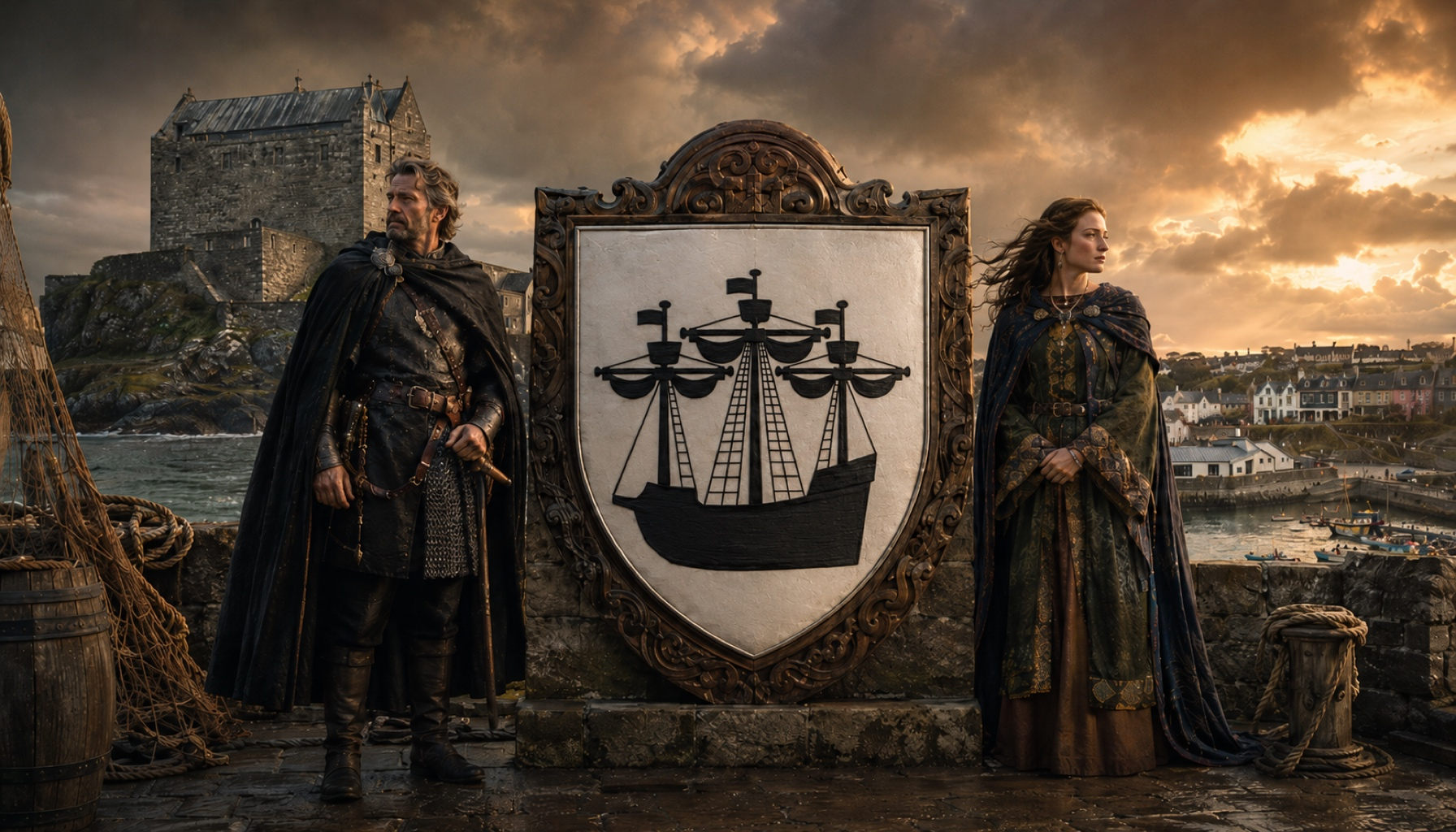
Clann Ui Eidersceoil was a Gaelic Irish maritime kindred of south-west Ireland, remembered as one of those coastal families whose identity was tied not just to ancestry, but to sea-lanes, inlets, harbours, and the hard political realities of local lordship. In the Gaelic world, a clan name was not a decorative label. It signalled descent, land, and authority. For Ui Eidersceoil, that meant a place in the network of regional power along Ireland's Atlantic edge, where kinship, tribute, alliance, and seamanship all mattered. The primary haplogroup linked here is I2a1a2a1b1c1a, a lineage with deep prehistoric roots in Europe.
The family belongs to a very recognisable Irish pattern: a ruling or semi-ruling coastal lineage whose memory survived through genealogy, oral tradition, and attachment to ancestral ground. This was not a world neatly separated into land people and sea people. In south-west Ireland, the two were inseparable. Coastal lordship meant watching coves and channels, protecting local interests, managing ties with neighbours, and taking part in the seaborne movement of goods, people, and news. Figures such as Lughaidh Laidhe stand in that remembered landscape, where lineage prestige and regional reputation could endure long after political fortunes changed.
Read more about Clan OSullivan
The location anchor for Clann Ui Eidersceoil is the south-western Irish coast, especially the old maritime zone of West Cork, a region of peninsulas, island-dotted waters, sheltered anchorages, and narrow sea passages that shaped power just as much as any inland stronghold. This is the kind of landscape that explains the family better than a simple map pin ever could. Here, control was local, practical, and deeply personal. A harbour was income, influence, and security; a headland was a lookout; a creek could be a trade route or a defensive refuge. In historical context, the clan emerged from a Gaelic order in which families were embedded in territory and where authority could be exercised from the shoreline outward as much as from the countryside inward. Much of this coast, with its ancient settlement pattern and long memory of Gaelic families, can still be visited today, and it remains one of the best places in Ireland to understand how maritime lordship actually worked on the ground.
From a DNA perspective, the clan's primary haplogroup, I2a1a2a1b1c1a, sits within a much older European story. Related or linked ancient samples include Els Trocs in ancient Spain (I0412), Esperstedt in Neolithic Germany (I0172), the ancient Gotlander Battle Axe sample Ajvide52X, Distillery Cave in Oban, Argyll and Bute, Scotland (I3133), and several Irish Neolithic individuals including County Clare (PB443), Neolithic Ireland (CH448), and Ardcrony, Tipperary (ARD2). These do not prove direct descent from any one ancient person to the Ui Eidersceoil family, and we should be careful about that. What they do show is that the broader paternal line has a deep time depth stretching across prehistoric Europe and into Ireland itself, giving a fascinating backdrop to a later Gaelic coastal clan whose identity was preserved in history rather than prehistory.
Explore Neolithic Irish kinship
If you are curious whether your own family story may connect with Clann Ui Eidersceoil, with south-west Ireland, or with ancient DNA samples linked to haplogroup I2a1a2a1b1c1a, this is exactly the sort of journey genetics can help illuminate. Upload your DNA to MyTrueAncestry and see whether you match this family story or related ancient individuals from Ireland, Britain, and wider prehistoric Europe.


Comments