Clan Cheyne

– 3 min read


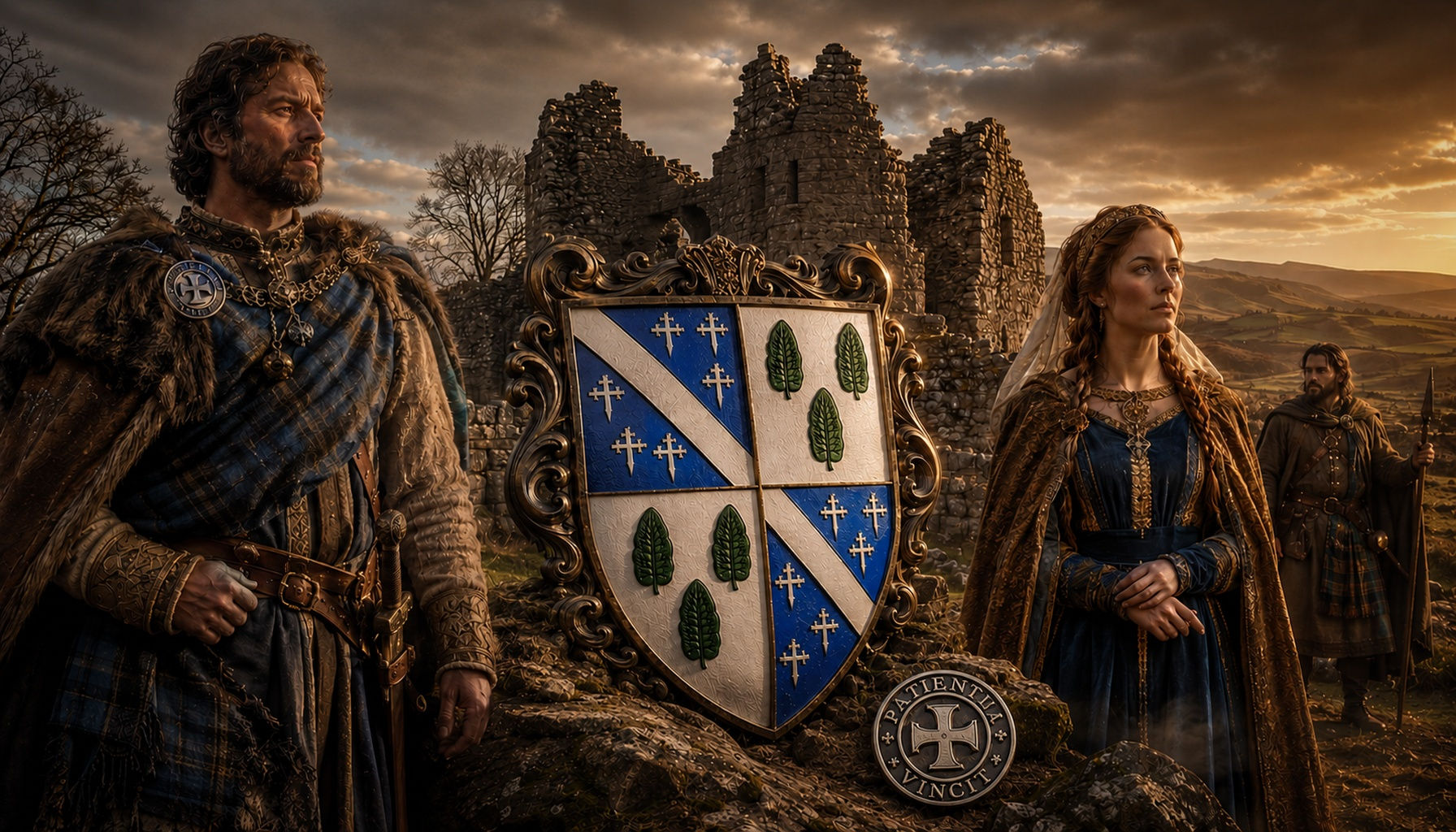
Clan Cheyne was a Norman-origin Scottish family that put down deep roots in medieval Scotland, especially in the north, where land, royal favour, and strategic marriage mattered as much as a good sword arm. Their name is usually traced to Cheyney or Quesnay in Normandy, part of that wider movement of knightly families who crossed into Britain after the Norman world spread its influence and then, in Scotland, gradually became Scottish magnates in their own right. For DNA-tagging purposes, the primary family haplogroup linked here is R1b1a1b1a1a2b1a1, a branch within the very widespread western European R1b line.
The Cheynes are a fine example of how medieval identity actually worked: not a neat box marked "foreign" or "native," but a long process of adaptation. Norman by background, they entered Scottish society through the familiar channels of service to the crown, estate grants, and alliance-building, then emerged as part of the fabric of Scottish lordship. Their motto, Virtute Cresco, "I grow through virtue," has just the right medieval ring to it: moral strength, noble conduct, and status built not only by inheritance but by reputation. In northern Scotland, where authority was often anchored in landholding and fortified residences, the Cheynes became associated with local power, heraldic memory, and the durable social prestige that came from being seen, quite literally, on the landscape. A named figure such as Sir Reginald le Chain, recorded in 1350, reminds us that this was not an abstract clan story but one lived through identifiable men moving in the world of charters, obligation, and regional influence.
The family's strongest location anchor is Inverugie Castle, near Peterhead in Aberdeenshire, set close to where the River Ugie meets the North Sea. That position mattered enormously. This was not a romantic ruin dropped at random into the landscape, but a site controlling movement, territory, and status in a coastal region tied into trade, lordship, and competition among powerful families. The castle developed over time from an earlier stronghold into a more substantial courtyard castle, and its later history drew in the Earls Marischal as well as the older Cheyne connection. What survives today is ruinous, but still striking: fragments of tower and walls enough to show that this was once a serious seat of authority rather than a mere manor house. In other words, Inverugie is one of those places where stone still does the talking. It remains a visible historic site and can still be visited from the outside, reasonably supported by its surviving ruins and known location, though visitors should expect a ruin in a rural setting rather than a fully staffed heritage attraction.
From an ancient-DNA point of view, the R1b1a1b1a1a2b1a1 tag places the Cheyne story within a very broad and very old western and central European paternal landscape. Related or linked samples carrying this branch appear across an astonishing spread of time and place: from Bell Beaker and Copper Age contexts in Czechia such as Brandysek samples I7249, I7278, I7271, I7251, I7269, I7276 and I7275, to Early and Bronze Age central European burials like Leubingen Sommerda samples LEU025, LEU055, LEU056, LEU051, LEU060, LEU015, LEU012, LEU041 and LEU026, and on into Iron Age and Celtic worlds including Durotriges England at Winterborne Kingston sample WBK13, Pont de Cornaux-Les-Sauges in Switzerland samples 3429, 3431 and 3439, Radovesice and Teplice in Bohemia, Pocklington in Yorkshire, and Broxmouth in East Lothian, Scotland, sample I16422. The same linked branch also turns up in later contexts ranging from Etruscan Tarquinii samples TAQ018A, TAQ018B and TAQ018x to post-Roman, medieval, and dynastic individuals in Croatia, Belgium, Hungary, Poland and beyond. That does not prove direct descent from any one of these people, of course. What it does show is that the wider paternal line associated with Clan Cheyne belonged to a deep historical stream flowing through Bronze Age central Europe, Iron Age Celtic societies, and the later medieval populations from which Norman and Scottish lineages emerged.
If you carry the Cheyne name, have Cheyne lines in your family tree, or simply suspect a connection to this Norman-Scottish world of castles, heraldry, and northern lordship, DNA can add another layer to the story. Upload your DNA to MyTrueAncestry to see whether you match Clan Cheyne, the primary haplogroup R1b1a1b1a1a2b1a1, or any of the related ancient DNA samples linked to this wider European lineage.
Comments