Clan Chattan
– 2 min read


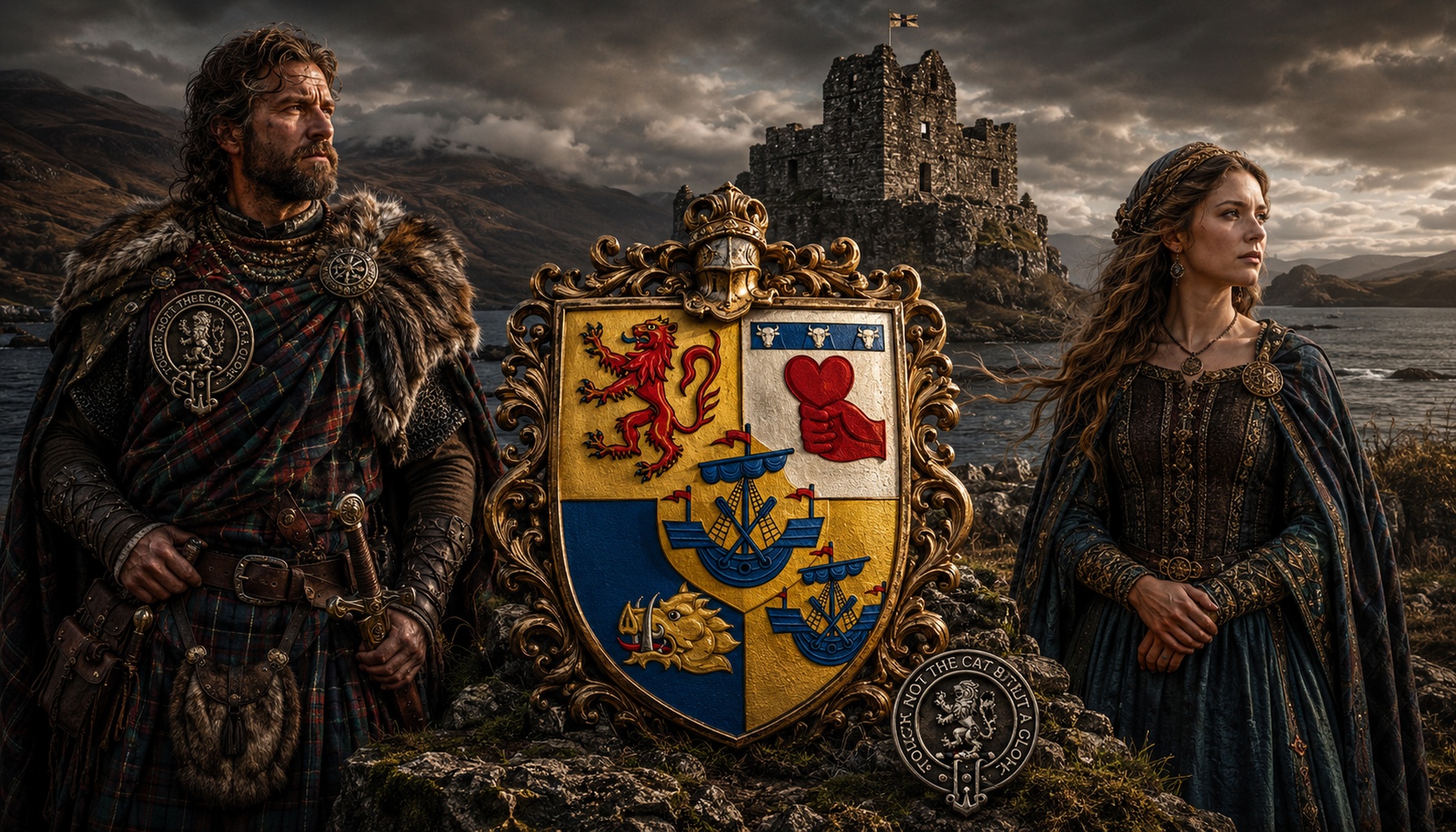
Clan Chattan was not a clan in the narrow sense, but one of the great Highland confederations: a gathering of related and allied families bound together by loyalty, military obligation, protection, and memory. Rooted chiefly in the central Highlands, especially around Badenoch, Lochaber, and Inverness-shire, Clan Chattan became a name larger than any single surname. MacKintosh, MacPherson, Davidson, Shaw, MacGillivray, MacBean and others all moved within its orbit. Its primary linked Y-DNA haplogroup here is I2a1b1a1a1a1a1b, a lineage with deep prehistoric roots in Britain and Ireland and an intriguing presence across later medieval contexts as well.
What makes Clan Chattan so fascinating is precisely its untidiness. Highland history was rarely neat, and Clan Chattan shows that beautifully. This was a political and martial structure as much as a bloodline, shaped by marriage, fosterage, landholding, feud, and the practical need to survive in a competitive Highland world. The wildcat emblem and motto capture that ferocity rather well. By the late medieval period the confederation had become a formidable force, feared by rivals and complicated even to itself, with disputed leadership and internal strains never far from the surface. Early figures associated with the story include Dougal Dal (1291), a name that belongs to the murky but compelling formative period when the confederation was taking shape in the shifting world of Highland lordship.
Read more about Clan MacKintosh
A particularly evocative location anchor for the Clan Chattan world is Tor Castle, near Fort William in Lochaber. The castle stands on a rocky mound above the River Lochy, and the site is thought to have earlier origins before the surviving structure took shape in the 16th century. It is a tower house rather than a vast fortress, which is exactly the point: this is Highland power in a local, hard-edged form, tied to control of land, movement, and allegiance rather than grand courtly display. Tor Castle is strongly associated with the chiefs of Clan Mackintosh, and through them with the wider Clan Chattan confederation. In historical terms it belongs to that world of guarded river crossings, regional influence, cattle-raiding anxiety, and shifting loyalties that defined Lochaber and the western approaches to the Great Glen. The castle still survives as a known historic site and can still be visited from the outside as part of the landscape, though access to the interior may be limited depending on ownership and condition.
The haplogroup I2a1b1a1a1a1a1b opens a much deeper time window than clan history alone. Related or linked ancient DNA samples carrying this broader paternal signature appear in a striking range of contexts: the Medieval England Augustinian Friars sample ATP_PSN_527, the Celtic Briton from Cliffs End Farm in England I14866, Neolithic Wales at Orchid Cave in Denbighshire I16491, Iron Age East Lothian in Scotland I16418, the MacAurthur Cave individual from Oban, Argyll and Bute I2657, Bell Beaker Upavon in Wiltshire I4949, Ancient Carrowmore in Ireland car004, and Pabay Mor on the Isle of Lewis I2655. These do not prove direct descent to Clan Chattan, of course, but they do show that related paternal branches were present across Britain and Ireland from prehistory into the medieval world. In other words, the genetic backdrop to a Highland confederation like Clan Chattan reaches far beyond tartan-era memory and into a much older human landscape.
Read more about Clan MacPherson
If Clan Chattan is part of your story, DNA can add another layer to the old records, the place-names, and the clan traditions. Upload your DNA to MyTrueAncestry and see whether you match Clan Chattan connections or ancient samples linked to haplogroup I2a1b1a1a1a1a1b across Britain and Ireland.






Comments