Clan Cathcart

– 3 min read


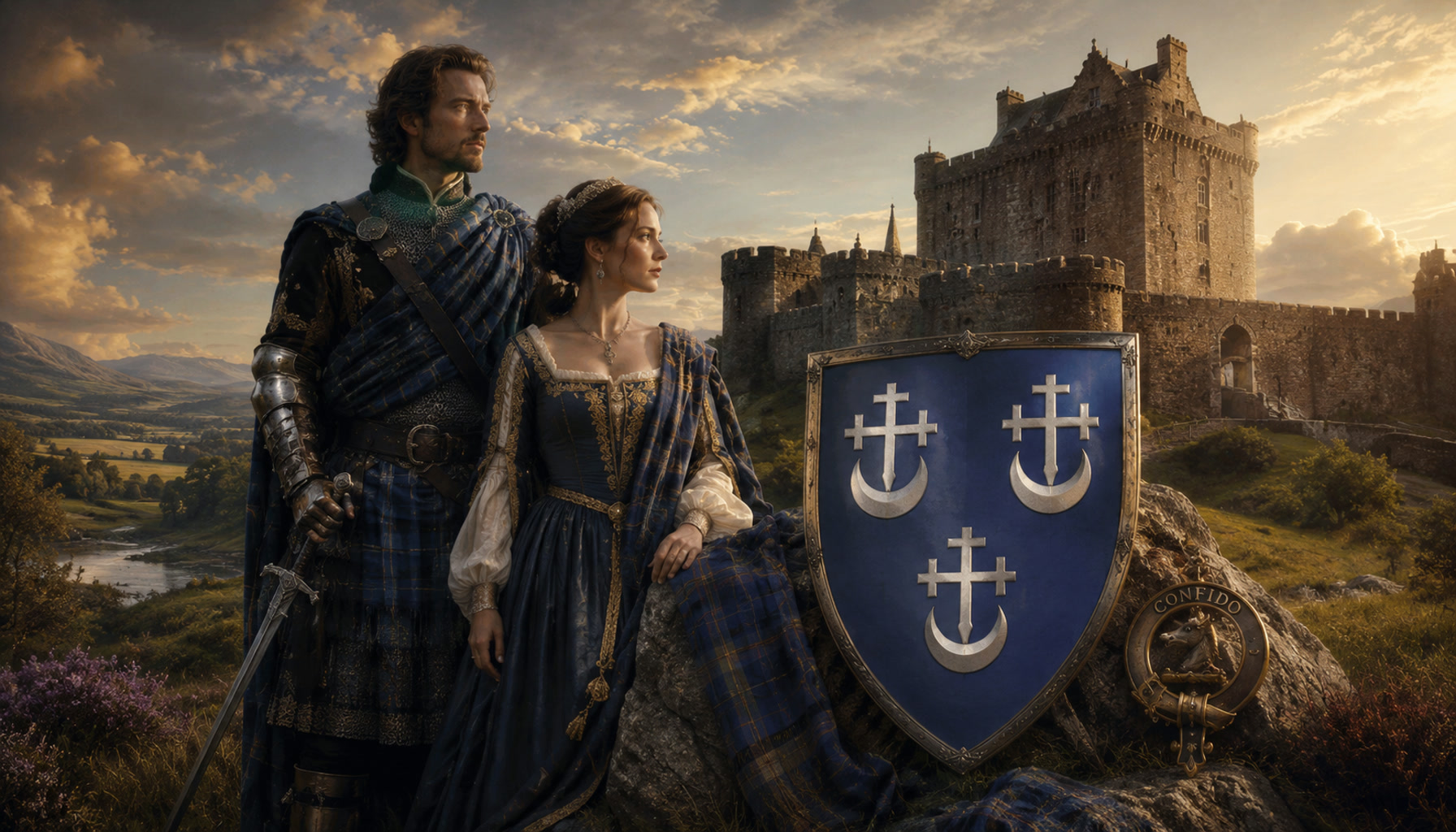
Clan Cathcart was a Scottish Lowland family rooted in the lands of Cathcart near Glasgow, and in genetic tagging terms the primary family haplogroup associated here is R1b1a1b1a1a2a. That opening point matters, because the Cathcarts belong to a very recognisable Scottish pattern: not the sprawling image of a Highland kindred spread across glens, but a landed Lowland house whose identity grew out of place, tenure, service, and local authority. Their name itself comes from their territory, and that is a wonderfully medieval thing. In Scotland, especially in the earlier record, surname and estate often went hand in hand. To be "of Cathcart" was not simply to have a label. It meant being tied to a landscape, a jurisdiction, and a social role.
The family appears early in the documentary trail, with Rainaldus de Kethcart recorded in 1178, which places the lineage firmly in the world of twelfth-century feudal Scotland, when royal administration, church patronage, and lordship were becoming more tightly documented. William de Cathcart appears in 1296 on the Ragman Roll, in that fraught moment when Scottish landholders were being drawn into the political pressure of Edward I's domination. By the sixteenth century, the family had become fully embedded in the public life of the kingdom, and figures such as Alan Cathcart, 4th Lord Cathcart, who died in 1568, stand for a house that had moved beyond local relevance into the orbit of noble politics, military responsibility, and national service. Their motto, I am grip fast, sounds almost like a line from a hard-bitten border chronicle: terse, stubborn, and practical. It captures the Cathcart reputation rather well, a family remembered less for theatrical legend than for durability, loyalty, and holding their ground.
The great location anchor for the family is Cathcart Castle, once standing above the White Cart Water in what is now the south side of Glasgow. The castle was probably established in the later medieval period and served as the principal seat of the Lords Cathcart, giving physical form to the family's territorial identity. This was not just a house in the modern sense but a statement of control over land, movement, and status. Like so many Scottish castles, it sat where topography did political work for you: on rising ground above a river, visible and defensible, a seat of authority in stone. Over time the castle declined, and by the twentieth century its remains were considered unsafe and were demolished. That sounds bleak, but the site itself is not lost to history. The location lies within what is now Linn Park, and visitors can still go to the area where the castle once stood, with landscape features and commemorative markers preserving the memory of the stronghold. So yes, in a reasonable sense, Cathcart Castle can still be visited, even if what survives is the place rather than the standing fortress. For anyone interested in clan history, that distinction is important: sometimes the ground itself is the most eloquent surviving document.
From an ancient-DNA perspective, the Cathcart tag here is linked with the paternal line R1b1a1b1a1a2a, a branch widely represented across western and central Europe over long stretches of time. That does not prove direct descent from any one ancient individual, and it is important not to pretend otherwise. What it does offer is a web of related or linked samples that help sketch the deeper prehistoric and historic backdrop against which a Lowland Scottish family like the Cathcarts emerged. Among those linked examples are Pict-era Scotland samples from Rosemarkie Cave on the Black Isle such as KD001 and related individuals, and an early medieval Pict-era sample from Lundin Links, LUN004, which are especially evocative for a Scottish context. There are also Iron Age and Romano-British links from Britain, including Roman Era England Northwest Cambridgeshire Eddington NWC009, Roman Era Fenstanton FEN008, and multiple Celtic Durotriges individuals from Duropolis at Winterborne Kingston such as WBK103, WBK106, WBK17, and WBK36. Beyond Britain, the same broader paternal branch appears among elite Celtic burials in Germany, including Magdalenenberg MBG013, Asperg-Grafenbuehl APG001 and APG003, and Hochdorf HOC001, HOC001b, and HOC001c, as well as in medieval northern Spain at Las Gobas with samples such as ldo066, ldo037, ldo046, and ldo048. Taken together, these linked samples suggest a very long and very mobile western European story for this haplogroup, one that runs through Bronze Age, Celtic, Roman, Pictish, and medieval settings before ever arriving in the documentary world of Clan Cathcart.
Read more about Clan Cunningham
If you have Cathcart roots, or simply an interest in the Scottish Lowland clan tradition, this is exactly the sort of family history that becomes richer when documents, landscape, heraldry, and DNA are read together. Uploading your DNA can help you see whether you match Clan Cathcart or any of the related ancient DNA samples linked to the same wider paternal story, from Pictish Scotland to Celtic and Roman-era Europe.
Comments