Clan Carroll
– 3 min read


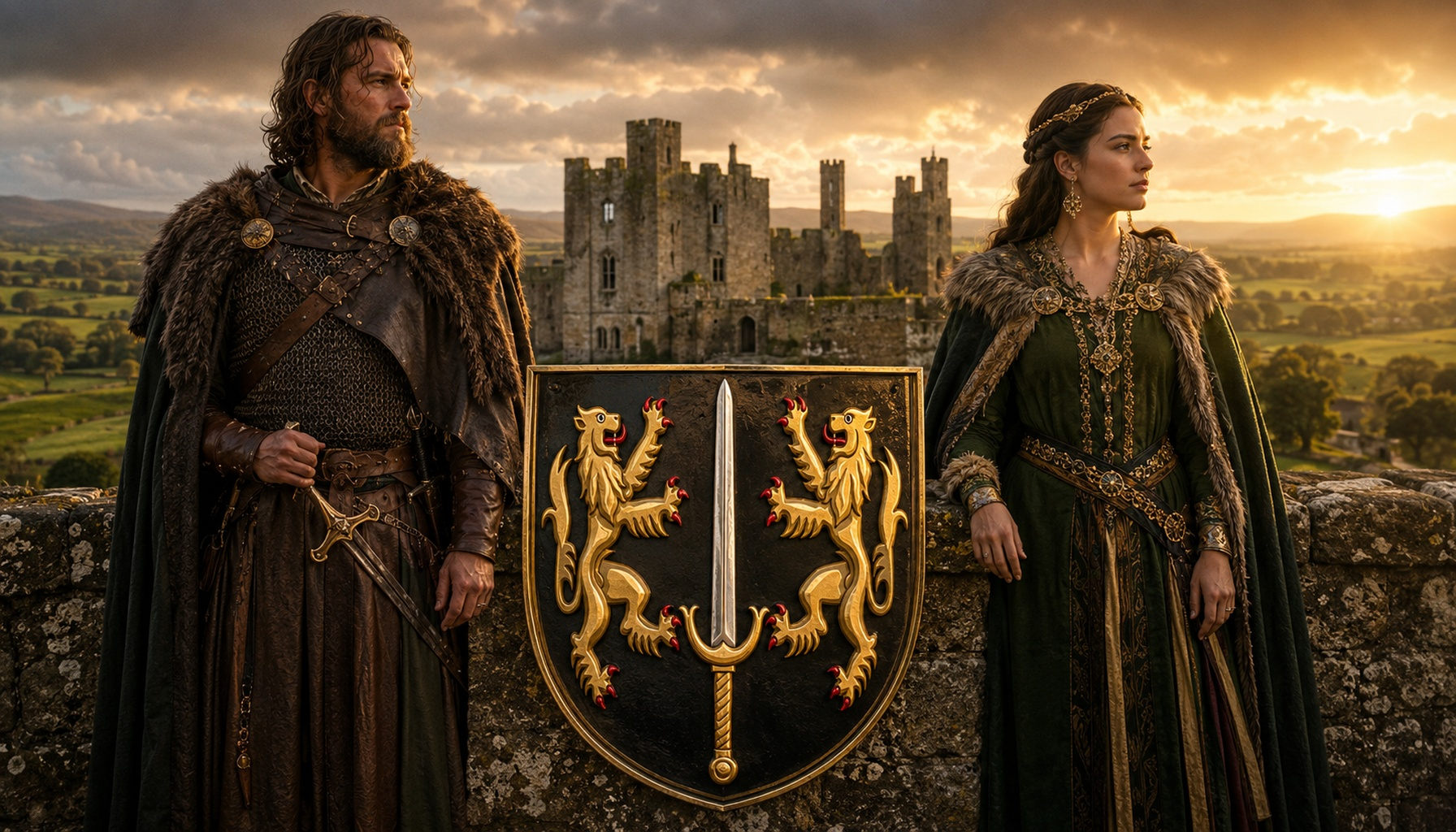
Clan Carroll was one of the old Gaelic Irish lordly families, descended from the O Cearbhaill tradition and rooted above all in Ely O'Carroll, a historic territory centered in what is now south Offaly and north Tipperary. In the world they inhabited, a family was not just a surname but a political organism: a kin-group with land, followers, fighting men, church ties, marriage alliances, and a very sharp sense of ancestral right. The Carrolls belonged to that unmistakably Irish pattern of regional kingship and lordship, where authority was negotiated in cattle, tribute, fortifications, reputation, and memory as much as in parchment. Their primary associated Y-DNA haplogroup is tagged here as R1b1a1b1a1a2c1a5d, a branch linked more broadly to long-running paternal lineages across Atlantic and Celtic-facing Europe.
Historically, the Carrolls are remembered for endurance. They stood their ground through the pressures that transformed medieval Ireland: rivalry with neighboring Irish dynasties, the shifting consequences of the Anglo-Norman presence, and later the expanding reach of English royal authority. Their motto, In Fide et in Bello Fortis, strong in faith and in war, captures something very real about Gaelic lordship. It was not merely swagger. It suggests a family expected to defend churches as well as cattle, lineage as well as land, and to preserve the name through centuries when many such dynasties were broken, displaced, or absorbed. One notable figure is Domhnall OCarroll, King of Ely, recorded in 1241, a reminder that this was a ruling family with a place in the political map of medieval Ireland, not simply a surname floating loose from its homeland.
No discussion of the Carrolls feels complete without Leap Castle, one of the most evocative strongholds associated with their territory. Standing in County Offaly, near the old heartland of Ely O'Carroll, the castle occupies a strategic site that made perfect sense in the age of competing lordships: control the height, watch the roads, and make your presence impossible to ignore. The stone structure generally seen today is late medieval in date, with origins often placed around the 15th century, and it is traditionally linked to the O'Carroll lords. Like many Irish tower-house sites, it combines practical defensibility with the theatrical message of status. Leap Castle later passed through turbulent episodes, including violent internal family conflict in tradition and later ownership changes in the early modern period. It remains famous not only as a historical monument but also as one of Ireland's best-known haunted castles, which is what often brings modern visitors in the gate before history does the deeper work. Happily, it is indeed a place that can still be visited, making it a tangible anchor for anyone exploring Carroll heritage on the ground rather than only on the page.
From a DNA perspective, the Carroll-associated haplogroup tag R1b1a1b1a1a2c1a5d sits within a very wide and historically mobile paternal landscape. It is important not to claim direct descent from ancient excavated individuals unless the evidence specifically supports it. What we can say is that related or linked samples appear across an impressively broad archaeological range, including Celtic Durotriges burials from Duropolis at Winterborne Kingston in England such as WBK12, WBK20, WBK29, WBK41, WBK05, WBK30, WBK43, WBK06, WBK08, WBK18, and WBK191; Iron Age and Celtic Brittonic contexts from Kent, Somerset, Oxfordshire, Yorkshire, Hampshire, Cornwall, Wales, and Scotland; Pict-era Orkney examples such as CGG018915 and CGG018915x; medieval Irish individuals from Kilteasheen in Roscommon including KIL025, KIL015, and KIL012; and additional linked finds stretching from Bronze Age Orkney and Rathlin Island to Roman Croatia, medieval Spain, Belgium, Germany, Hungary, and beyond. In other words, the deeper story behind a Carroll-linked paternal signature is not narrowly local but part of the long genetic backdrop of Atlantic Europe, Iron Age Celtic worlds, and the medieval populations that emerged from them.
If you carry the Carroll name, or suspect Carroll lines in your family tree, this is exactly the sort of heritage story that becomes more vivid when documents, geography, and DNA are allowed to speak to one another. Uploading your DNA to MyTrueAncestry can help you explore whether you match Clan Carroll, the Carroll-linked haplogroup R1b1a1b1a1a2c1a5d, or any of the related ancient DNA samples from Iron Age Britain, medieval Ireland, and the wider Celtic world.
Comments