Clan Buchanan

– 3 min read


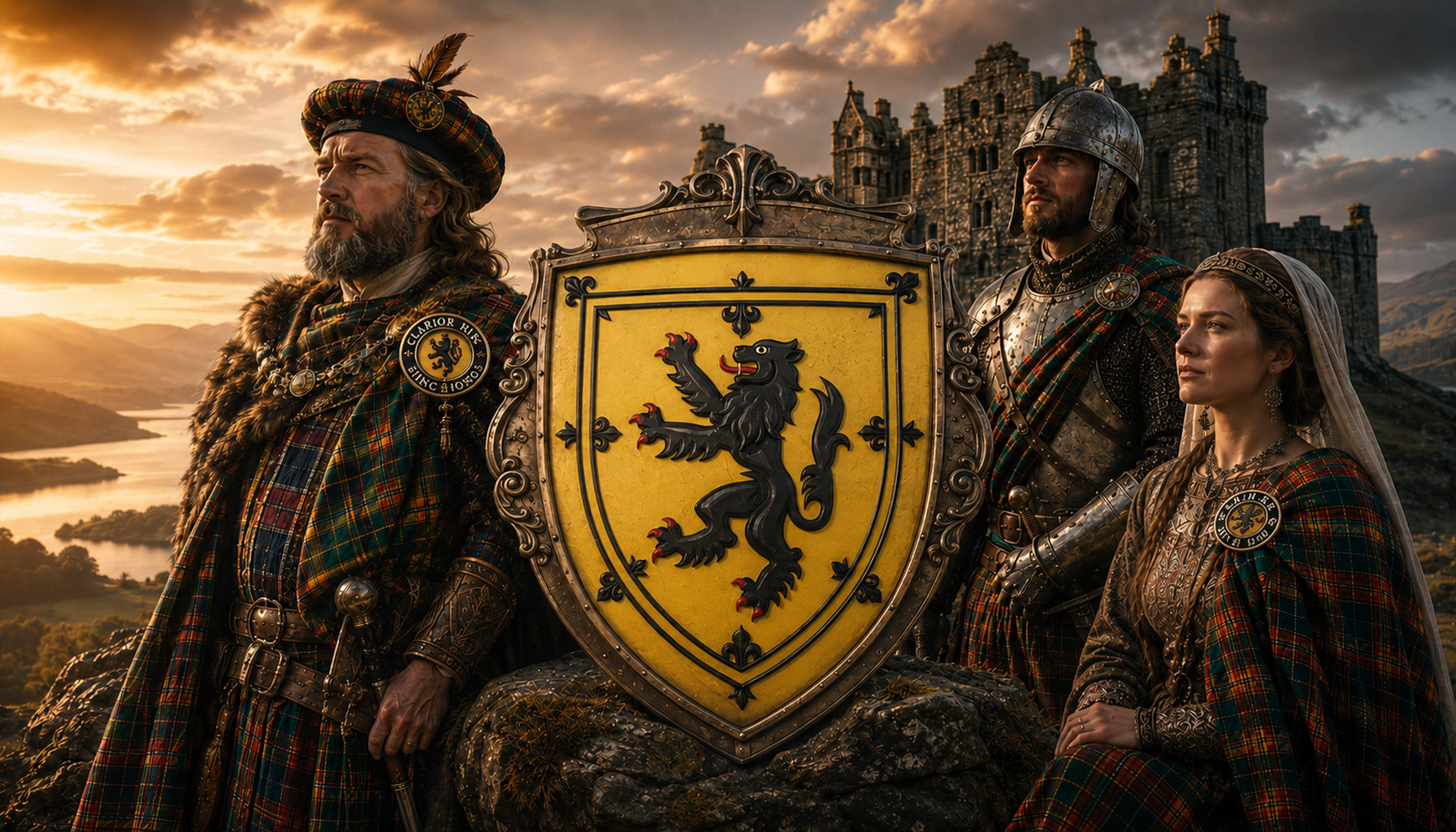
Clan Buchanan was one of the great landed kindreds of western and central Scotland, rooted above all in the country east of Loch Lomond and reaching into Stirlingshire. In historical terms, this was a classic Scottish clan: a family built not simply on surname, but on territory, lordship, marriage alliances, service, memory, and the hard practical business of holding ground in a competitive medieval world. The primary Buchanan haplogroup linked with the family is R1b1a1b1a1a2c1a1f1, a branch within the wider paternal lineage so often found across Atlantic and western European populations.
The traditional story reaches back to Anselan O Kyan, styled King of North Ulster in 1016, a figure who belongs as much to dynastic memory as to documentary history. Whether read as legend, identity statement, or ancestral claim, that tradition mattered because it placed the Buchanans within the Gaelic and Scottish world of noble origins. By the later medieval period the clan is on firmer ground historically, emerging through charters, estates, and local authority in the Lennox region. Men such as Sir Alexander Buchanan, active in 1424, and later Sir George Buchanan, associated with 1650, show the family moving through the military and political life of Scotland. Their motto, Clarior Hinc Honos, brighter hence the honor, says exactly what many clans wanted history to say about them: that rank and reputation were inherited, certainly, but also enlarged by service and conduct.
If you want the geographical anchor of Clan Buchanan, look to Buchanan Auld House near Drymen, not far from Loch Lomond, in the old clan heartland. The site stood on the Buchanan estate and served as the long-established seat of the chiefs before later changes in residence and fortune. What survives today is not a fully standing great house, but an evocative ruin: exactly the sort of place that reminds you that clan history is not an abstract pedigree chart but something fixed in stone, weather, and land use. The house is associated with the older territorial identity of the clan and with the estate structure that underpinned Buchanan power in the district. In that sense it tells a broader Scottish story too, about how noble families were tied to named places, and how those places gave authority, continuity, and social weight to a surname.
Buchanan Auld House can still be visited in the sense that the remains are known and the site survives as part of the historic landscape, though visitors should sensibly check local access conditions and respect the ruin and surrounding property. Even in fragmentary form, it is one of those places where the clan world becomes wonderfully concrete. You are no longer talking only about chiefs and charters, but about where people lived, received tenants, managed estates, and looked out over the ground that made the clan possible.
From a DNA perspective, the Buchanan-associated haplogroup R1b1a1b1a1a2c1a1f1 sits within a deep and very widespread western European paternal story. Related or linked ancient samples assigned to this branch or nearby placement appear across an impressively broad map and timespan, which is a useful reminder that haplogroups track deep paternal lines, not surnames. Among the linked examples are multiple Celtic Durotriges burials from Duropolis at Winterborne Kingston in England, including WBK12, WBK20, WBK29, WBK41, WBK05, WBK30, WBK43, WBK06, WBK08, WBK18, and WBK191, along with samples such as Iron Age Worlebury Somerset England (I11991), Iron Age Hillfort Battlesbury Bowl England (I21309), Celtic Briton Oxfordshire Yarnton England (I21182), Post Roman Era Worth Matravers Dorset England (I11580), Bronze Age Boatbridge Quarry South Lanarkshire Scotland (I5473), Bronze Age Orkney Westray Links of Noltland (KD061), Bell Beaker Wiltshire Upavon England (I4950), Bronze Age Amesbury Down Wiltshire England (I2417), Bronze Age Trumpington Meadows Cambridge England (I3256), Early Bronze Age England Thames (I5377), Bronze Age Bedfordshire England (I7576, I7577), and Ireland Copper Age (Rathlin2B). Further linked examples stretch into continental and later settings, including Imperial Roman Era Zadar Croatia (I26776), Early Medieval Belgium Sint-Truiden Groenmarkt (ST2025), Medieval Belgium Outsider Sint-Truiden Onze-Lieve-Vrouwekerk (ST1308), Gallic France Parancot (CGG023699), Merovingian Grave Alt-Inden Germany (IND013), Late Roman Klosterneuburg Lower Austria (R10656), Late Roman Conimbriga Portugal (R10488), Viking Age Warrior Oppland Norway (VK386), Medieval Age Faroe Islands Sandoy Church (VK242), Bronze Age Calabria Grotta della Monaca Sant Agata di Esaro (GMO015), and Celt Hinxton Iron Age (HI2). None of these should be taken to mean direct descent from Clan Buchanan; rather, they show the wider ancient paternal landscape to which the clan's primary haplogroup belongs.
Clan Buchanan remains one of the most recognizable examples of Scottish ancestral identity: a family of place, kinship, heraldry, service, and memory, still tied in imagination and in landscape to Loch Lomond and Stirlingshire. If you carry Buchanan ancestry, or suspect a link to this wider Scottish and Atlantic-world heritage, uploading your DNA can help you explore whether you match the family profile or any of these related ancient DNA samples.
Comments