Clan Barrett
– 3 min read


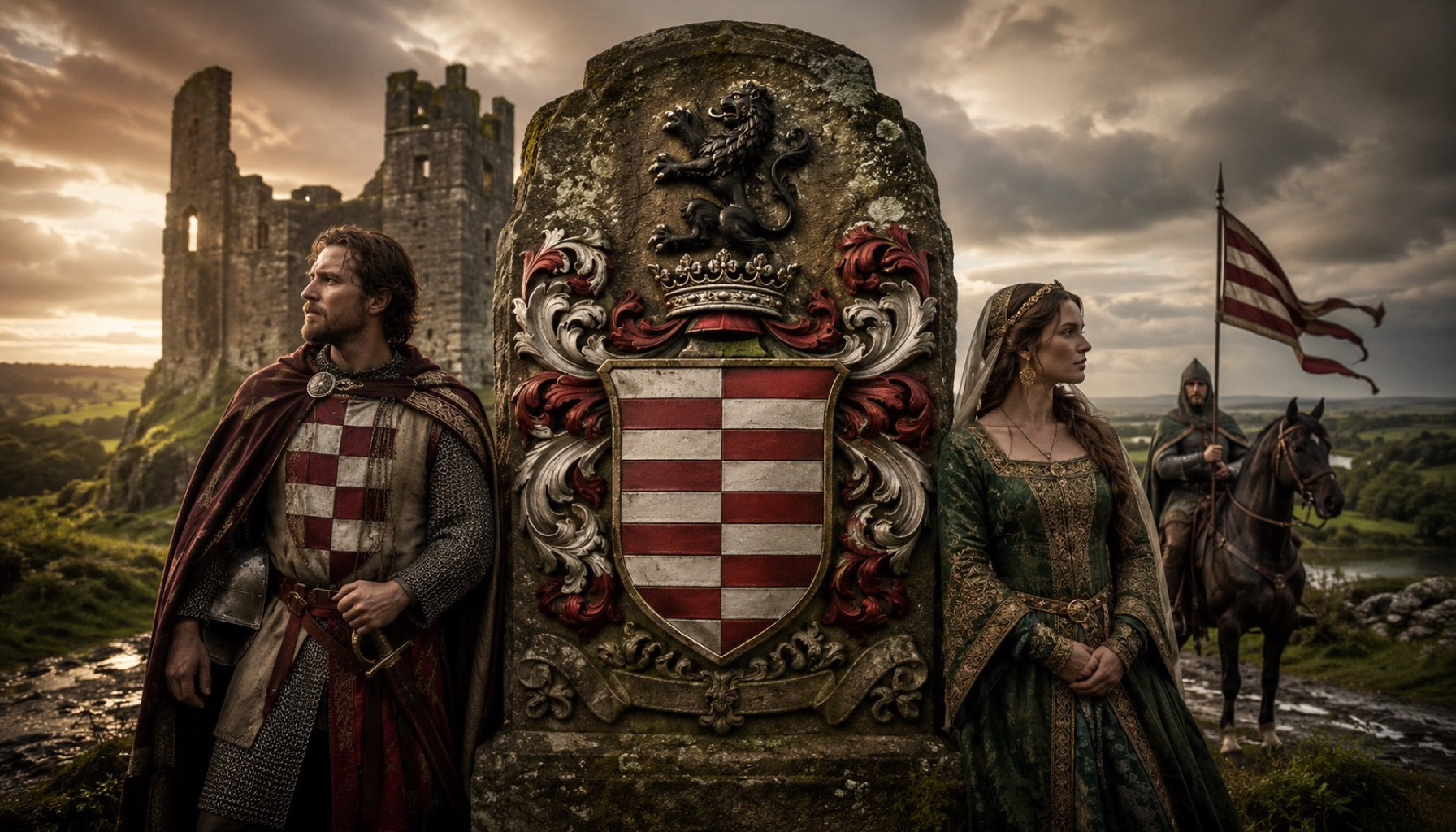
The Barrett family was one of the Norman lineages that crossed into Ireland during the great Anglo-Norman expansion, and over time became thoroughly woven into Irish life, especially in Cork and Mayo. In family and DNA terms, the clan is here tagged with haplogroup R1b1a1b1a1a2c1a2b2b, treated as the primary family haplogroup association for this heritage profile. Like so many Norman-Irish houses, the Barrett story begins on the Continent, passes through the world created by the Norman Conquest, and then settles into Ireland where military service, lordship, landholding, and local alliance mattered more than tidy origin stories.
What makes the Barretts so interesting is that they fit a recognisable Irish medieval pattern while still keeping a distinctive family character. They were not simply outsiders who arrived and remained unchanged. They adapted. They planted themselves in regional society, took part in the hard business of frontier power, and endured through centuries when conquest, rebellion, confiscation, and migration repeatedly rearranged the map of Ireland. The family motto, Frangas non Flectes, usually understood as "you may break but not bend," suits that long survival rather well. An early named figure often cited in the wider surname history is John Baret in 1086, a reminder that the name itself is rooted in the Norman world before its Irish chapters fully unfold.
A particularly evocative place to anchor the Barrett story is Ballincollig Castle in County Cork. The site stands on a limestone outcrop above a bend of the River Lee, which is exactly the sort of position medieval builders prized: visible, defensible, and tied to movement through the landscape. The castle is generally dated to the 15th century, with a tall tower house and a bawn or enclosing wall, and it is associated with the Barrett family before later passing through other hands. In practical historical terms, this was not just a romantic ruin but a working stronghold in a contested region, part residence, part statement of authority, part instrument of local control. Ballincollig later found itself in the orbit of the expanding gunpowder mills district, but the medieval core still speaks clearly of the earlier world of landed families and fortified households. The ruins still stand and can be visited from the public parkland around Ballincollig, so this is one of those rare family landmarks where the past is not merely read about but physically encountered.
From the ancient DNA side, the haplogroup link to R1b1a1b1a1a2c1a2b2b places the Barrett profile within a much broader west European paternal story rather than proving descent from any one excavated individual. Related or linked ancient samples associated with this branch include a striking spread across time and place: Celtic Durotriges burials from Duropolis at Winterborne Kingston in England such as WBK12, WBK20, WBK29, WBK41, WBK05, WBK30, WBK43, WBK06, WBK08, WBK18, and WBK191; Iron Age and post-Roman Britain including I11991 from Worlebury, I21309 from Battlesbury Bowl, HI2 from Hinxton, and I11580 from Worth Matravers; Bronze Age Britain and Ireland including KD061 from Orkney, I3256 from Trumpington Meadows, I2417 from Amesbury Down, I4950 from Bell Beaker Upavon, I7576 and I7577 from Bedfordshire, I5473 from South Lanarkshire, I5377 from the Thames, and Rathlin2B from Copper Age Ireland. Linked examples also appear farther afield in Roman and medieval Europe, including I26776 from Imperial Roman Zadar in Croatia, R10488 from Late Roman Conimbriga in Portugal, R10656 from Late Roman Klosterneuburg in Austria, IND013 from Alt-Inden in Germany, ST2025 and ST1308 from medieval Belgium, VK27 from the Faroe Islands, CGG023699 from Gallic France, and GMO015 from Bronze Age Calabria. None of these individuals should be presented as direct Barrett ancestors on present evidence, but together they help sketch the deep prehistoric and historic world from which a later Norman-Irish paternal line emerged.
Read more about the House of Barry
If you carry the Barrett name, have Barrett lines in Cork or Mayo, or simply suspect a Norman-Irish strand in your family story, DNA can add an entirely new layer to the archive. Uploading your results to MyTrueAncestry lets you see whether you match Clan Barrett associations or any of these related ancient DNA samples, and that can be a wonderfully concrete way of connecting family memory with the deeper human past.
Comments