Clan Baillie

– 3 min read


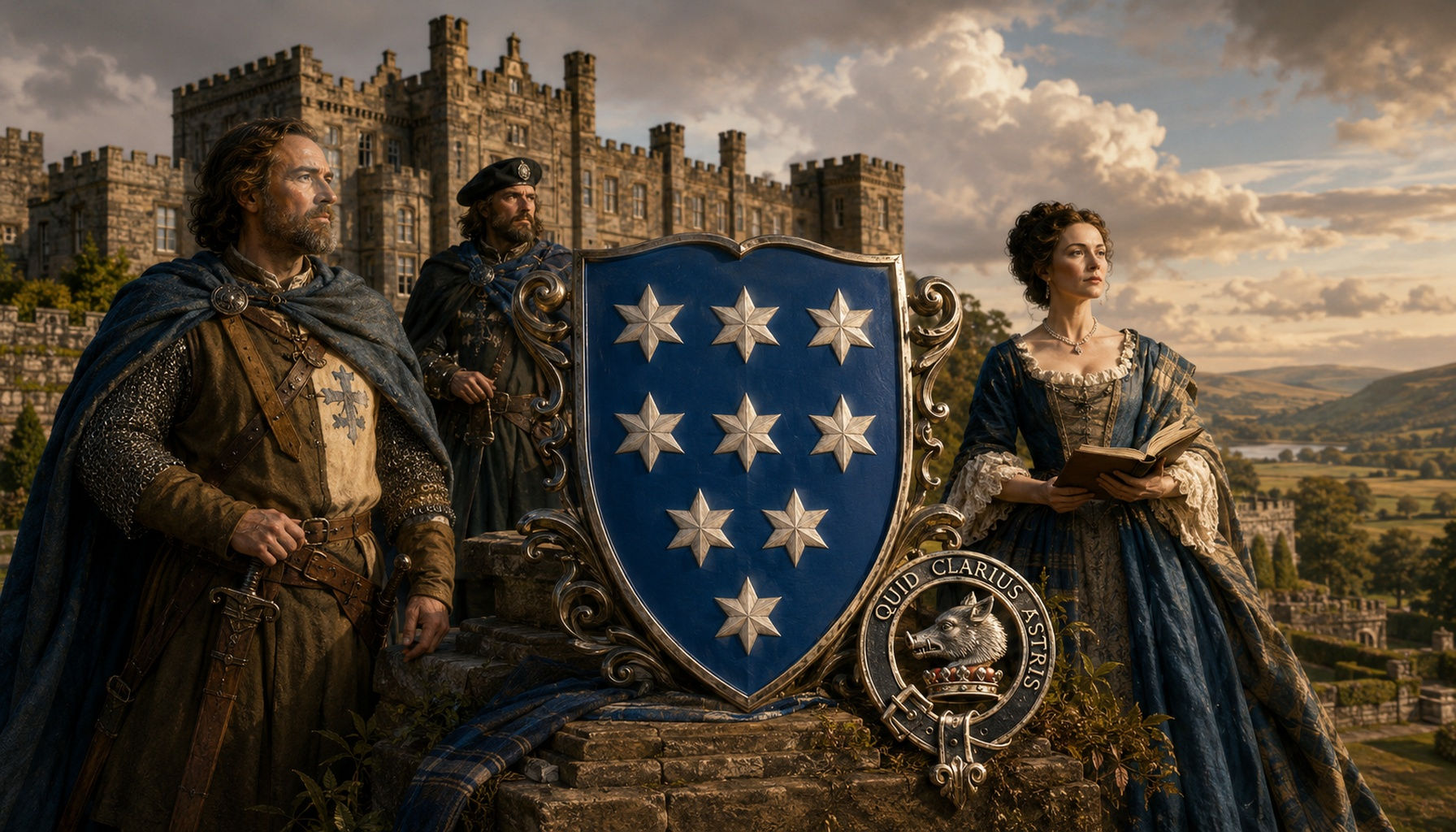
Clan Baillie was a Lowland Scottish family of Norman origin, established in medieval Scotland and closely associated with landholding, law, public service, and the political life of the realm. In genetic tagging terms, the primary family haplogroup linked here is R1b1a1b1a1a2a4, a branch within the broad R1b line that appears again and again across western and central Europe in ancient DNA. Historically, the Baillies belong to that distinctly Lowland story: families who arrived in the wake of Norman and Anglo-Norman influence, settled into Scottish society, and built their standing not simply by the sword, but by offices, estates, marriages, and useful service to crown and community.
The name itself fits that world rather well. "Baillie" is tied to the office of bailie, a local official or magistrate, which tells you something important about the family's reputation: they were not merely ornamental nobles perched on a hilltop, but people woven into the machinery of administration. Over the centuries the Baillies developed through estate connections and alliances with other notable lineages, becoming part of Scotland's landed and professional class. Their motto, Quocunque Jeceris Stabit, "wherever you throw it, it will stand," is wonderfully compact and very Scottish in spirit, suggesting steadiness under pressure, resilience in changing times, and a certain refusal to topple when history became rough. Among their better-known figures are George Baillie (1664-1738), a statesman and member of parliament, and Lady Grisell Baillie (1665-1746), remembered for her intelligence, writings, and deeply human presence in Scottish history.
One of the most evocative location anchors for the family is Redcastle in the Black Isle area of Ross-shire, on the north side of the Beauly Firth in the Scottish Highlands. Despite the name "Black Isle," it is not an island at all, but a peninsula, and Redcastle sits in a striking waterside position that has made the site strategically useful for centuries. The place has a long history: an earlier medieval fortification stood here before later rebuilding produced the castle remains associated with subsequent owners and changing political circumstances in the north. Like so many Scottish castles, Redcastle is less a single frozen building than a layered historical site, altered by conflict, inheritance, and rebuilding over generations. It gives us a vivid reminder that families such as the Baillies were tied not only to surnames and charters, but to actual landscapes of firth, road, estate, and defensive power. The ruins of Redcastle are still known today, and the site can still be visited from the surrounding area, at least from outside and by reasonable local access conditions, which makes it a tangible stop for anyone tracing northern Scottish family history.
From an ancient DNA perspective, the Baillie-linked haplogroup R1b1a1b1a1a2a4 belongs to a very old and wide-reaching paternal story across Europe. Related or linked samples appear in a remarkable spread of contexts: Medieval Northern Spain at Las Gobas, including ldo066, ldo037, ldo046, ldo048, ldo062, and ldo040; Iron Age and Roman Britain, including Durotriges individuals WBK106 and WBK36 from Duropolis and Roman-era FEN008 from Fenstanton in Cambridgeshire; Pict-era Scotland at Rosemarkie Cave on the Black Isle, with samples such as KD001 and related individuals KD001_2, KD001_3, KD001_4, KD001_6a, and KD001_6b; and even earlier Bronze Age and Bell Beaker contexts in France, the Netherlands, Bohemia, and Germany, including SMGB54, BRE445FK, VLI092, and several central European elite burials. None of this proves direct descent from any one ancient individual, and it is important not to overclaim. What it does suggest is that the Baillie paternal line sits within a deep western European lineage with visible archaeological footprints from Bronze Age expansion, through Iron Age Celtic societies, into Roman and medieval populations, and right up into the world from which Scottish Lowland families emerged.
Explore the Royal House of Balliol
If you carry the Baillie name, have Baillie ancestors in your tree, or simply want to see whether your DNA connects with this wider world of Norman-rooted Lowland Scotland and R1b1a1b1a1a2a4-linked ancient samples, you can explore it directly through MyTrueAncestry. Upload your DNA and see whether you match the family story, the broader Scottish context, or related ancient DNA samples from Britain and continental Europe.
Comments