Clan Ross
– 3 min read


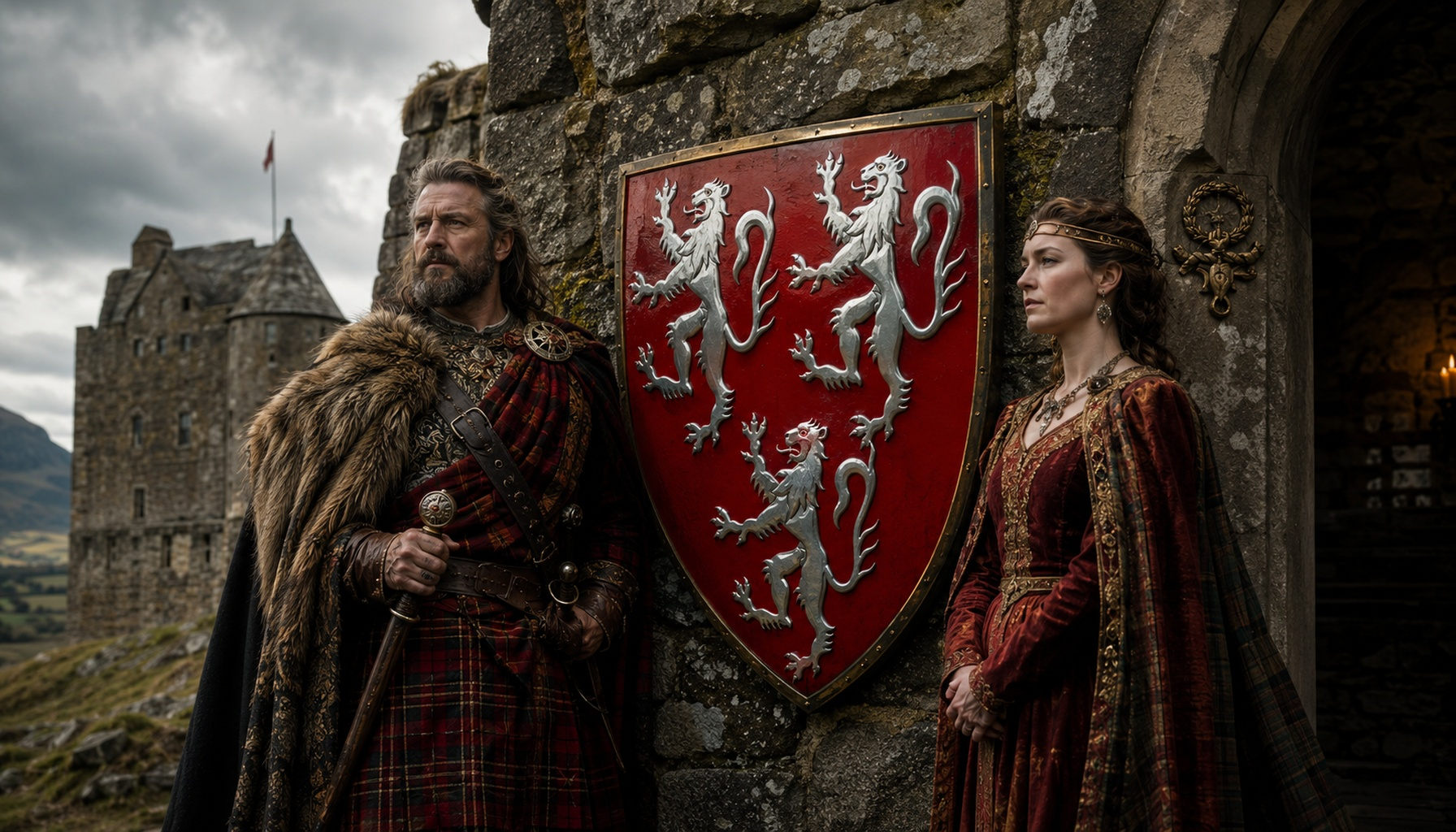
Clan Ross was one of the great Highland kindreds of northern Scotland, rooted above all in Easter Ross and the older territorial world that tied lordship, kinship, and land tightly together. In historical terms, the Rosses fit the classic Highland noble-clan pattern: chiefs, fighting men, landed authority, heraldic standing, castle-based power, and a family identity that endured across centuries even as politics shifted around them. Their story belongs to the northern Highlands, where local rule, royal favour, military service, and regional alliances all mattered enormously. Haplogroup tags linked with Ross research include R1b lineages, with the primary family haplogroup here noted as R1b1a1b1a1a2c1a2.
The family background is richer than the old shorthand version of clan history. Clan Ross grew within the medieval lordly landscape of the north, where control of territory was never just about acreage on a map, but about rights, followers, marriage ties, armed support, and recognition by the crown. The clan's rise is often associated with Fearchar, usually identified as Fearchar mac an t-sagairt, who flourished in the early 13th century and was active between 1214 and 1249. He emerged as a powerful figure in Ross and became Earl of Ross, showing just how closely clan power and wider Scottish politics could be intertwined. Through chiefship, landholding, noble title, and the long memory of descendants, the Rosses remained one of the defining names of the Highlands.
One of the great location anchors for Clan Ross is Balnagown Castle, near Kildary in Easter Ross. This has long been associated with the chiefs of the Clan Ross and stands as a very physical reminder that Highland history was lived in places as much as in pedigrees. The site began as a castle of considerable age, with medieval origins, and over time it was altered, extended, and adapted, so that what survives reflects several periods of occupation rather than a single moment frozen in stone. Like many Scottish castles, Balnagown is part fortress, part noble residence, and part statement of family continuity. It is not just a romantic ruin in the landscape, but a seat tied to the authority and identity of the clan in its home territory. It has also been restored in modern times, which is one reason it remains so important in public memory. Balnagown Castle can still be visited in a limited heritage and accommodation sense, reasonably supported by its continuing use and public profile, so for people interested in Ross ancestry it remains one of the most tangible places to connect with the clan's historical heartland.
The primary family haplogroup noted here, R1b1a1b1a1a2c1a2, belongs to a wider northwestern European genetic landscape with deep roots in later prehistoric and historic populations. It should not be used to claim that Clan Ross descends directly from any one excavated individual, but it does place Ross DNA interest within a broad network of related or linked ancient samples. These include Iron Age and Romano-British individuals from southern Britain such as the Celtic Durotriges burials at Duropolis, Winterborne Kingston, including WBK12, WBK20, WBK29, WBK41, WBK05, WBK30, WBK43, WBK06, WBK08, WBK18 and WBK191; Roman Era Cambridge Vicars Farm VIC016; Pict-era and earlier northern samples such as Bronze Age Orkney Links of Noltland KD061, Pict Era Knowe of Skea KD004 series, Mine Howe CGG018915, Late Bronze Age Covesea Caves I2859x, and Iron Age Highland Applecross I3567 and I3566. The same broader lineage also appears across later Celtic, Roman, early medieval, Anglo-Saxon, Irish, Scandinavian, and continental contexts, from East Kent, Yorkshire, Somerset, Oxfordshire, Wales, Scotland, Ireland, Spain, Belgium, Germany, Croatia, Portugal, Hungary, and Sweden. In plain English, this is the sort of haplogroup pattern that reminds us how the Highlands were never biologically sealed off: Ross heritage is distinctly Highland in culture and history, but the deeper paternal line sits within a much older Atlantic and European story.
If you are researching Clan Ross, the most interesting next step is to combine the paper trail with the DNA trail: surnames, places, old parish records, clan history, and haplogroups together tell a far fuller story than any one source on its own. If you want to see how your DNA may connect with populations linked to the same wider haplogroup world, upload your DNA to MyTrueAncestry and explore the ancient matches for yourself.
Comments