Celtic Lady of Ditzingen-Schöckingen
– 4 min read


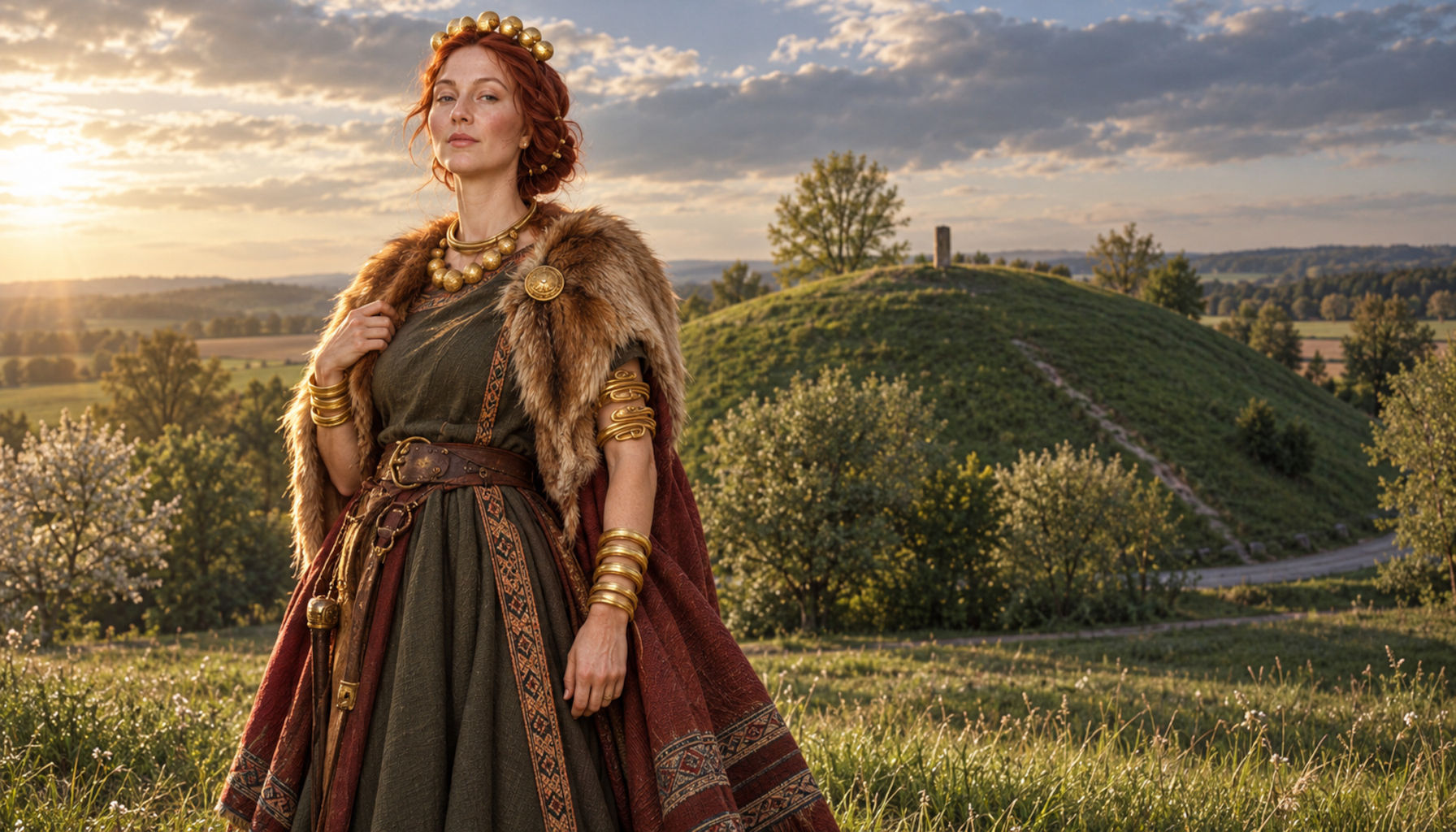
The Celtic Lady of Ditzingen-Schöckingen was a high-status woman buried in southwestern Germany around 300 BC, in the La Tène Iron Age world of wealthy Celtic communities. She is not known to us by a personal name, which is often the case in pre-Roman Europe, but her grave and her DNA make her historically important all the same. Through sample SCN001, she offers a rare, direct glimpse of a woman who belonged to the aristocratic society clustered around the Neckar region and the powerful center of Hohenasperg.
This was not a quiet rural backwater. The landscape of southwestern Germany in the centuries around 300 BC was dense with status, rivalry, display, and long-distance exchange. Elite families controlled routes linking Central Europe to the Mediterranean, and they advertised their power in the most visible way possible: by burying their dead with care, wealth, and symbolism. Rich graves, wagons, ornaments, imported luxuries, and elaborate funerary rites were not merely possessions in the ground; they were statements about rank, kinship, and authority. The woman from Ditzingen-Schöckingen belonged to that world.
Explore Celtic Origins in Ancient DNA
What makes the Celtic Lady of Ditzingen-Schöckingen so compelling is that she stands at the meeting point of archaeology and personhood. We can place her within an elite Celtic environment also associated with famous sites such as Hochdorf and Asperg-Grafenbühl, both of them touchstones for the study of Iron Age power in southwestern Germany. These were communities in which prestige mattered enormously, and where noble households appear to have shaped the political and economic life of the region. The lady represented by SCN001 was part of that same broad milieu: not an abstract “type,” but an actual woman who lived, moved, ate, formed family ties, and was eventually buried in a manner that marked her as socially important.
The recent genetic work published in Nature Human Behaviour helps connect these elite burials to the people inside them. That is the great value of this kind of study. Archaeologists have long been able to describe the splendour of Iron Age graves; ancient DNA allows comparison between individuals from different cemeteries and power centers, testing whether these aristocratic networks were also biological kin networks, local dynasties, or more mixed social coalitions. In other words, her genome helps shift the discussion from splendid objects to the human beings who used them.
The biological sample discussed here is identified as Elite Celtic Lady of Ditzingen-Schoeckingen, sample SCN001, dated approximately to 300 BC. The identification is secure in the archaeological sense as an excavated Iron Age woman from the Ditzingen-Schöckingen burial context, but she is not a named historical individual known from written sources. So this is not the case of a queen or princess whose identity can be checked against an inscription; rather, it is a well-contextualized archaeological individual from an elite grave.
The supplied material does not specify in detail which skeletal element yielded the DNA, so it is best not to invent one. What matters is that her remains were sufficiently preserved for ancient DNA analysis and could be studied alongside other elite Celtic burials from the region. That comparative framework is crucial, because Ditzingen-Schöckingen was part of a broader constellation of Iron Age centers whose funerary customs, wealth, and connections hint at enduring noble lineages and carefully managed alliances.
A short note on related ancient DNA helps place her in deeper time. Comparisons with other western and central European ancient individuals, including Bronze Age Germany Regensburg-Dechbetten (RISE473) and Iron Age Casterley Camp Wiltshire England (I21313), can be useful when available because they show how lineages and ancestry components persist, shift, and recombine across centuries. Such links do not mean these people were close relatives. They simply provide reference points for understanding how an elite Celtic woman from 300 BC fits into the wider genetic history of prehistoric Europe.
There is also a more immediate H3g-linked perspective. Since the mtDNA haplogroup here is H3g, the most obviously relevant linked sample is this same individual, SCN001, the Elite Celtic Lady of Ditzingen-Schoeckingen. As more ancient genomes are published, additional H3g-bearing individuals may help clarify whether this maternal line was common or comparatively rare among Iron Age communities in southwestern Germany. At present, the value lies less in grand claims and more in careful accumulation of comparable ancient maternal lineages.
Read about Matrilineal Kinship in Iron Age Britain
The published genetic information for SCN001 includes an mtDNA haplogroup of H3g. Mitochondrial DNA is passed down through the direct maternal line, from mother to child, so this lineage reflects the lady’s mother, her mother’s mother, and so on back through time. H3g is therefore a marker of one narrow ancestral line, not a label for her whole identity.
No Y-DNA haplogroup is available here, which is entirely expected for a female individual. Y-DNA traces the direct paternal line through the Y chromosome and is normally only recoverable from biological males. So in this case, the paternal-line haplogroup is simply not applicable or not determined, and there is no reason to guess.
What, then, does H3g tell us? It tells us that one maternal lineage present in Iron Age Celtic society in southwestern Germany belonged to the wider mitochondrial haplogroup H family, a broad and long-established set of maternal lineages seen in many ancient and modern West Eurasian populations. But one must keep one’s archaeological feet on the ground. H3g does not prove tribe, language, or “Celticness.” It does not tell us what language she spoke, whether she saw herself as part of a particular people, or whether her family’s status came from old local roots, marriage alliances, or political success. Haplogroups are lineage markers, not passports.
The historical interest of the Celtic Lady of Ditzingen-Schöckingen lies precisely in this balance between richness and restraint. Her burial places her among the elite of the La Tène world. Her genome lets researchers compare her with other high-status individuals in the same region and ask whether noble power was tied to close biological kinship, broader regional ancestry, or more varied social recruitment. Ancient DNA can illuminate population connections and family structure within these communities, but it cannot on its own reconstruct her beliefs, her daily experience, or the full meaning of her grave goods. For that, archaeology still does the heavier lifting.
Discover Celtic Mobility in the Iron Age
If this world of Celtic elites, ancient burials, and deep maternal lineages fascinates you, MyTrueAncestry lets you compare your DNA with ancient populations and archaeological samples from across history. You can explore whether your genetic profile shows connections to the wider ancient European populations that formed the backdrop to individuals like the Celtic Lady of Ditzingen-Schöckingen.
Comments