The Stafford Family
– 3 min read


The Stafford family was one of the great noble houses of medieval England, a dynasty that emerged from the Norman settlement after 1066 and built its power in the county of Staffordshire. Its traditional founding figure is Robert de Tosny, often called Robert de Stafford, a Norman knight linked to William the Conqueror who received lands in the Midlands and helped establish the family around Stafford Castle. In haplogroup terms, the primary family line here is linked with E1b1b1a1b1a10a2, a paternal signature that opens an intriguing genetic window onto the deeper past behind a very English medieval story.
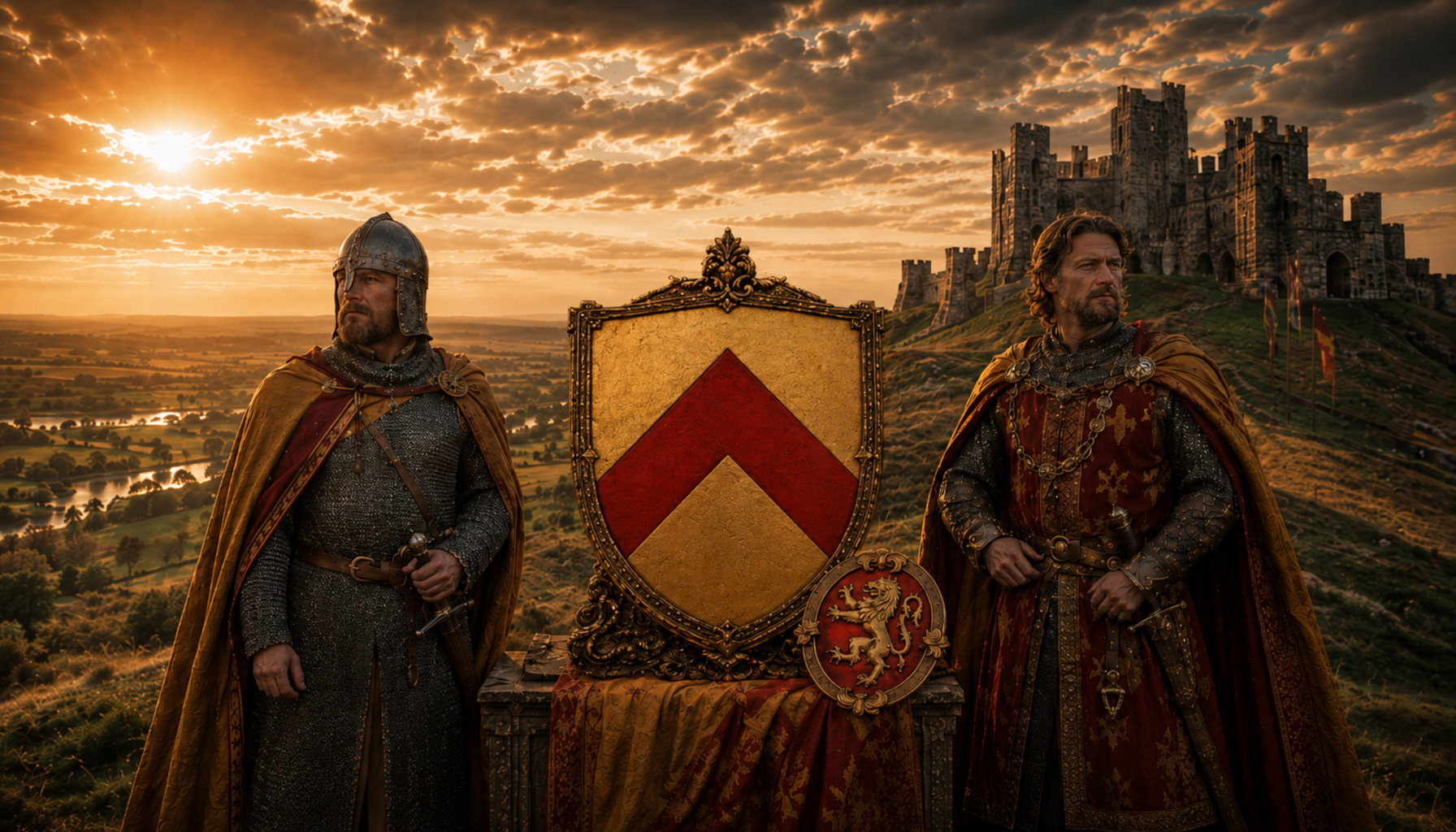
What makes the Staffords so interesting is that they are almost a textbook example of how a Norman family became thoroughly woven into English history. From a fortified base and a county identity, they rose through landholding, royal favour, military service, and ambitious marriage into the front rank of the aristocracy. Their arms, a gold shield with a red chevron, became a familiar badge of noble authority. Over time the family held titles including Baron Stafford, Earl of Stafford, and Duke of Buckingham, and its members moved through the dangerous world of Plantagenet and Tudor politics. Ralph de Stafford, 1st Earl of Stafford (1301-1372), helped carry the family into the higher nobility; Humphrey Stafford, 1st Duke of Buckingham (1402-1460), stood at the heart of the Wars of the Roses; and Edward Stafford, 3rd Duke of Buckingham (1478-1521), met the classic Tudor fate of a magnate who stood too close to the throne and lost his head for it.
Read more about the House of Tosney
The family's great location anchor was Stafford Castle, just west of the town of Stafford in Staffordshire, and it is exactly the sort of place that explains medieval power better than a dozen charters. The original castle was established soon after the Norman Conquest as a motte-and-bailey stronghold, commanding the surrounding landscape and asserting the new order in a region that had just been folded into Norman rule. It was rebuilt in stone in the later twelfth century, then damaged and reshaped over centuries of conflict, neglect, and revival. The visible remains today include substantial earthworks and surviving masonry, while the nineteenth century also saw a Gothic revival reconstruction on the site, giving visitors that wonderfully layered experience so common in British heritage: Norman foundations, medieval ruin, and Victorian reimagining all stacked together in one place. It still stands as the symbolic heart of the family story, and yes, it can still be visited today as a heritage site, making it one of the most tangible ways to meet the Stafford past face to face.
From an ancient DNA perspective, the Stafford haplogroup link to E1b1b1a1b1a10a2 connects the family, at least in a broad paternal-line sense, with a scattered but fascinating set of ancient and medieval samples across central and eastern Europe. Related or linked examples include Avar Elite Hungary Rakoczifalva (RKC041), Goth Maslomecz (PCA0110), Piast Dynasty Greater Poland Poznan Srodka Lad (PCA0255), Medieval Poland Konskie Sub Carpathia (PCA0306), Thuringii Tribe Germany Obermoellern (OBM013), Migration Period Germany Rathewitz Saxony-Anhalt (RTW003), Principality of Halych-Volhynia Ukraine Korolivka (KRW002), Medieval Slav Avar Slovakia Cifer-Pac (CGG018923), Roman Slovakia Danube Gerulata (CGG021935), and Dark Ages Breclav-Libiva Czech (LIB11). These do not prove direct descent from any one ancient individual, of course, but they do show that the haplogroup belongs to a much older and wider human story than the medieval records alone can tell.
Explore the Piast dynasty DNA story
If you are exploring the Stafford family in your own tree, this is where history becomes properly exciting: not just names on parchment, but castles, conquest, dynastic ambition, and genetic echoes reaching far beyond medieval England. Upload your DNA to MyTrueAncestry to see whether you match the Stafford family or any of the related ancient DNA samples linked with E1b1b1a1b1a10a2.
Comments