The Spencer Family
– 3 min read


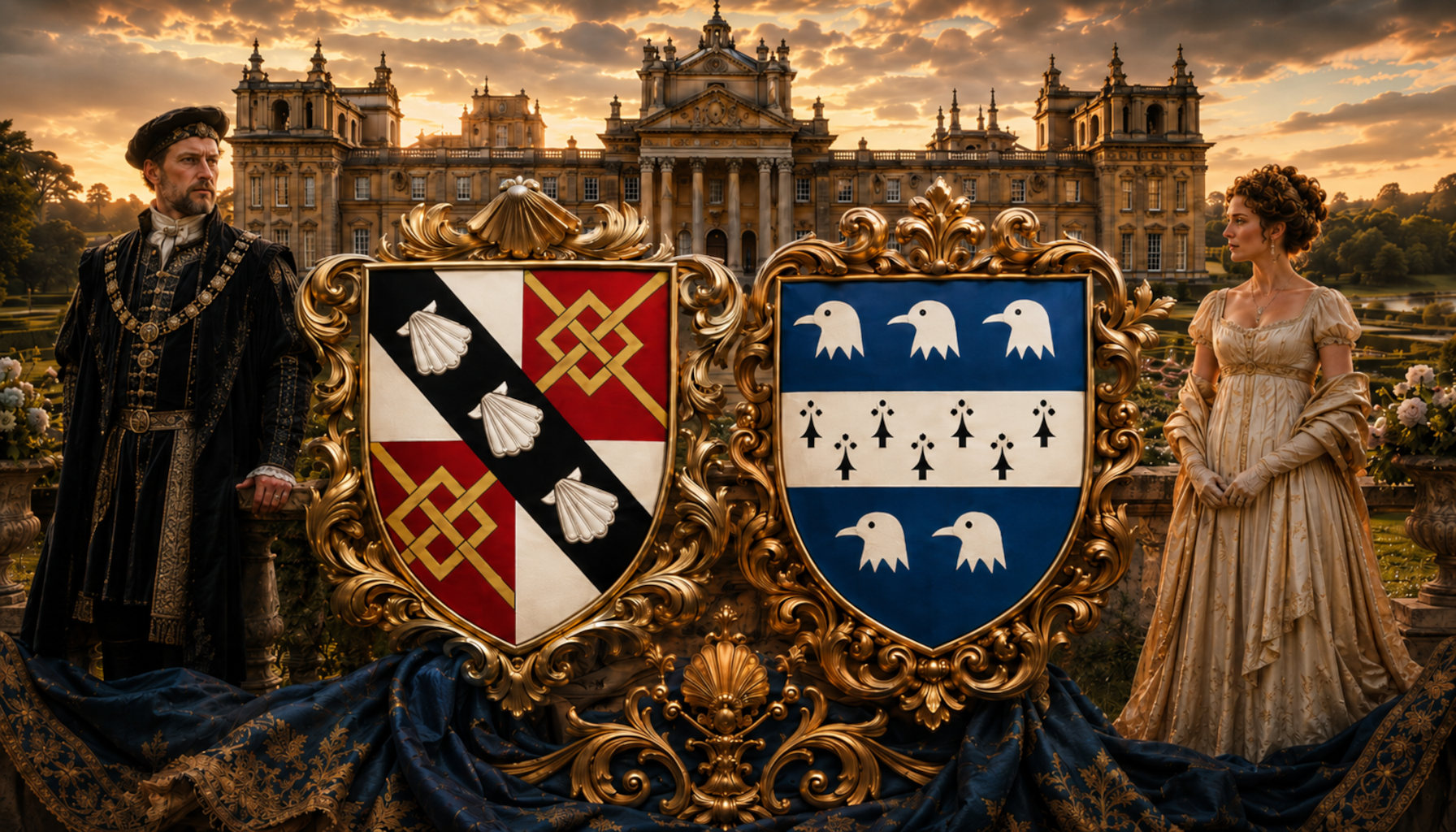
The Spencer family was one of the great aristocratic houses of England, but its story did not begin in a mist of ancient ducal grandeur. It began much more concretely in the English Midlands, with the Spencers of Northamptonshire and Warwickshire, in the late medieval and Tudor world of land, sheep, rents, and careful estate management. Their primary family haplogroup is tagged here as E1b1b1a1b1a10c, a lineage label that adds a genetic thread to a family better known from title deeds, heraldry, and palaces. Historically, the Spencers rose not because they were always grand, but because they were exceptionally good at becoming grand.
The key figure in that rise was Sir John Spencer, whose success in livestock, landholding, and rural business laid the foundations of the fortune. By purchasing Wormleighton Manor and Althorp, he turned agricultural wealth into dynastic permanence. The family was granted an early coat of arms in 1504, described as an ermine fess between six sea-mews heads, before later adopting the more famous arms associated with a claimed Despencer connection. From there the Spencers moved steadily upward into the upper reaches of English society, producing barons, earls, dukes, courtiers, soldiers, parliamentarians, and royal relations. Among the notable figures are John Spencer of 1522, part of the family's crucial Tudor consolidation, Sir John Spencer of 1586, who stood within the mature landed power of the house, and, in modern memory, Lady Diana Spencer (1961-1997), whose life carried the Spencer name into global public consciousness.
Explore the Noble House of Churchill
If one place sums up the Spencer story, it is Althorp in Northamptonshire. Acquired in the early 16th century, it became the enduring seat of the Earls Spencer and the emotional as well as political center of the family. What makes Althorp so revealing is that it is not simply a grand country house floating above history; it is the built result of generations of accumulation, rebuilding, collecting, and self-fashioning. The house developed over centuries, with important Tudor roots and later architectural changes, surrounded by an extensive parkland landscape. It holds a major picture collection, a long ancestral gallery, and the family chapel and burial associations that turned estate into dynasty. It is also famously associated with the memory of Diana, Princess of Wales, who was buried on an island in the Oval Lake within the grounds. Althorp remains one of those English houses where the social history of landownership, politics, taste, and family memory all sit together in the same landscape. And yes, Althorp can still be visited by the public during seasonal opening periods, which makes it not just a name in a pedigree but a real historic place people can still encounter.
Read more about The House of Seymour
With the Spencer family tagged to haplogroup E1b1b1a1b1a10c, the interesting thing is not to claim some neat straight-line descent from any one ancient burial, because the evidence does not support that. Rather, it is to notice how this lineage appears in a striking spread of related ancient DNA samples across Europe and the Mediterranean. These linked samples include Medieval Sicily at Teatro di Segesta (SGBN10), Late Imperial and Imperial Roman Serbia from Timacum and Viminacium such as I15553, I15554, I15544, I15504, I15507, I15513, I15518, I15490, and I15525, Migration Period and Avar-era Hungary at Rakoczifalva including RKC041, RKF026, and RKF027, Dark Ages Italy in South Tyrol (2425), Merovingian Bavaria (Alh_154), Piast dynasty and medieval Polish contexts such as PCA0400 and PCA0255, Saxon-period England at Eastry in Kent (EAS006), Viking Age Denmark (VK362), Iberian Cordoba Caliphate sample I7498, and even Late Medieval Rome at Cancelleria Basilica (R1219). What that tells us is not that the Spencers came from Sicily, Serbia, Hungary, Kent, and Denmark all at once, but that their haplogroup belongs to a much older and far wider historical tapestry, one that passed through Roman frontiers, post-Roman kingdoms, medieval courts, and migration-period communities long before the Spencer name appeared in English records.
Explore Medieval Sicily's Multi-Faith Genetic History
The Spencer family story is a wonderfully English tale of social ascent: sheep and estate books turning, over generations, into coronets, palaces, and national memory. But DNA adds another layer, connecting family history to much deeper human movement across Europe and the Mediterranean. If you want to see whether your own DNA matches the Spencer family or any of these related ancient DNA samples, upload your results to MyTrueAncestry and start exploring where your past may lead.
Comments