The House of Seymour
– 3 min read


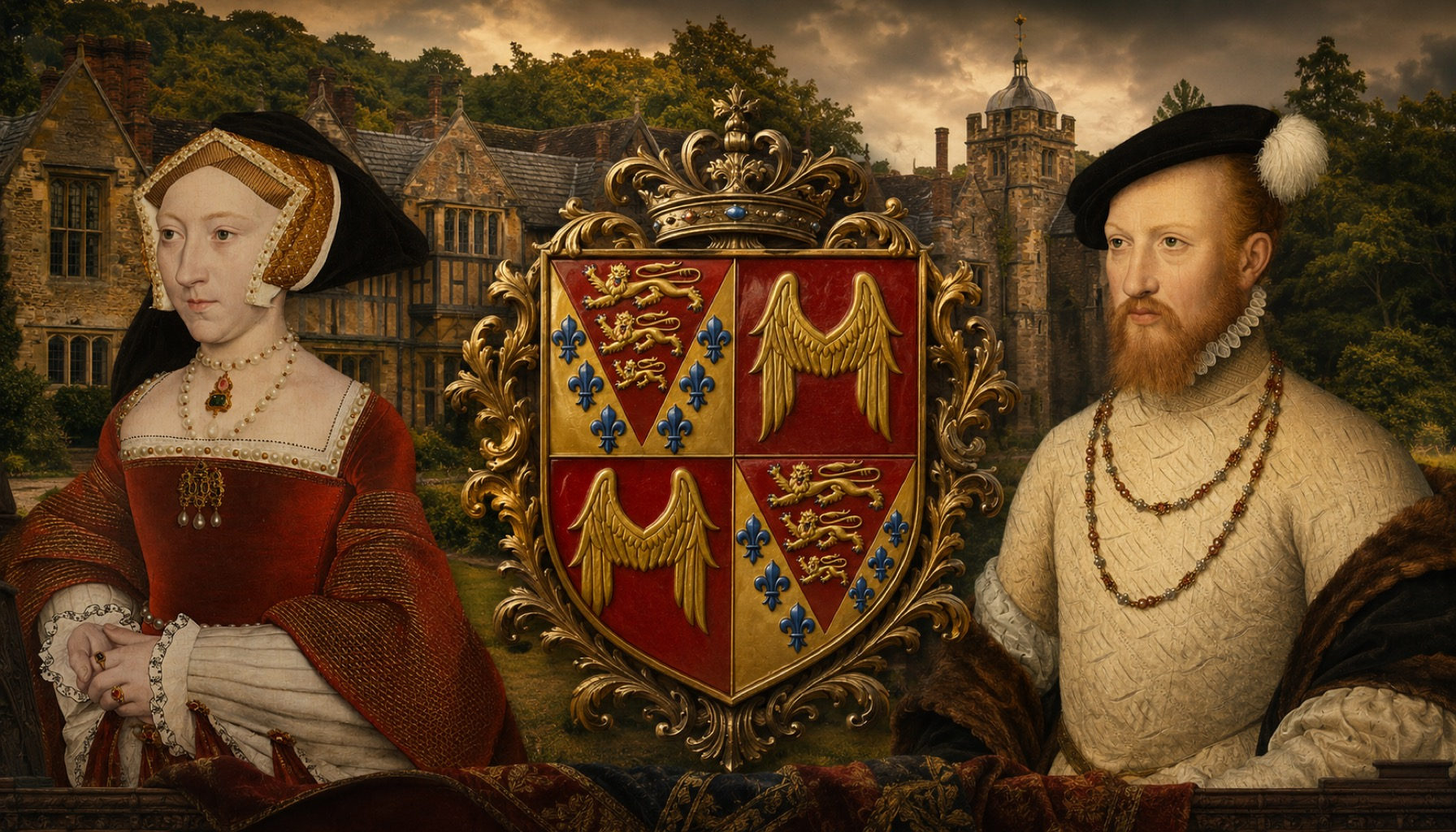
The House of Seymour was one of the great noble families of Tudor England, a lineage whose fortunes rose dramatically through royal service, careful marriage, and that most dangerous of all privileges, closeness to the crown. Associated here with the haplogroup R1b1a1b1b3a1a, the Seymours emerged from an older family often written as St Maur, a name reflecting their Norman background after the Conquest. Like so many English aristocratic houses, they were not simply "there" from time immemorial; they were made, remade, and advanced through landholding, court access, and the shifting politics of medieval and early modern England.
The family's deeper roots are commonly traced to the St Maur line, with figures such as William St Maur standing in that earlier world of marcher lordship, regional influence, and feudal connection. By the late 15th and early 16th centuries, the family had become firmly embedded in the western English gentry and noble landscape. Sir John Seymour (1474-1536), of Wulfhall in Wiltshire, was a particularly important link in this story: a well-placed courtier and soldier whose daughter Jane Seymour would become the third wife of Henry VIII and the mother of Edward VI. That marriage brought astonishing advancement. The Seymours gained titles, most famously the dukedom of Somerset, and became central players in government, military command, and court faction. But Tudor favour was never safe for long. Their story is therefore not just one of ascent, but of exposure: the House of Seymour shows exactly how royal connection could make a family and imperil it at the same time.
Read more about the House of Neville
One of the most atmospheric places tied to the Seymour story is Berry Pomeroy Castle in Devon, a site that feels almost designed to remind visitors that aristocratic history is never neat. The estate began as a medieval castle of the Pomeroy family, probably from the late 15th century in its surviving stone form, set above a deep wooded combe near Totnes. In the 16th century it passed to the Seymours, and it was they who transformed it with ambitious residential additions, trying to turn an old fortress into something grander and more fashionable. The result is a magnificent hybrid: part medieval stronghold, part Tudor great house, and part ruin. The Seymour phase is especially revealing, because it shows the family not merely as court figures in velvet sleeves hovering around Henry VIII, but as estate-builders expressing status in stone, landscape, and architecture. Today Berry Pomeroy Castle is a celebrated ruin, long associated with local legend as well as documented history, and it can still be visited, making it one of the best surviving places to sense the world in which the Seymours projected their power.
From a DNA perspective, the primary family haplogroup linked here is R1b1a1b1b3a1a, a branch within the broad R1b paternal landscape that appears across a striking spread of ancient and medieval contexts. That does not mean the Seymours descend directly from any one excavated individual, and it is important not to pretend otherwise. What it does mean is that related or linked R1b1a1b1b3a1a-associated samples help place the family within a much wider Eurasian paternal story. Examples include Medieval Northern Spain Las Gobas (ldo263), Medieval Sicily Teatro di Segesta (SGBN22), Roman Era Cambridge Vicars Farm (VIC004), Medieval Croatia Gornji Kosinj Saint Ana (I35014), Late Roman Trogir Dragulin Croatia (I26718), Early Bronze Age Bulgaria Boyanovo (BOY009), Medieval Hungary Carolingian Empire Zalavar Varsziget (AHS23, AHS07, AHS22), Afanasievo Elo Altai Republic Russia (I5269), Merovingian Period Frankish Moemlingen Germany (Mln43), Late Roman Frontier Straubing Azlburg Germany (STRAZ_I_11, STRAZ_I_14), Early Bronze Age Russia Samara Yamnaya (I0231), Afanasievo Karasuk Khakassia Russia (I3952), Medieval Ibiza Al-Andalus (ldo131), Migration Period Outlier Hungary Rakoczifalva Szolnok (RKF245), Iron Age Pommerania Gdansk Wielbark (PCA0475), Piast Dynasty Poland Santok Lubusz Province Gorzw Wielkopolski (PCA0516), Migration Period Roman Saxony-Anhalt Bruecken (BRC005x), Hungarian Conqueror Commoner Nagytarcsa-Homokbanya (NTH-1), Early Medieval Croatia Velim-Velistak (VEM038), Phoenician Era Mozia Sicily (I24680), Early Medieval France Burgundy Camp du Chateau (CGG023657), Neolithic Pre-Ural Steppe Yamnaya Ekaterinovka (I0231a), Dark Ages Hungary Gothic Tribe Csongrad-Berzsenyi utca (CSB-3), Merovingian Grave North Rhine-Westphalia Germany Alt-Inden (IND014), Late Roman Era Emona Slovenia (R10478), Bronze Age Mala Ohrada CWC Central Bohemia (I13467), Avar Elite Early Medieval Hungary (I16759), Early Medieval Visonta Nagycsapas North Hungary (I16752), Early Bronze Age Bell Beaker Molenaarsgraaf Netherlands (I13026), Iron Age Hallstatt Lovosice NW Bohemia (I14983), Iron Age Vas County Hungary (I4996), Post Medieval Plague Victim Ellwangen Germany (ELW028), Early Bronze Age Lower Tyumechin Afansievo Culture (I5273), Early Bronze Age Elo bashi Afansievo Culture (I5277), Medieval San Lorenzo Foggia Italy (VK535), and Scythian Southern Moldova (scy305). In other words, the Seymour-linked haplogroup sits within a very old and far-travelled web of paternal ancestry stretching from Bronze Age steppe horizons into Roman, medieval, and early modern Europe.
Explore Roman and early medieval Britain DNA
If the Seymours catch your imagination, that is because they embody one of the great English historical patterns: local roots, Norman inheritance, Tudor opportunity, and the constant risk of court politics. Uploading your DNA can help you see whether you match the House of Seymour, share signals with the linked haplogroup R1b1a1b1b3a1a, or connect more broadly with related ancient DNA samples from Britain and across Europe.
Comments