The Sewell Family
– 3 min read


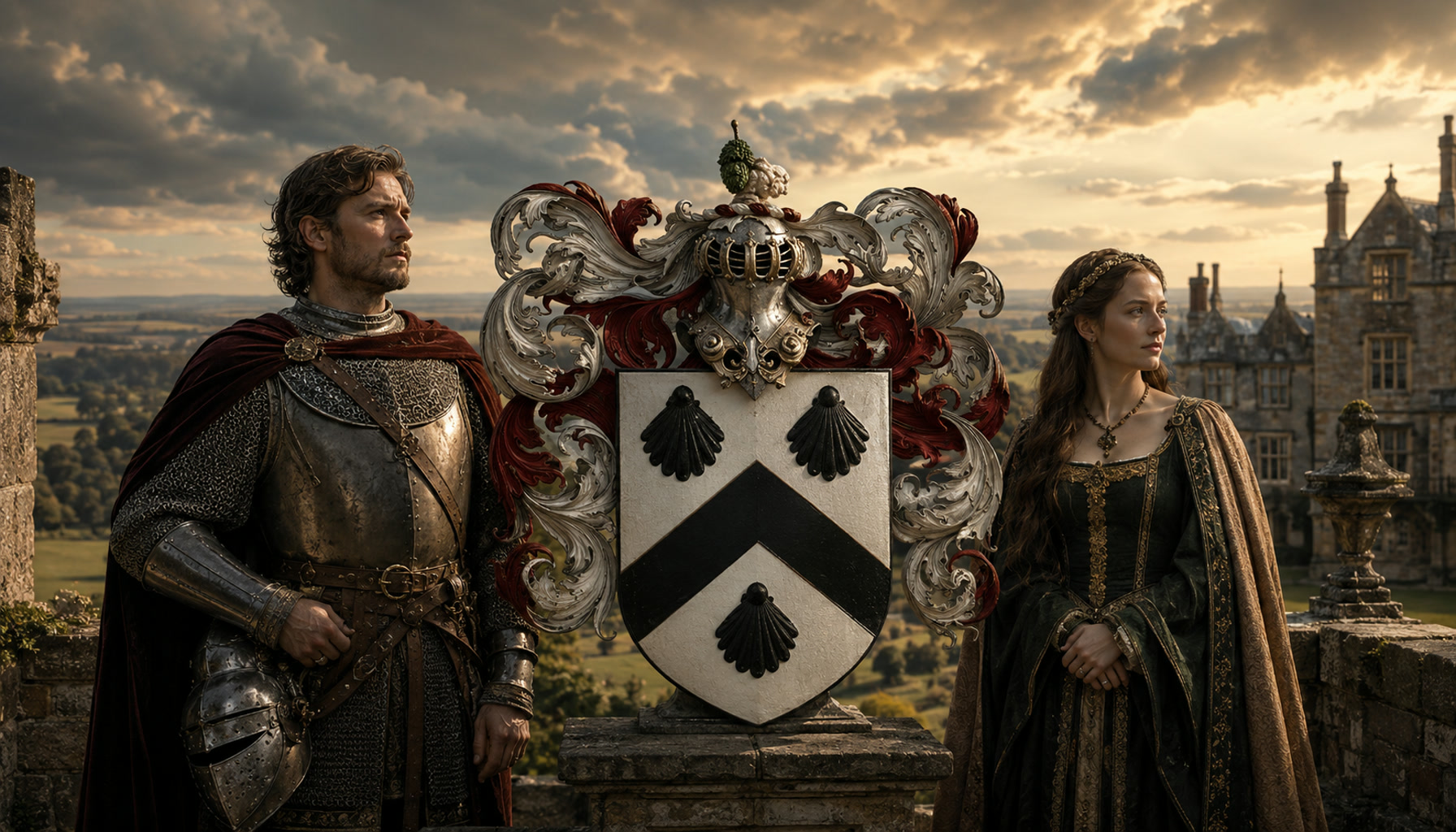
The Sewell family was one of those durable English and later British families whose story is less about a single great princely house and more about the long, steady business of service, literacy, office, and reputation. Their roots lie in medieval England, where the name appears in forms shaped by local spelling habits and Norman-influenced record keeping, including Girart de Sevele in 1180. Over time, Sewell lines became associated with parish life, church service, legal work, education, civic duty, landholding, and the wider machinery of the British world. The primary family haplogroup linked here is R1b1a1b1a1a2c1a, a branch within one of the most widespread paternal lineages in western Europe.
What makes the Sewell family historically interesting is precisely that they reflect a very recognisable British pattern: not royal conquerors, but educated service families who rose and endured through learning, administration, marriage, clerical office, and public responsibility. That is the sort of family history the records preserve particularly well: wills, heraldry, parish registers, university ties, legal notices, and memorial inscriptions. By the early modern and colonial periods, the name had travelled widely, and one of its best-known bearers, Samuel Sewall (1652-1730), became a prominent figure in New England as judge, diarist, and public man. The Sewell story, then, is both local and expansive: rooted in English soil, yet drawn outward by empire, religion, law, and print.
Read more about the Paston Family
A good location anchor for the wider Sewell world is Ettington Park in Warwickshire, near Stratford-upon-Avon, a landscape that feels almost theatrically English and deeply layered with status, inheritance, and country-house culture. The present house known as Ettington Park Hotel stands on the site of an older estate associated above all with the Shirley family, and the Victorian rebuilding gave it the striking neo-Gothic form visitors recognise today, with turrets, limestone frontage, and a deliberate air of ancestral drama. This matters for families like the Sewells because such estates were not merely grand residences; they were hubs in the social geography of Britain, places tied to land, marriage alliances, clerical patronage, county administration, and the world of educated gentry in which service families often moved. Ettington Park still exists today as a historic hotel and can be visited, which gives modern family historians something rare and valuable: the chance to stand in a landscape that still conveys the atmosphere of the institutional and landed world in which many British families built their reputations.
Explore the House of Cavendish
From a genetic-history perspective, the Sewell family's tagged paternal line, R1b1a1b1a1a2c1a, belongs to a broad western European story stretching back through Britain and the continent. Ancient DNA samples linked or related to this haplogroup appear across a remarkably wide map and timespan: Roman Era England at Knobbs Farm Somersham (KNF006), Roman Era Fenstanton Cambridgeshire (FEN008), Roman Era Cambridge Vicars Farm (VIC016), Medieval England Cambridge St Johns Hospital (ATP_PSN_192 and ATP_PSN_68), Medieval England Augustinian Friars (ATP_PSN_512 and ATP_PSN_520), and Late Medieval Clopton Cambridgeshire (ATP_PSN_1217). Beyond England, related examples include Medieval and Dark Ages Las Gobas in northern Spain such as ldo066, ldo037, ldo048, ldo062, ldo039, ldo052, and ldo242, as well as elite Celtic burials from Germany like Asperg-Grafenbuehl (APG001, APG003) and Ludwigsburg Roemerhuegel (LWB001). There are even deeper prehistoric echoes in Bell Beaker and Bronze Age contexts in Britain and continental Europe. None of this proves direct descent from any one ancient individual, of course; what it does show is that the Sewell paternal signature sits within a very old network of lineages tied to the making of Celtic, Romano-British, early medieval, and later medieval western Europe.
Explore Roman and Early Medieval Britain DNA
If you are researching the Sewell family, this is exactly where documentary history and DNA can become wonderfully entangled. A surname like Sewell lives in parish books, wills, old university records, court papers, colonial archives, and heraldic memory, but it may also sit beside much older genetic links reaching back into Roman Britain, medieval England, and the wider western European past. Upload your DNA to MyTrueAncestry to see whether you match the Sewell family network or any of the related ancient DNA samples connected with R1b1a1b1a1a2c1a.






Comments