The Princely House of Tsitsishvili
– 3 min read


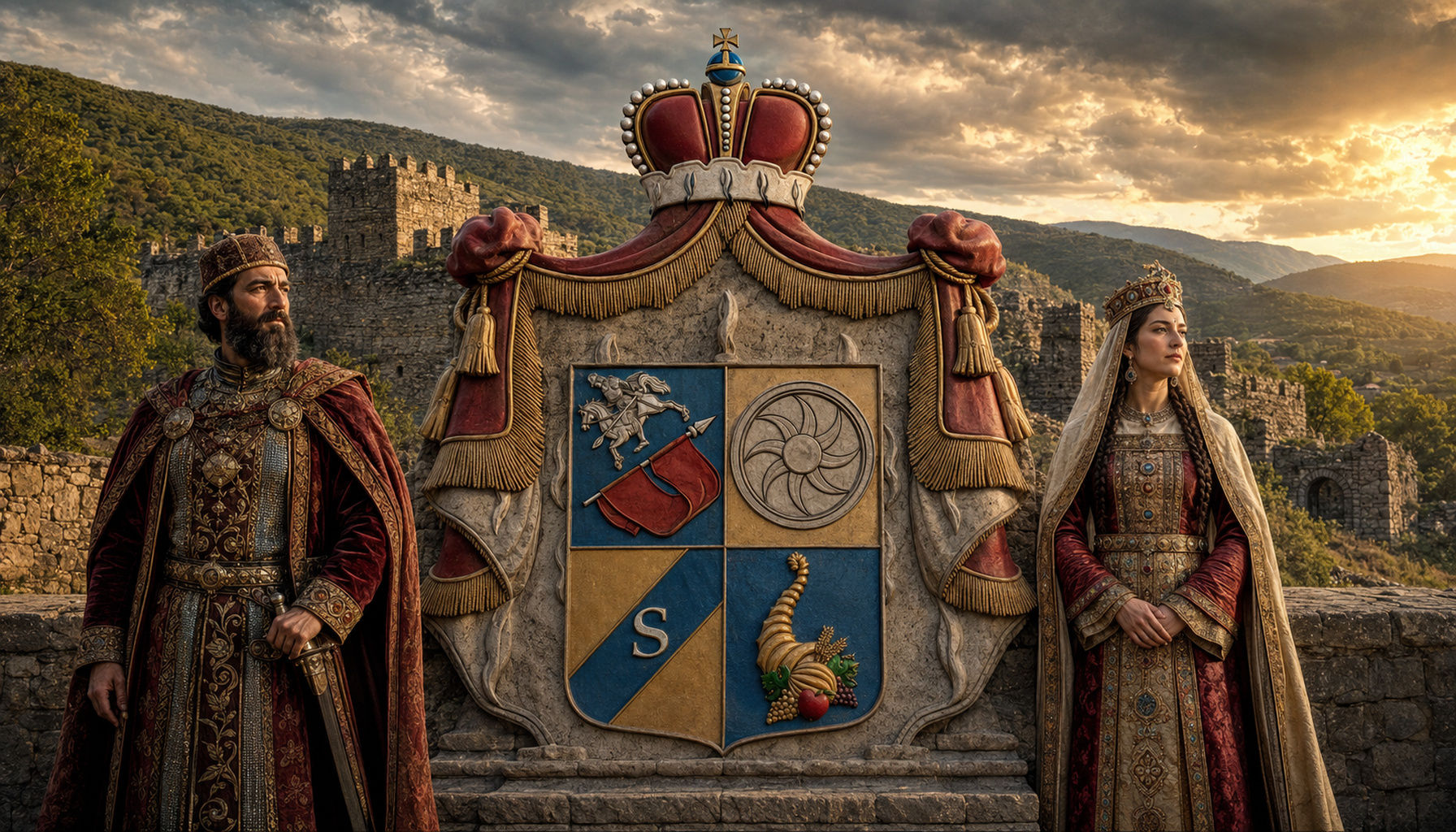
The Tsitsishvili family was one of the princely houses of Georgia, rooted above all in Kartli and shaped by the long aristocratic traditions of the Caucasus. In the world they inhabited, a prince was not simply a grand surname on a document. He was expected to serve a king, defend land, manage estates, command retainers, and hold his place inside a dense web of noble alliances and rivalries. The primary family haplogroup associated here is I2c2b2, linking the story of this house not only to Georgian history but also to the deeper paternal branches traced through ancient DNA.
The family emerged from a landscape where kingship, frontier war, and noble memory all mattered intensely. Georgia was never isolated: Kartli stood in the path of Persian influence, Ottoman pressure, and later Russian imperial expansion, while its noble houses balanced loyalty, ambition, and survival. The Tsitsishvili line fits that classic Georgian princely pattern rather well, with regional authority, military service, heraldic identity, landed power, and a stubborn continuity of status across changing empires. Figures linked to the wider family tradition include Zachariah of Panaskerti, the learned churchman and intellectual; Prince Zaza I Panaskerteli, remembered as a notable aristocratic figure in late medieval Georgia; and Pavel Tsitsianov, born in 1754 and dead in 1806, the imperial general whose career shows how Georgian noble lineages could be drawn into the service of expanding Russia while still carrying the prestige of their native house.
Explore South Caucasus genetic history
A particularly tangible anchor for the family is Tsitsishvili Castle, also known as Tsitsishvilebis Tsikhe-Darbazi, a fortified noble residence associated with the house and its regional standing. It is the sort of place that reminds us that aristocratic history is not abstract. These families lived in defensible homes that were also symbols of rank, authority, and continuity. The complex is known for its castle-hall character, combining residence and fortification in a way that is very typical of the political realities of old Georgia, where noble power had to be displayed and defended at the same time. As described in Georgian heritage and travel material, the site still stands as a visible remnant of the Tsitsishvili legacy, and yes, it can reasonably be described as visitable today for those interested in Georgia's noble past and architectural heritage.
Read about the Royal House of Karadorde
For the DNA side of the story, the key tag here is Haplogroup I2c2b2. That does not mean we can jump from ancient graves straight to the Tsitsishvili pedigree and declare direct descent; history is never that tidy, and genetics should not be forced into fairy tales. What we can say is that related or linked I2c2b2-associated ancient samples help place this paternal line in a much deeper human timeline. Among those linked samples are several Alemanni burials from Basel-Waisenhaus in Switzerland, including Grave 9 individuals KH201125, KH201125a, KH201125b, and KH201127, as well as Grave 0 individual KH201110. Going further back, related examples include the Neolithic Kanaljorden Motala sample I0012 in Sweden, Neolithic Altendorf sample AD186 in Baden Wuerttemberg, Bronze Age Drasenhofen sample DSH020 in Austria, and Bronze Age Esperstedt sample I0116 in Germany. These do not prove a family tree for the Tsitsishvili house. What they do offer is a glimpse of the long and winding prehistoric and early historic background of one paternal lineage that later appears in noble family contexts.
Read more on ancient DNA and archaeogenetics
The Tsitsishvili story is a reminder that noble houses are made from more than titles. They are made from places, service, ambition, memory, and survival across centuries of upheaval. If your own family history reaches into Georgia, the Caucasus, or the wider aristocratic world of eastern Europe, uploading your DNA can help you see whether you match the Tsitsishvili family line or any of the related ancient DNA samples linked with haplogroup I2c2b2.


Comments