The Royal House of Karadorde

– 3 min read


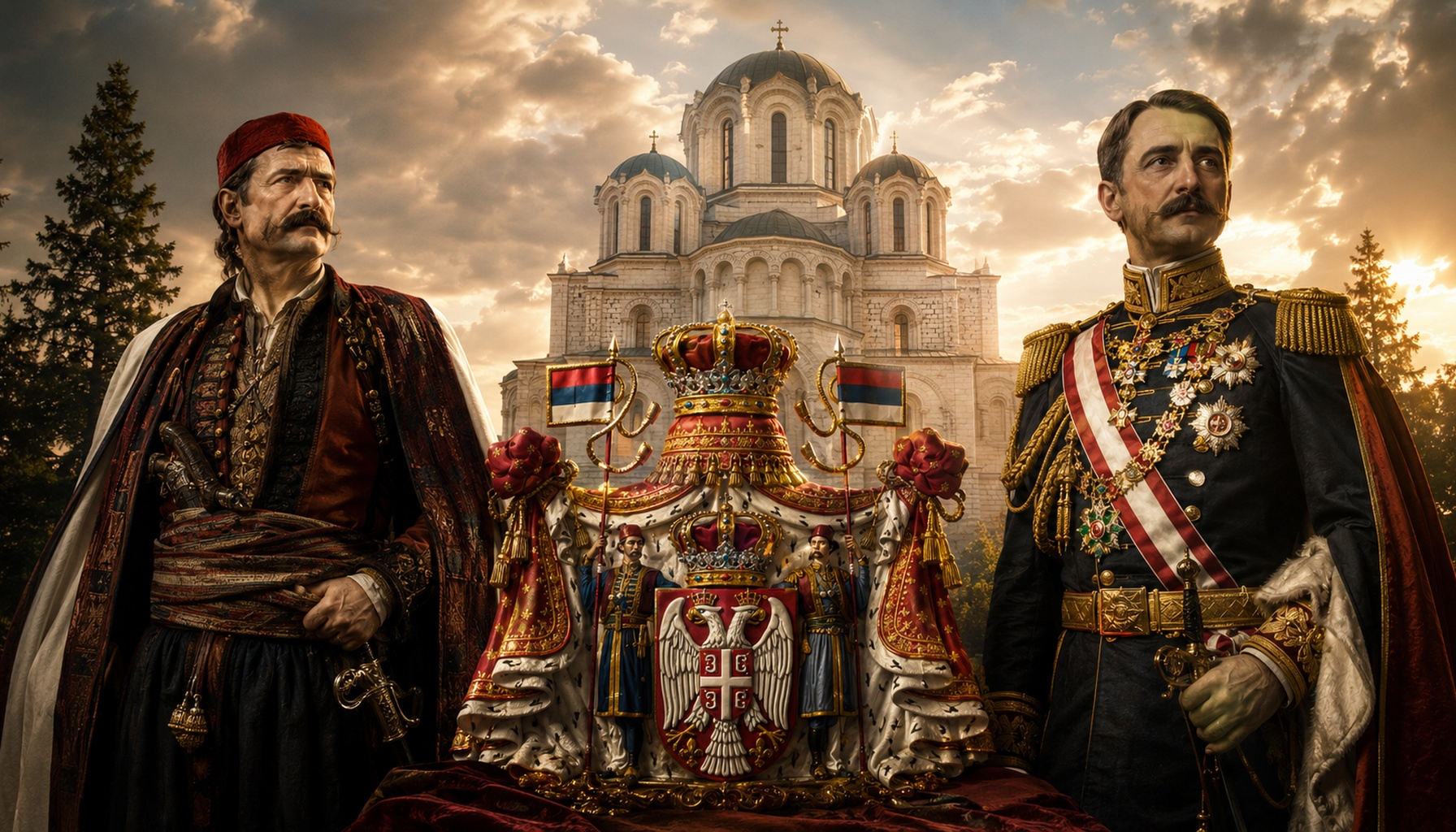
The Royal House of Karadorde was the Serbian ruling house descended from Dorde Petrovic, better known as Karadorde (1768-1817), the great insurgent leader of the First Serbian Uprising against Ottoman rule. In origin this was not an ancient court dynasty formed in some misty medieval palace, but a family that rose out of the hard political and military world of the central Balkans, especially the Sumadija region of Serbia, at a moment when Ottoman authority was being challenged by local elites, peasant fighters, and ambitious national leaders. The haplogroup linked here with the family is I2a1a2b1a1, a lineage often associated with deep Balkan and South Slavic paternal history.
That is what makes the Karadordevic story so compelling. It is, in a sense, the classic Balkan royal-house pattern: rebellion first, monarchy second. Karadorde himself became a symbol of liberation, while his descendants turned that insurgent legitimacy into dynastic authority. Across the nineteenth and twentieth centuries, the house stood at the center of Serbian state formation, constitutional change, military leadership, and the long rivalry with the Obrenovic dynasty. Named figures such as Dorde Petrovic, King Peter I of Serbia (1844-1921), and King Alexander I of Yugoslavia (1888-1934) each mark a different chapter in that transformation, from anti-Ottoman revolt to kingship, and from a Serbian kingdom to the larger and more fragile experiment of Yugoslavia.
Explore the Royal House of Petrovic-Njegos
A particularly vivid location connected with the dynasty is Beli dvor, the White Palace, in the Royal Compound in the Dedinje area of Belgrade. Built between 1934 and 1937 for King Alexander I and completed under the supervision of Prince Paul after the king's assassination, it became one of the principal residences of the Karadordevic family. Architecturally it is a refined neo-Palladian building, with interiors shaped by both royal taste and the interwar desire to present Yugoslavia as a modern European monarchy with deep cultural confidence. The palace is known not only for its elegant facade and ceremonial rooms, but also for its art collections, library, and place within the wider royal complex alongside the Royal Palace. In historical terms, Beli dvor is a reminder that the Karadordevic dynasty had moved a very long way from the uprising camps of early nineteenth-century Serbia to the cultivated, image-conscious monarchy of the twentieth century. It is also a place that can still be visited through organized tours of the Royal Compound, which makes it one of the more tangible surviving anchors of the family's public memory.
Read about the Royal House of Basarab
From a DNA perspective, the primary family haplogroup tag here is I2a1a2b1a1. We should be careful, though, because ancient DNA does not let us simply draw a neat arrow from a Bronze Age burial to a modern royal family. What it does show is a broader web of related or linked paternal lineages appearing across eastern, central, and southeastern Europe over long stretches of time. Among the relevant I2a1a2b1a1-linked samples are HUASper85 from the Hungarian Nobility Gothic Vault Royal House of Aba Benedictine Monastary, PER02 from the medieval Hungarian Bathory male nobility at Pericei, PIE078 from Early Bronze Age Romania at Giurgiu Pietrele Magura Gorgana, YUN037 and YUN038 from Early Bronze Age Yunatsite in Bulgaria, AHPS103 from Arpad Period Visegrad Sibrik domb I Esperesi, AHPS118 from medieval Hungary at Sarbogard-Tringer tanya, I10479 from Bronze Age Romania's Moneoru Culture at Arman Carlomanesti, PCA0521 and PCA0565 from Piast-era Poland, NDW076 and the Obermoellern western Slav samples OBM028, OBM043, OBM045, OBM029, and OBM031 from Germany, TOR003 and TOR004 from early medieval northern Croatia, VEM018, VEM052, VEM001, and VEM007 from early medieval Velim-Velistak in Croatia, CGG021918 from migration-period Hungary, AHS54 and AHPS202W from medieval and Carolingian-era Hungary, I19454 from Bronze Age Bulgaria at Tell Kran Yasanovo, VK542 linked to Gleb Svyatoslavich of the Rurik line, and K2per16_GE and K2per52 from Hungarian conqueror contexts. These are best understood not as proven ancestors of the Karadorde house, but as part of the wider historical landscape in which this paternal lineage appears among Balkan, Slavic, and neighboring populations.
Explore the Piast rulers and DNA
The Karadorde family sits at that fascinating point where family history becomes national history: revolt, kingship, exile, memory, and symbolism all tangled together in one lineage. If your own ancestry reaches into Serbia, the Balkans, or the wider South Slavic world, uploading your DNA can help you see whether you match the Karadorde family line or any of these related ancient I2a1a2b1a1-linked samples from Hungary, Croatia, Bulgaria, Romania, Poland, and beyond.



Comments