The Princely House of Kastrioti

– 2 min read


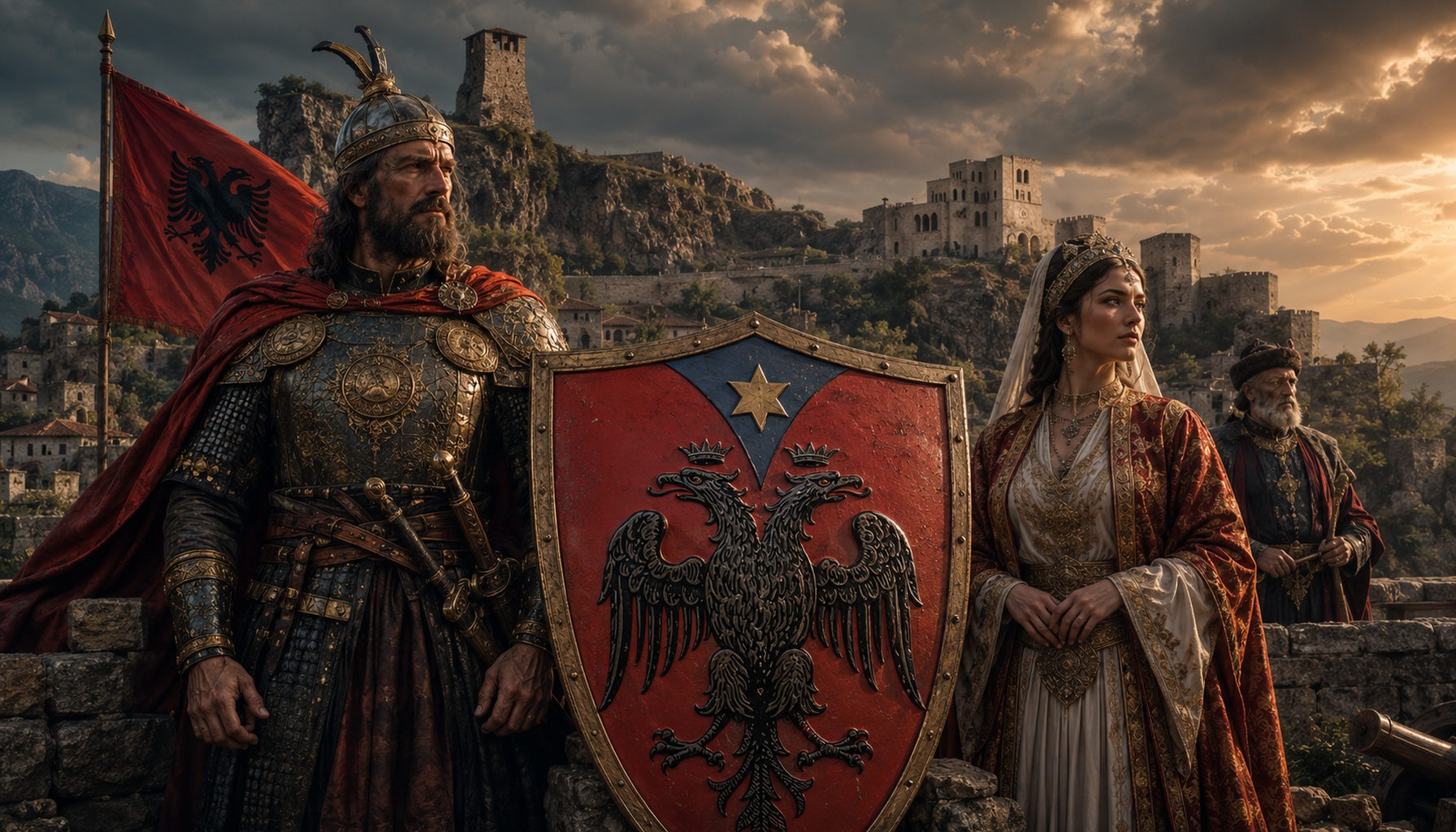
The Kastrioti family was one of the great historic noble houses of Albania, rooted in the western Balkans and remembered above all through George Kastrioti Skanderbeg. In both history and memory, they stand for princely authority, military leadership, and the defense of Albanian lands during the great age of Ottoman expansion. The haplogroup linked here with the family is E1b1b1a1b1a6a1e, a branch with a wider Balkan and Mediterranean story behind it. As with so many frontier dynasties, the Kastrioti name was shaped not in a quiet courtly world, but in a hard landscape of shifting loyalties, fortified hills, and powerful neighboring empires.
The family emerged from medieval Albania, in a region where local lords had to balance survival with ambition under Byzantine, Serbian, Venetian, and later Ottoman pressure. That is the real texture of the Kastrioti story: not just banners and battles, but the daily politics of a borderland. Konstantin Kastrioti is mentioned in the late 14th century, around 1390, and by the 15th century the line had become inseparable from Skanderbeg (1405-1468), whose long resistance turned a noble surname into a national symbol. The Kastrioti inheritance includes arms, strongholds, heroic tradition, and a reputation that long outlived the medieval principality itself.
Read more about the Royal House of Karadorde
No place anchors the Kastrioti story more vividly than the Castle of Kruje in central Albania. Perched high above the surrounding plain, the fortress was not merely a residence but a strategic stronghold commanding approaches inland from the Adriatic. Its history stretches back well before Skanderbeg, with earlier fortifications on the site and a long life through medieval and Ottoman periods, but it became world-famous because Kruje served as the center of Skanderbeg's resistance. The Ottomans besieged it more than once, and that is really the point: this was a castle tested by history, not invented by later romance. Within its walls stood the political and symbolic heart of Kastrioti power, and from here the family became attached to one of the most enduring resistance stories in Balkan history. The castle area, its museums, and surviving fortifications can still be visited today, which gives the Kastrioti legacy an unusually tangible presence for modern travelers.
Explore deep Balkan roots in Albanian ancestry
From an ancient DNA perspective, the family's linked haplogroup E1b1b1a1b1a6a1e fits into a broader historical pattern seen across parts of southeastern Europe and beyond. Related or linked samples include Medieval Era Serbia Timacum Kuline Ravna Village (I15537), Post Roman Era Serbia Kormadin Jakovo (I27297), Late Roman Empire Viminacium Serbia Pirivoj Necropolis (I15495), Migration Period Roman Outlier Germany Saxony-Anhalt Bruecken (BRC043x), Otyrar culture Konyr Tobe (KNT001), and Late Medieval Duomo San Nicola Sardinia (SNN001). These do not prove direct descent from the Kastrioti line, and it would be wrong to pretend otherwise, but they do show how this paternal branch appears across a wide historical landscape connected by mobility, empire, frontier zones, and the long entanglement of Balkan, Mediterranean, and Eurasian populations.
Read more about the Royal House of Hunyadi
If the Kastrioti story speaks to you, the next step is wonderfully simple: upload your DNA to MyTrueAncestry and see whether you match the family story, the E1b1b1a1b1a6a1e line, or related ancient DNA samples from the medieval Balkans and beyond. History is at its best when it stops being abstract and starts feeling personal.

Comments