The Percival Family
– 3 min read


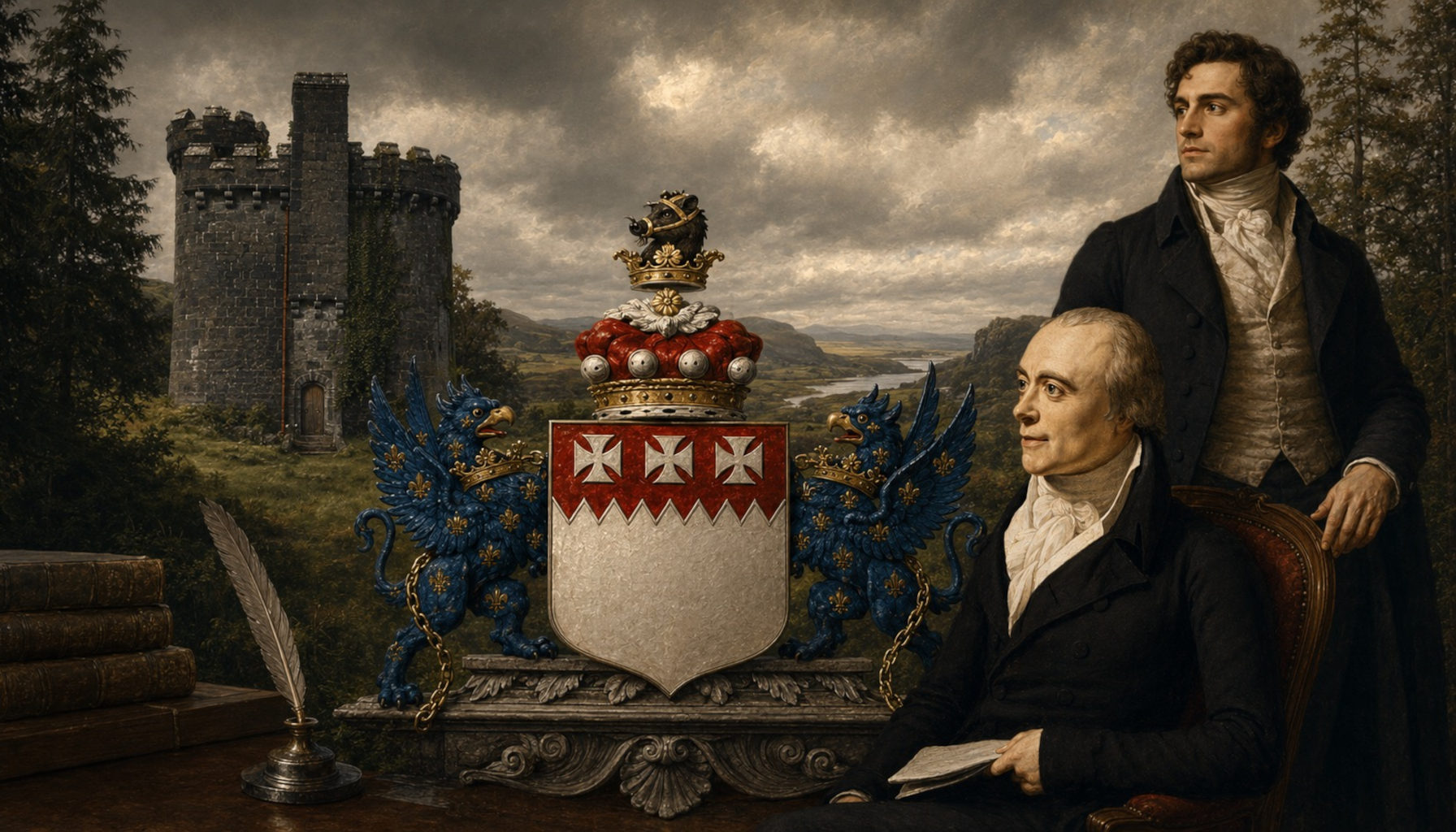
The Percival family was a historic English and later Anglo-Irish noble lineage, rooted in the world of landed society, estate management, public office, and political advancement. Their story begins in England, especially in Somerset, and then broadens into the wider orbit of Britain and Ireland, where the family rose through service, property, and carefully built connections into the peerage as the Earls of Egmont. In genetic tagging terms, the primary family haplogroup linked here is E1b1b1a1b1a2a, a lineage with a remarkably wide and old geographic footprint across Europe and the Mediterranean.
What makes the Percivals interesting is that they are not simply a family of titles dropped from the clouds of aristocratic romance. They belong to the documented machinery of power: law, parliament, local administration, marriage alliances, and the never-ending business of holding and improving estates. The family name itself carries an older literary echo, Percival or Perceval, familiar from medieval chivalric romance, but the historical Percivals were figures of archives, deeds, offices, and inheritance. Among the named figures associated with this history are Richard Percyval, recorded in the 16th century and known in 1550-era contexts, and John Percival, 1st Earl of Egmont (1683-1748), one of the family members who best illustrates their arrival into the upper ranks of the British and Anglo-Irish elite.
A key location anchor for the family is Cannington Court in Somerset, near Bridgwater, a place that helps pin the Percivals to the map rather than leaving them floating in the mist of genealogy. Cannington itself has deep roots as a historic settlement, and the court became associated with the Percival family through their estate interests in the region. The building seen today is largely a substantial medieval and later manor house, much altered over centuries, with a history that reflects exactly the sort of continuity and reinvention one expects from English landed property. It has links to earlier ecclesiastical ownership, later domestic adaptation, and the practical reworking of a manorial site across generations. In other words, it is not merely a grand house: it is a little historical engine room, showing how local power, landholding, and status were anchored in stone, timber, and legal possession. Cannington Court still stands and, in a modern form of afterlife very common to such sites, remains a place that can still be visited under current institutional use and heritage interest, making it one of those rare family landmarks where the paper trail and the physical landscape still meet.
Read more about the Paulet Family
For the haplogroup tag E1b1b1a1b1a2a, the wider ancient-DNA picture is broad, mobile, and rather fascinating. Related or linked samples carrying this lineage or close haplogroup assignments appear across a striking range of places and periods: Medieval Sicily at Teatro di Segesta with SGBN10 and SGBN20, Ancient Ukraine at Deriivka with UKR102, Scythian contexts at Bilsk Poltava with UKR091 and UKR089, Early Iron Age Kartal in Odesa with UKR007, Hellenistic Olbia with UKR152, Migration Period and Avar era burials in Hungary such as RKO016, RKF026, RKF027, KUP021, and RKC003, and Late Roman or Gothic-era individuals from Serbia and the Balkans including R3931, I15553, I15554, I15544, I15504, I15507, I15513, I15518, I15490, I15512, and I15525. There is even an example in medieval England from Cambridge St Johns Hospital, ATP_PSN_27, alongside later and earlier linked cases from Italy, Croatia, Germany, Poland, Belgium, Byzantium, Bulgaria, Crimea, Kent, Denmark, Sicily, and beyond.
That does not mean these individuals were direct ancestors of the Percival family, and it would be quite wrong to pretend otherwise. What it does show is that the haplogroup linked with the Percivals belongs to a deep and wide historical network stretching through Roman frontiers, steppe corridors, medieval towns, Balkan cemeteries, English hospitals, and Sicilian burial grounds. In plain terms, the Percival genetic tag sits within a lineage that has moved through some of the busiest historical crossroads of Eurasia. For a family whose own documentary history is bound up with England, Ireland, governance, and cross-channel mobility, that larger backdrop is a useful reminder that noble pedigrees are only the latest chapter in a much older human story.
Explore Medieval Sicily's Multi-Faith Genetic History
If you are exploring the Percival family, the most interesting next step is to put the paperwork beside the deep past: family trees, place history, heraldry, and DNA. Uploading your DNA to MyTrueAncestry can help you see whether you match the Percival family profile or any of the related ancient DNA samples linked with haplogroup E1b1b1a1b1a2a, adding an archaeological dimension to names that may already appear in your family history.




Comments