The Obrenovic Dynasty
– 3 min read


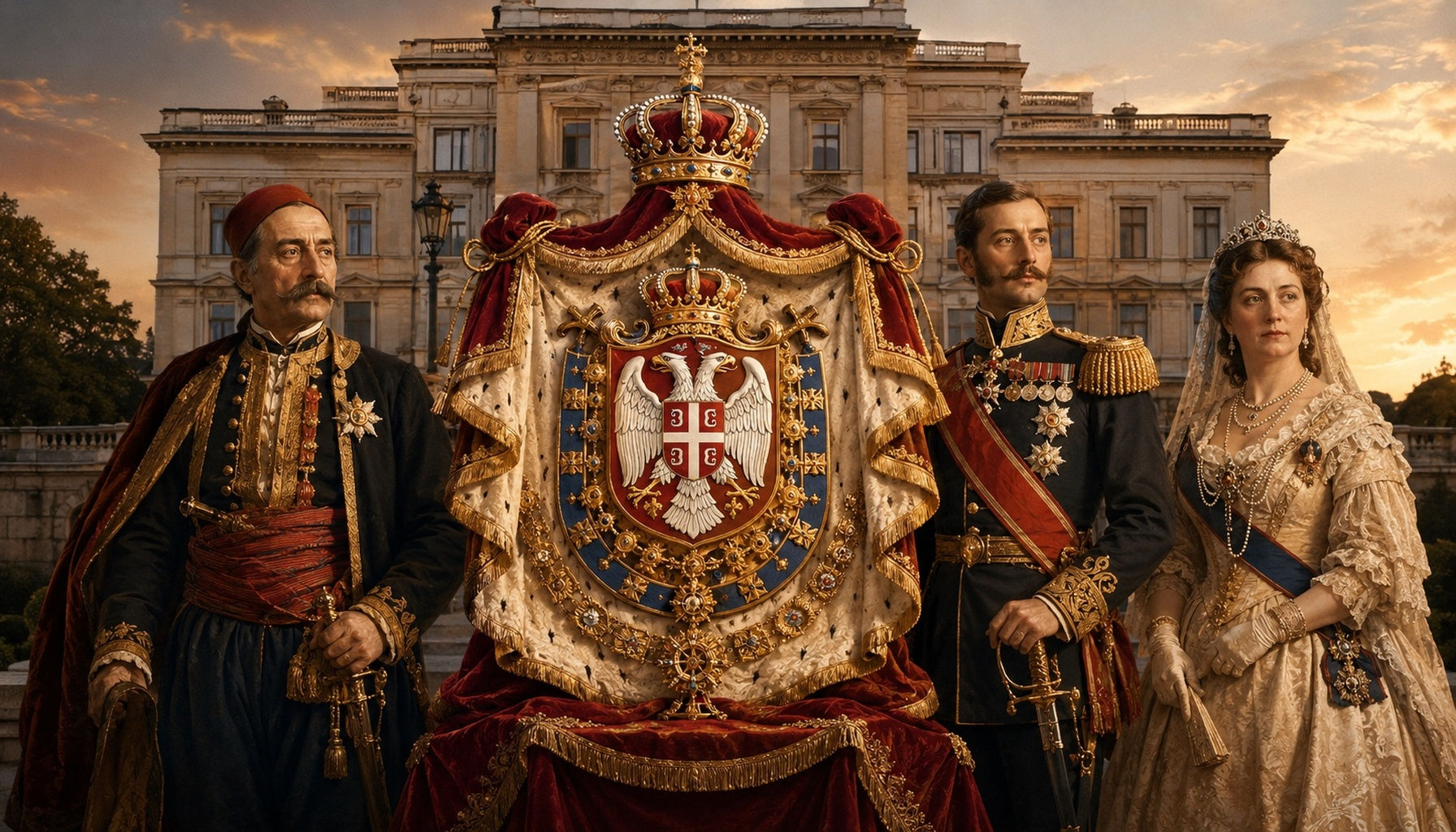
The Obrenovic Dynasty was one of the great ruling houses of nineteenth-century Serbia, a family bound up with the hard, uneven making of the modern Serbian state. Emerging from the world of Ottoman provincial rule, local strongmen, peasant rebellion, and Balkan diplomacy, the Obrenovics helped steer Serbia from uprising toward recognized autonomy, then principality, and finally kingdom. Their primary linked haplogroup here is E1b1b1a1b1a6a1, and that genetic tag sits rather neatly with the wider Balkan story: deep regional roots, movement across imperial frontiers, and long continuity mixed with change.
The family itself came out of central Serbia, in the historic landscape of Sumadija, where villages, trade routes, and armed resistance all mattered. This was not an old medieval dynasty dusted off from a chronicle, but a newer ruling house forged in the political heat of the late eighteenth and early nineteenth centuries. Milos Obrenovic (1780-1860) became the towering founder figure, shrewd, pragmatic, and sometimes ruthless, a man who understood that statehood was not won only on the battlefield but also in negotiation chambers. Later rulers such as Milan Obrenovic IV (1854-1889) and Aleksandar Obrenovic, King of Serbia (1876-1903), carried the dynasty into the age of constitutions, railways, court politics, and international pressure, though never free of controversy or the bitter rivalry with the Karadordevic line. In broad historical terms, the Obrenovics fit a familiar Balkan royal pattern: liberation struggle, dynastic contest, reform, diplomacy, and the slow assembly of a modern monarchy.
Read more about the Royal House of Karadorde
If you want one place that anchors the Obrenovic story in stone, it is Stari Dvor, the Old Palace in Belgrade. Built in the late nineteenth century as a royal residence for the Obrenovic dynasty, it stood at the ceremonial and political heart of the Serbian capital, expressing exactly the image the dynasty wished to project: a European monarchy, modern, self-confident, and fully at home among the courts of the continent. The building was commissioned under King Milan and completed in the 1880s, with richly decorated interiors suited to receptions, court life, and state display. It later became closely associated with King Aleksandar Obrenovic as well. Stari Dvor has had a turbulent history, like Serbia itself, suffering damage in later conflicts and passing through changing political eras, but it still stands in central Belgrade and remains one of the city's key historic buildings. Today it serves civic functions and, as a major landmark on Nikola Pasica Square, it can certainly still be viewed and visited externally, while access to interiors may depend on public opening arrangements and official use.
Explore the Royal House of Petrovic-Njegos
From a DNA perspective, the Obrenovic-linked haplogroup E1b1b1a1b1a6a1 belongs to a wider web of ancient and medieval individuals found across the Balkans and beyond, which is exactly what one might expect in a region shaped by Roman frontiers, migrations, trade, armies, and imperial collapse. Related or linked samples include several from Serbia itself, such as Late Imperial Roman Timacum Kuline Ravna Village individuals I15553 and I15554, Medieval Era Serbia Timacum Kuline Ravna Village I15537, Imperial Roman Era Serbia Timacum Slog Necropolis I15544, and multiple Late Roman Viminacium samples including I15504, I15507, I15513, I15518, I15490, and I15525. Beyond Serbia, linked examples appear in Migration Period Hungary at Rakoczifalva (RKF026 and RKF027), Medieval Sicily at Teatro di Segesta (SGBN10), Early Medieval Croatia at Velim-Velistak (VEM022), Merovingian Bavaria at Altheim (Alh_154), Dark Ages Italy at Malles Burgusio Santo Stefano (2425), and even farther afield in places like Burgundy, Crimea, Kent, Denmark, and Iberian Cordoba. None of this proves direct descent from any one ancient individual, of course. What it does show is that this paternal line, or very close related branches of it, formed part of a long-lived human story stretching across the Roman, post-Roman, and medieval worlds, with particularly strong resonance in the Balkans and the Danubian corridor.
Explore the Royal House of Hunyadi
The Obrenovic Dynasty is a fine reminder that royal families are not just lists of names but engines of state-building, symbols of national ambition, and sometimes victims of the very modern politics they helped create. If your own DNA links to E1b1b1a1b1a6a1 or to related ancient samples from Serbia, Hungary, Croatia, Italy, or the wider Roman and medieval Balkans, you may be touching a much older regional story of continuity and movement. Upload your DNA to MyTrueAncestry and see whether you match the Obrenovic family group or any of these related ancient DNA samples.


Comments