The Noble House von Eltz
– 3 min read


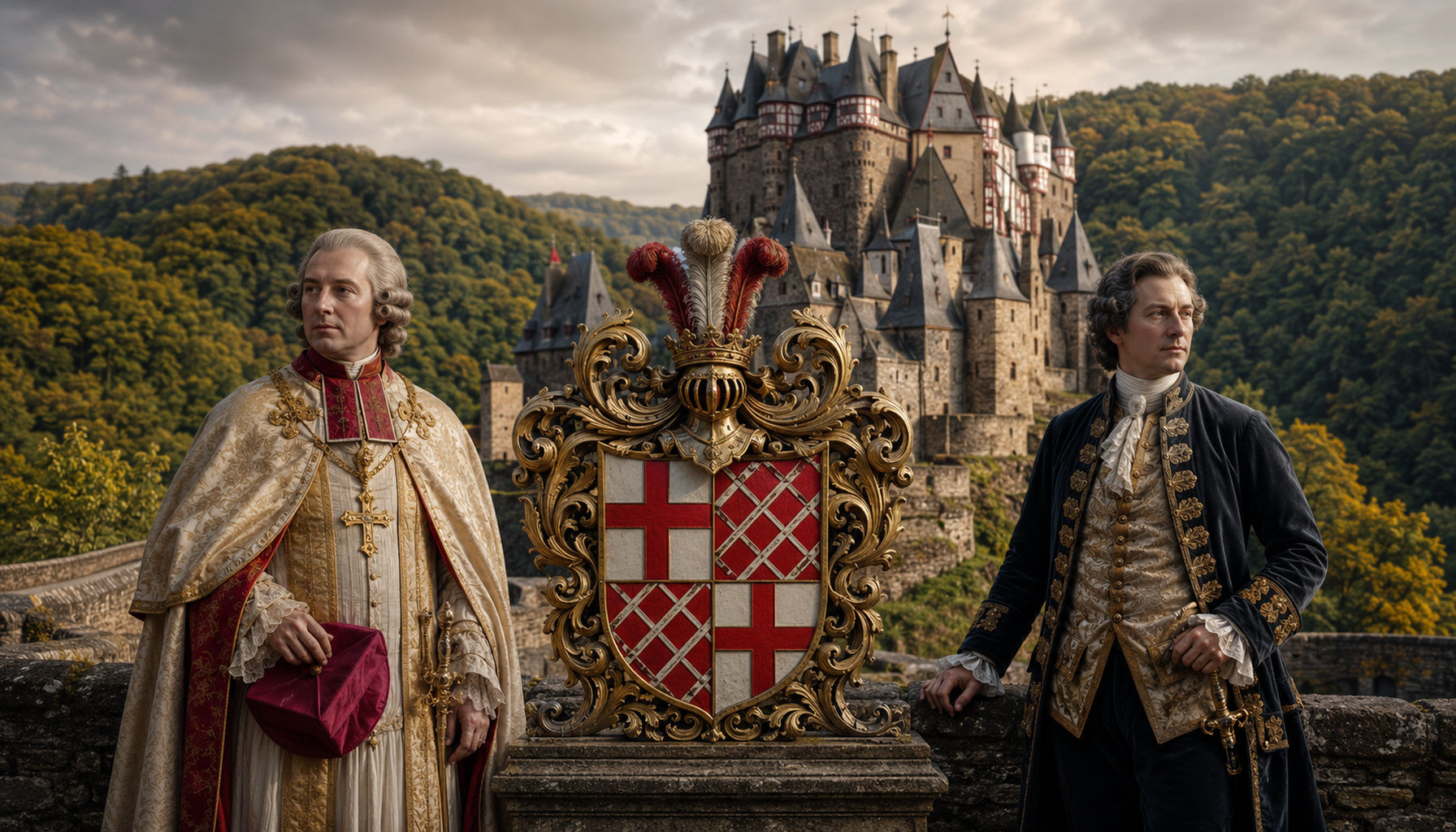
The von Eltz family was, and remains, one of the great historic noble houses of Germany, rooted in the Rhineland and inseparably linked to Eltz Castle. Their identity grew out of the classic world of the medieval German knightly nobility: castle lordship, feudal service, landed continuity, heraldry, and careful participation in the tangled regional politics of the Holy Roman Empire. The primary haplogroup associated with the family is R1a1a1b1a1a1c1, a paternal line that places them within a much wider European story stretching across medieval and earlier populations.
The family emerged from a very particular landscape and political setting: the wooded hill country above the Moselle, in a frontier-like noble world where power was local, fortified, and negotiated through service and kinship. Like many long-lived German noble houses, the von Eltz line did not survive by accident. It endured through estate management, church careers, military roles, alliances with other noble families, and an unusual ability to remain tied to the same ancestral seat across centuries. Among its notable figures are Jakob von Eltz-Ruebenach (1510-1581), prince-elector and archbishop of Trier during the confessional tensions of the Reformation era; Philip Karl von Eltz-Kempenich (1665-1743), who rose to become archbishop-elector of Mainz and a major figure in imperial ecclesiastical politics; and Jakob Graf von und zu Eltz (1921-2006), a modern representative of a lineage that had already become legendary for its continuity.
Explore the Noble House von Weltzien
Eltz Castle is the great anchor of the family's story, and indeed one of the most striking survivals of noble Europe. Set in the hills above the Elzbach, a tributary near the Moselle between Koblenz and Trier, the castle is famous for seeming to grow out of the landscape itself: perched on a rocky spur, surrounded by forest, and enclosed on three sides by the river valley. What makes it especially remarkable is that it was never destroyed, unlike so many castles of the Rhineland, and it has remained in the possession of the same family for more than eight centuries. Architecturally it is not a single neat block but a layered complex of Romanesque, Gothic, and later additions, reflecting the branching lines of the family who shared and expanded it over generations. Inside are historic furnishings, treasury objects, portraits, and heraldic traces that make the castle feel less like a ruin and more like a long unbroken family archive in stone. It is also a genuine public heritage site today and can still be visited, which is part of the thrill: this is not merely a name in a pedigree, but a place you can actually walk into.
Explore the Royal House of Hohenzollern
From a DNA perspective, the von Eltz family's tagged paternal line, R1a1a1b1a1a1c1, connects them not to one single ancient people but to a broad web of related or linked male lines found across central, eastern, and northern Europe. Ancient and medieval samples in this wider cluster include Late Roman Era Aquae Calidae Bulgaria (I41193), Medieval Poland Early Kingdom of Poland (PCA0166), Medieval Piast Dynasty Poland Plonsk Masovia (PCA0328), Piast Dynasty Lubusz-Greater Poland Border Santok Lad (PCA0386 and PCA0387), Medieval Kingdom of Poland Piast Dynasty Zielonka Poznan (PCA0572), Medieval Germany Sachsen-Anhalt Western Slav Settler Steuden (SDN017, SDN018, SDN019), Medieval Denmark Zeeland Ahlgade Holbaek (CGG101825), Viking Age Sigtuna Sweden Migrant (kls001 and kls001a), Viking Age Gotland Frojel Sweden (VK438), Viking Age Gotland Kopparsvik Sweden (VK452), Viking Age Galgedil Funen Denmark (VK139), Viking Age Skara Varnhem Sweden (VK309), Medieval Germany Krakauer Berg Peissen (KRA001, KRA003, KRA009), Bronze Age Poland Lublin Brodzica Trzciniec (poz554), and the Rurik dynasty sample Izjaslav Ingvarevych, Prince of Dorogobuzh (VK541). These do not prove direct descent from any one excavated individual, of course, but they do show that the von Eltz haplogroup sits within a deep historical landscape shared by medieval dynasties, frontier settlers, warrior elites, and long-standing central and eastern European paternal networks.
Read about the medieval Piast rulers
If the story of the House von Eltz catches your imagination, the next step is to test your own connection to the deeper past. Upload your DNA to MyTrueAncestry and see whether you match the von Eltz family profile or any of the related ancient DNA samples linked to haplogroup R1a1a1b1a1a1c1. It is a wonderfully direct way of asking whether your own family story brushes against the same medieval and ancient worlds.


Comments