The Lumley Family
– 3 min read


The Lumley family, or House of Lumley, was one of the notable noble houses of northern England, closely rooted in County Durham around Great Lumley and the powerful landmark of Lumley Castle near Chester-le-Street. Traditionally traced to early medieval northern ancestors sometimes linked in memory to Liulph or related Lumley forebears, the family emerged from a borderland world where lordship depended on land, marriage, royal loyalty, and the ability to hold a strong residence in a politically important landscape. Their primary Y-DNA association here is tagged to haplogroup R1b1a1b1a1a2a5, a branch within the wider paternal lineages long found across western Europe.
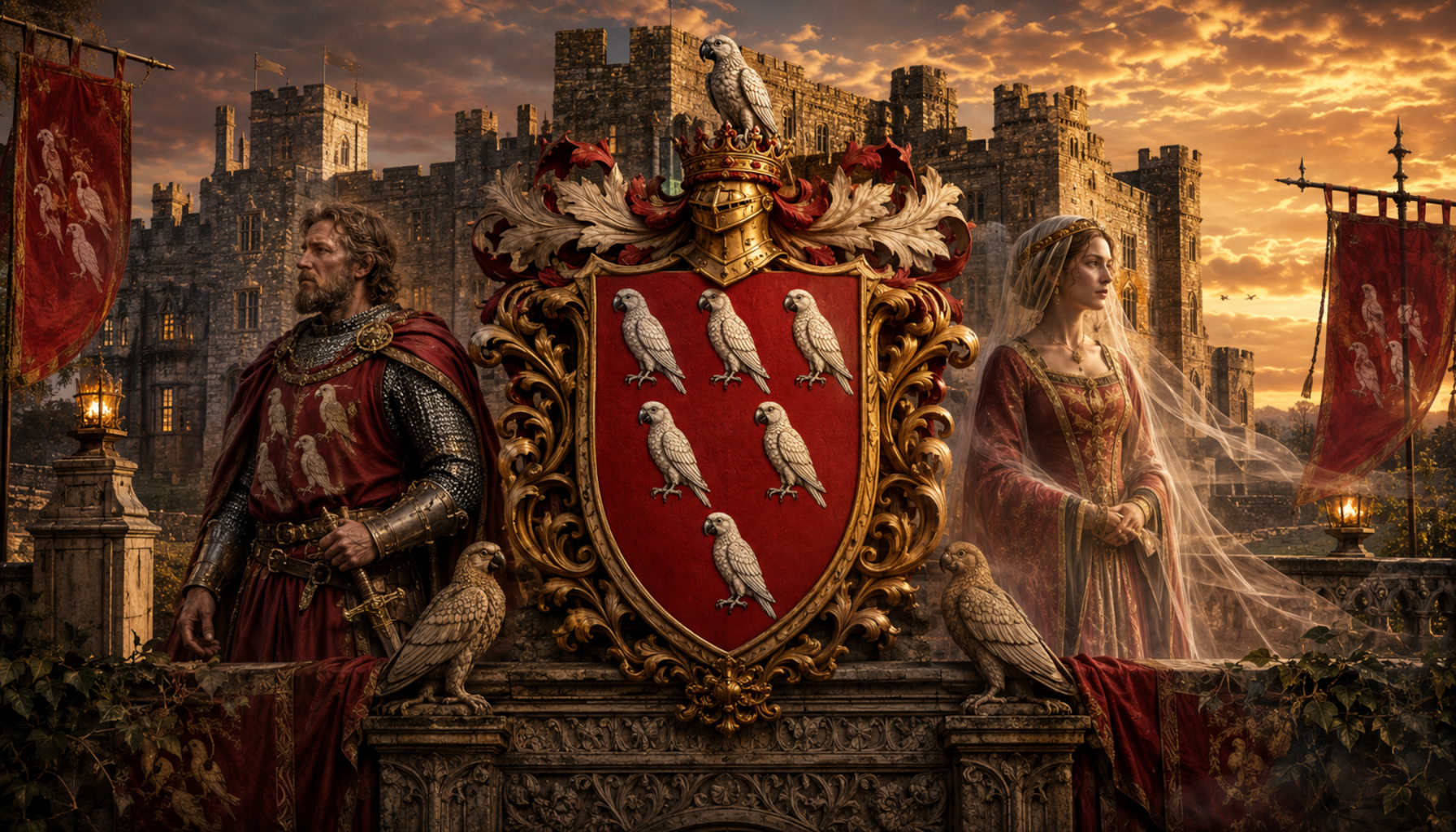
What makes the Lumleys so interesting is that they were never just a surname attached to one house: they were part of the long story of how northern aristocratic families made themselves durable. They accumulated standing through estates, baronial rank, heraldry, service to the Crown, and cultural ambition. Their ancient arms, famously a red field with white popinjays, belong to that vivid medieval language of identity in which a shield could say as much about lineage as a charter. One of the best-known figures in the family was John Lumley, 1st Baron Lumley (1533-1609), a courtier, nobleman, and major collector whose interests in books, portraits, and antiquities show the family not just as warriors and landholders, but as participants in the intellectual world of Tudor and early Stuart England.
Lumley Castle is the great architectural anchor of the family story. Standing above the River Wear near Chester-le-Street in County Durham, it began as a 14th-century fortified manor house and developed into the residence most strongly associated with the Lumleys. In other words, it was not simply a battlefield fortress in the storybook sense, but a high-status noble home built to project authority, security, and lineage in a region where such things mattered enormously. Over time the castle became the visible emblem of the family itself: a place where politics, hospitality, estate management, and memory all came together. Later centuries altered and restored it, but its medieval core still gives the building that unmistakable sense of aristocratic permanence. It is also tied to the well-known local legend of Lily Lumley, the castle ghost whose story has helped keep the family in popular imagination long after feudal lordship faded. Today Lumley Castle still stands and can indeed be visited, as it survives in active use as a heritage hotel and event venue.
Read more about the Noble House of Percy
From a DNA perspective, the Lumley family is tagged here with R1b1a1b1a1a2a5, and that matters because this paternal branch appears in a wide spread of ancient and historic individuals across western and central Europe. These are not claims of direct descent from specific excavated people, but related or linked samples that help sketch the deeper background of the lineage. Particularly interesting are medieval and Dark Age individuals from Las Gobas in northern Spain such as ldo066, ldo037, ldo046, ldo048, ldo062, and ldo040; Iron Age and Romano-British linked examples from Britain including Durotriges samples WBK106 and WBK36, Roman Fenstanton FEN008, Medieval England samples ATP_PSN_944, ATP_PSN_1217, ATP_PSN_36, and Durham Hartlepool Olive Street S17277; and northern British-era links such as the Pict-period Rosemarkie Cave individuals KD001, KD001_2, KD001_3, KD001_4, KD001_6a, and KD001_6b. Further back, related branches appear in Bronze Age and Iron Age contexts stretching from Bell Beaker and Early Bronze Age France to elite Celtic burials in Germany such as APG001, APG003, and the Ludwigsburg Roemerhuegel group. The broad picture is one of a long-lived western European paternal line moving through Bell Beaker, Bronze Age, Celtic, Roman, medieval, and later populations before turning up in historically documented families of places like northern England.
Explore Ancient DNA in Post-Roman Britain
The Lumleys sit at that fascinating crossroads where documented genealogy, castle history, heraldry, local legend, and deep ancestry all meet. If your own family history points to Durham, the north of England, or old aristocratic and borderland surnames, it is worth exploring whether your DNA shows links to the same wider genetic landscape, including haplogroup R1b1a1b1a1a2a5 and related ancient samples from Britain and continental Europe. Uploading your DNA can help you see whether you match the Lumley story directly, indirectly, or through older regional population history.

Comments