House of Liddell

– 3 min read


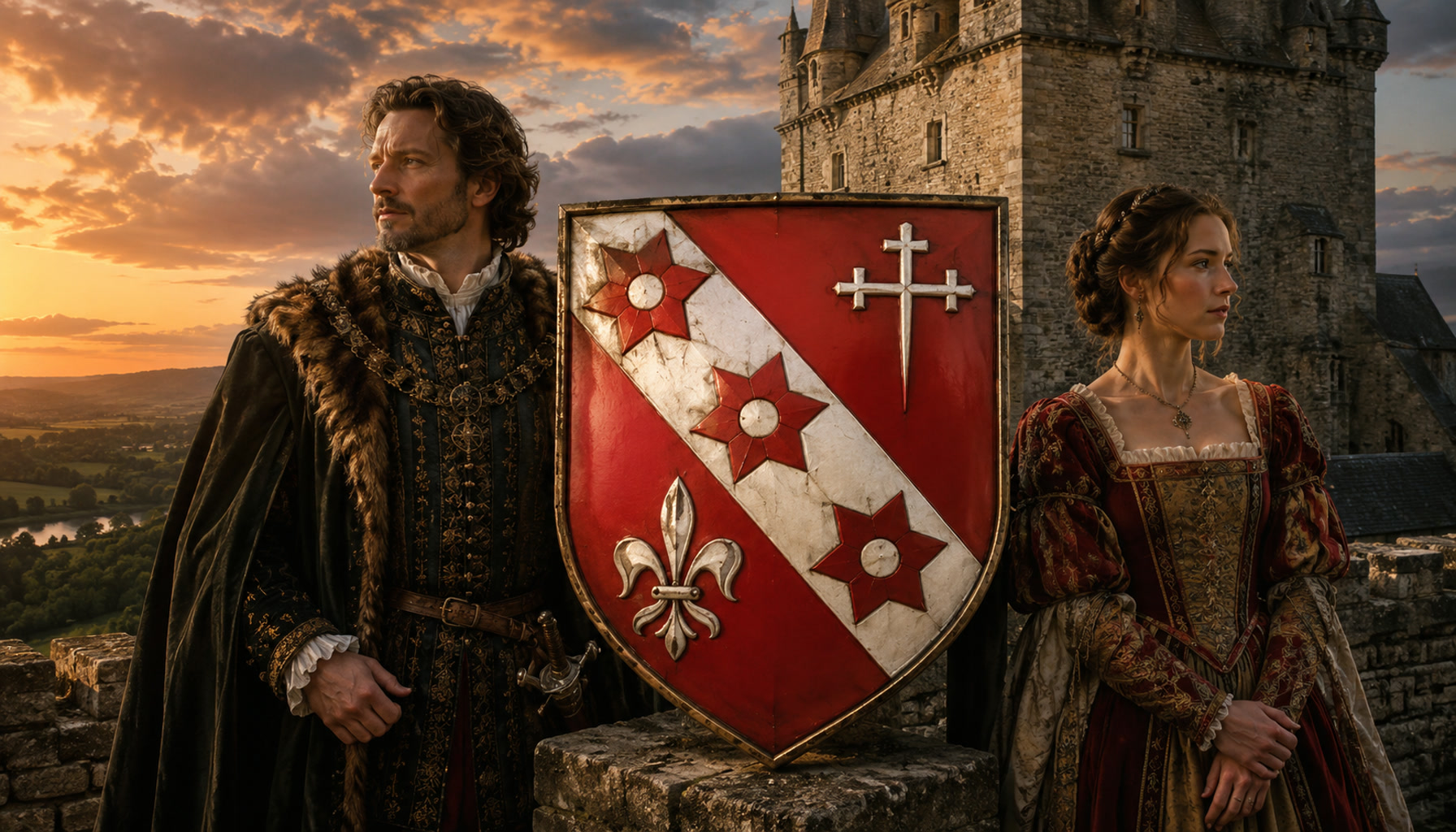
The House of Liddell was a British noble and landed family whose identity was bound up with estate life, regional authority, and the long memory of lineage. Rooted in the borderlands and later strongly associated with the north-east of England, the Liddells belong to that recognisably British story in which landholding, public service, marriage alliance, and heraldic continuity worked together to create family standing across generations. In haplogroup terms, the family is linked here with R1b1a1b1a1a2c1a1e, the primary family haplogroup tag used for this house.
The surname itself points us toward a landscape origin, almost certainly tied to the Liddel or Liddell river region on the Anglo-Scottish frontier, where names were often taken from places before becoming dynastic labels in their own right. That matters, because families like the Liddells did not emerge from nowhere fully powdered and armorial. They were shaped by a hard historical setting: frontier politics, shifting loyalties, property consolidation, and the patient transformation of local influence into gentry and noble status. By the early modern period, figures such as Sir Thomas Liddell, born in 1550, stand out as part of that ascent, representing the family in the world of land, office, and inherited reputation.
The great location anchor for the family is Ravensworth Castle, at Lamesley in Gateshead, County Durham, long associated with the Liddells and later the Barons Ravensworth. The site began as a medieval fortified manor, with a licence to crenellate granted in the 14th century, and over time it developed into a substantial castellated residence. What survives today is a romantic and rather atmospheric shell of that long history: medieval work, later rebuilding, and the visible ambition of a family keen to express status in stone. It sits in parkland south of central Newcastle, and like so many British aristocratic seats it tells two stories at once, one about defence and one about display. The remains are still standing and are known as a local historic landmark; while access can depend on current site arrangements and surrounding land use, the castle can at least be viewed and visited in that reasonable heritage sense by those exploring the area.
From a DNA perspective, the Liddell haplogroup tag R1b1a1b1a1a2c1a1e sits within a very deep and widespread western European paternal story. That does not prove direct descent from any excavated individual, and it would be quite wrong to pretend otherwise. What it does offer is a web of related or linked ancient samples across Britain and beyond. Particularly striking are multiple Celtic Durotriges individuals from Duropolis at Winterborne Kingston in Dorset, including WBK12, WBK20, WBK29, WBK41, WBK05, WBK30, WBK43, WBK06, WBK08, WBK18, and WBK191, alongside Iron Age and Romano-British linked finds from places such as East Kent, Yarnton, Pocklington, Somerset, Hampshire, Wiltshire, and Orkney. There are also later related examples from Saxon Hinxton, Buckland Dover, Lakenheath, Eastry, Worth Matravers, medieval Ireland, Belgium, Iberia, and the wider Roman and post-Roman world. In other words, this haplogroup points not to one single family tale frozen in time, but to a long-lived paternal line moving through Bronze Age, Iron Age, Roman, early medieval, and medieval Europe before ever appearing in the documentary world of the Liddells.
Explore ancient DNA in post-Roman Britain
The House of Liddell is a good reminder that family history is rarely just a list of names. It is a story of places, borders, buildings, ambition, memory, and the strange afterlife of identity through heraldry and inheritance. If you have tested your DNA, you can upload it to MyTrueAncestry to see whether you match the House of Liddell or any of the related ancient DNA samples connected with haplogroup R1b1a1b1a1a2c1a1e.



Comments