Clan Riddell
– 3 min read


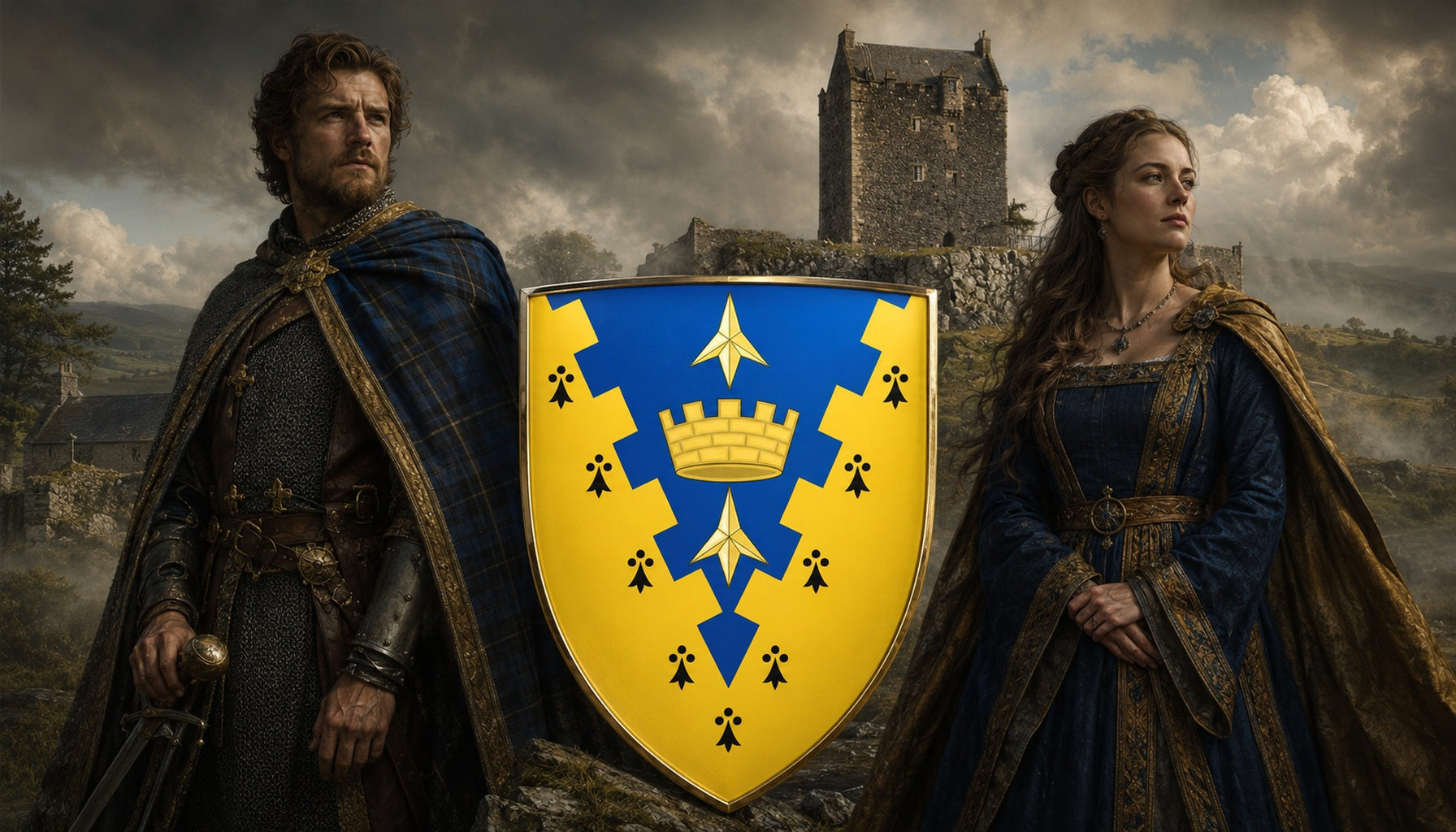
Clan Riddell was one of the old landed families of the Scottish Borders, rooted above all in Roxburghshire and in lands that carried the family name. This was not a Highland clan in the later tartan-and-chief sense, but a Border and Lowland kind of kin-group, where identity grew out of estate, local standing, service, memory, and heraldry. The Riddells belong to that long southern Scottish story in which a family could become inseparable from a place, and a place from a family name. Primary family haplogroup: R1b1a1b1a1a2c1a1i2.
The surname points back to locality and tenure, and the family emerges from the medieval world of frontier lordship, feudal obligation, and shifting Anglo-Scottish pressure. In that world, names mattered because land mattered. The Borders were not a soft edge on a map but a lived frontier, with loyalties layered between crown, lordship, parish, kin, and neighborhood. Among the early figures associated with the family are Gervase Ridale, recorded in 1116, and Sir William Riddell, who appears in 1296, a date that immediately places him in the hard political atmosphere of the Wars of Independence. The long continuity of the Riddells shows how some Border families endured not by grandeur alone, but by staying power, alliances, and the careful preservation of local authority across generations.
A useful historical anchor for thinking about the deeper background of families like the Riddells is Battle Abbey in Sussex, founded by William the Conqueror on the site of the Battle of Hastings in 1066. According to tradition, the high altar was placed where King Harold fell. The abbey was established as both monument and act of conquest, and in the centuries after 1066 it became one of the most famous Norman foundations in England. For Border families with medieval documentary roots, institutions such as Battle Abbey matter because they belong to the same wider world that reshaped landholding, lordship, record-keeping, and aristocratic memory across Britain after the Norman period. Battle Abbey later declined after the Dissolution, but substantial remains survive, and the site can still be visited today, making it a rare place where the political drama of medieval Britain is still physically present in the landscape.
The haplogroup linked here, R1b1a1b1a1a2c1a1i2, belongs to a wider genetic story spread across Britain and parts of Europe over a very long timespan. That does not prove direct descent from any ancient individual, and it should not be presented that way. But it does place Clan Riddell within a broader population history connected to related samples such as Celtic Durotriges individuals from Duropolis, Winterborne Kingston in England including WBK12, WBK20, WBK29, WBK41, WBK05, WBK30, WBK43, WBK06, WBK08, WBK18 and WBK191; Imperial Roman Era Zadar, Croatia I26776; Bronze Age Orkney, Westray Links of Noltland KD061; Bronze Age Calabria, Grotta della Monaca, Sant Agata di Esaro GMO015; Early Medieval Belgium Sint-Truiden Groenmarkt ST2025; Medieval Belgium outsider Sint-Truiden Onze-Lieve-Vrouwekerk ST1308; Gallic France Parancot CGG023699; Post-Roman Worth Matravers, Dorset I11580; Merovingian Alt-Inden in North Rhine-Westphalia IND013; Early Anglo-Saxon Hatherdene Close, Cambridgeshire HAD001; Late Roman Klosterneuburg, Lower Austria R10656; Late Roman Conimbriga, Portugal R10488; Bronze Age Amesbury Down I2598 and I2417; Celtic Briton Yarnton I21182; Iron Age Worlebury I11991; Iron Age Battlesbury Bowl I21309; Bronze Age Trumpington Meadows I3256; Bell Beaker Upavon I4950; pre-Viking Pict Buckquoy VK203; Bronze Age Bedfordshire I7576 and I7577; Bronze Age Boatbridge Quarry, South Lanarkshire I5473; Hinxton Iron Age HI2; Early Bronze Age Thames I5377; and Ireland Copper Age Rathlin2B. In other words, the Riddell DNA signature sits comfortably inside a deep northwestern European and especially British-Irish archaeological frame.
If you carry the Riddell name, or think your family may connect to the Scottish Borders, DNA can add another layer to the paper trail. Upload your DNA to MyTrueAncestry to explore how your results may link with ancient populations, historic migration patterns, and the deeper background behind families like Clan Riddell.
Comments