The Lubomirski Family
– 3 min read


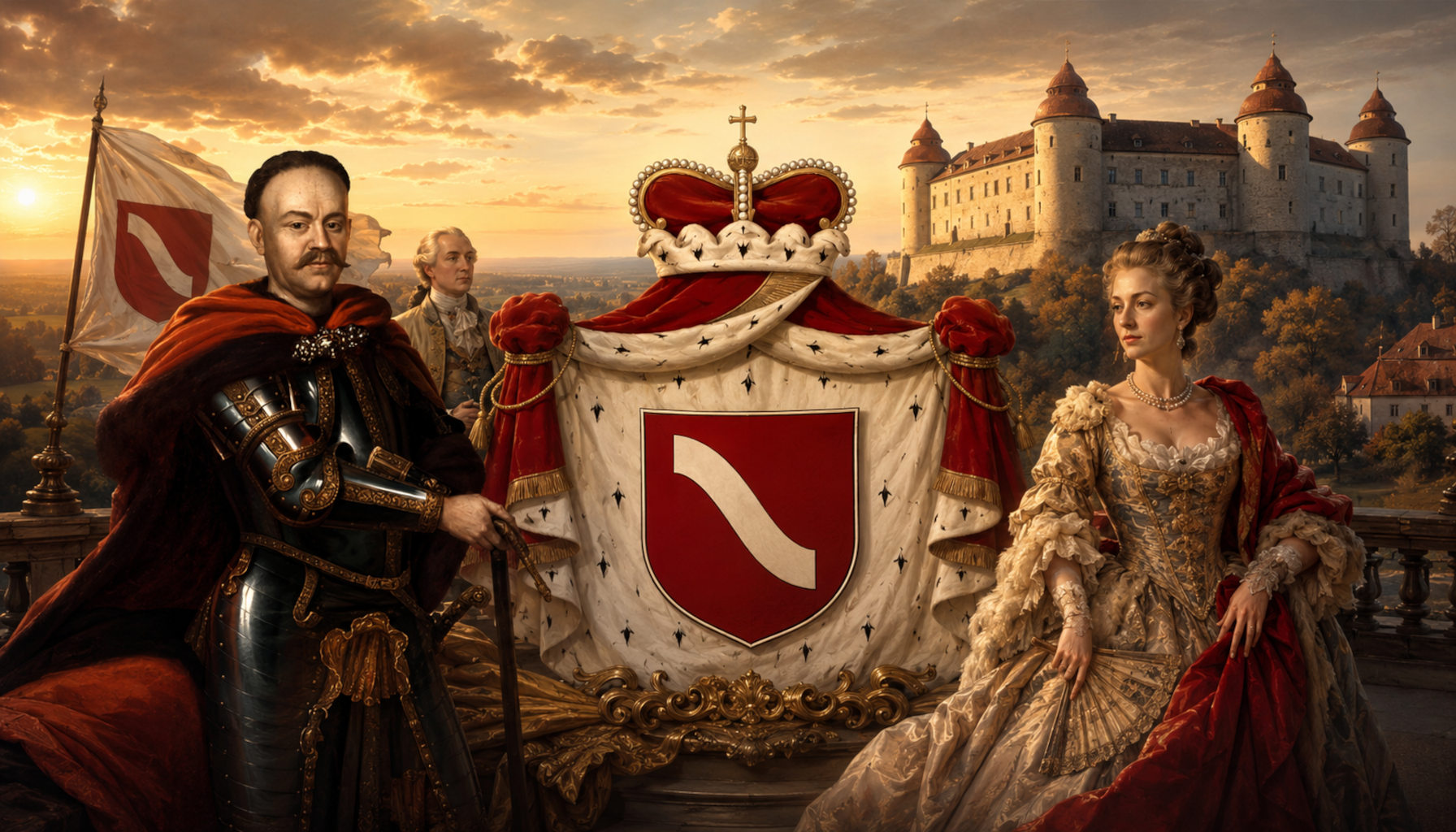
The Lubomirski family was one of the grand aristocratic houses of Poland, a princely and magnate lineage whose name became bound up with power, land, military command, and political theatre across the Polish-Lithuanian Commonwealth. They emerged from Lesser Poland, rooted in the older noble world of the kingdom and associated with the Szreniawa coat of arms, the striking red shield marked by the white Szreniawa curve. In haplogroup tagging, the primary family haplogroup linked here is J2b2a1a1a1b, a lineage with a deep and wide ancient footprint across parts of Europe and the Mediterranean.
The family name itself points back to Lubomierz, and the rise of the house belongs to that very Polish story in which regional nobles could, through office, marriage, landholding, and proximity to the crown, become near-royal in influence. By the late medieval and early modern periods, the Lubomirskis were no longer simply local landholders but major players in the Commonwealth's political machinery. Figures such as Piotr Lubomierz, recorded in 1480, belong to the earlier formation of the line, while later men like Stanislaw Lubomirski, who died in 1647, helped turn family prestige into something monumental: castles, fortified palaces, urban residences, armies, and influence at court. Jerzy Sebastian Lubomirski would later embody the family's more dramatic side, as soldier, statesman, and sometimes troublesome force in national politics. This was a dynasty that understood rank not just as inheritance, but as display.
If one place anchors the Lubomirski story in stone, it is Nowy Wisnicz Castle in southern Poland. The site began as a defensive residence in Lesser Poland, but it was Sebastian Lubomirski's acquisition of it in the late 16th century that made it a true family stronghold. His son Stanislaw Lubomirski then transformed it on a much larger scale into a grand Baroque fortified residence, one of those magnificent Commonwealth compounds where military architecture and aristocratic self-confidence meet face to face. The castle took on the fashionable bastioned form of the age, with fortifications, a commanding layout, and the sort of ceremonial presence designed to impress visitors before they had even crossed the threshold. It was not merely a home. It was a statement about status, security, and the scale of Lubomirski ambition.
Nowy Wisnicz Castle also tells the broader story of Polish noble residence culture: a fortress-palace world in which elite families defended territory, entertained lavishly, and staged their place in the political order through architecture. Though damaged by war and later decline, the castle survives and has been restored in part, and it can still be visited today. For anyone interested in the Lubomirskis, it offers that rare thing in history: not just a name in a chronicle, but walls, courtyards, and views that still carry the weight of the family's presence.
Read more about the Czartoryski family
The Lubomirski haplogroup tag, J2b2a1a1a1b, sits within a lineage that appears in a fascinating spread of ancient DNA contexts, though these samples should be understood as related or linked, not as evidence of direct descent from any particular ancient individual. Among the linked examples are Elite Celtic Burial Germany Magdalenenberg Villingen-Schweningen (MBG006), Gallo-Celtic Switzerland Pont de Cornaux-Les-Sauges (3432) and (3433), Imperial Roman Croatia Sisak Pogorelec (R2040), Imperial Roman Serbia Timacum-Minus-Slog Zajecar District Knjazevac Ravna (I15546), Imperial Roman Croatia Karlovac Pannonia Savia (BBC019, BBC008, BBC012), and Early Medieval Croatia Velim-Velistak (VEM015). The same broader line also turns up in Hellenic-Carthago Kerkouane Tunisia Pantelleria (I24032), Pre-Illyrian Bronze Age Croatia Cetina Valley (I18746), Proto-Illyrian Bronze Age Croatia Koprivno (I5073), Illyrian Croatia Velim-Kosa (I18830, I18831), Illyrian Velika Gruda Montenegro (I13775, I13777), Medieval Doclea Bjelovine Montenegro (R9918), Iron Age Kapiteljska njive Slovenia (I5691), Iron Age Smiljan Croatia (I23911, I23995, I24638), Illyrian Jazinka Cave Croatia (I26742), Iron Age Zagorje ob Savi Slovenia (I22940), Illyrian Smiljan Croatia (I24639), Pannonian Hill Fort Mala Metaljka Croatia (I24882), Early Bronze Age Mokrin Necropolis Serbia (MOK15), and even Etruscan Civitavecchia (R474). What is striking here is not a neat single-path origin story, but a long archaeological trail through Celtic, Illyrian, Roman, Adriatic, and Mediterranean worlds, reminding us how often elite family histories sit atop much deeper and more entangled human pasts.
Explore the medieval Polish Piasts
The Lubomirskis represent aristocratic Poland at full scale: princely titles, fortified residences, offices of state, patronage of churches and the arts, and a political reach stretching across Poland and the old Commonwealth. If your own family story may connect to this world, upload your DNA to MyTrueAncestry and see whether you match the Lubomirski family or related ancient DNA samples linked to haplogroup J2b2a1a1a1b.

Comments