House Radziwill
– 3 min read


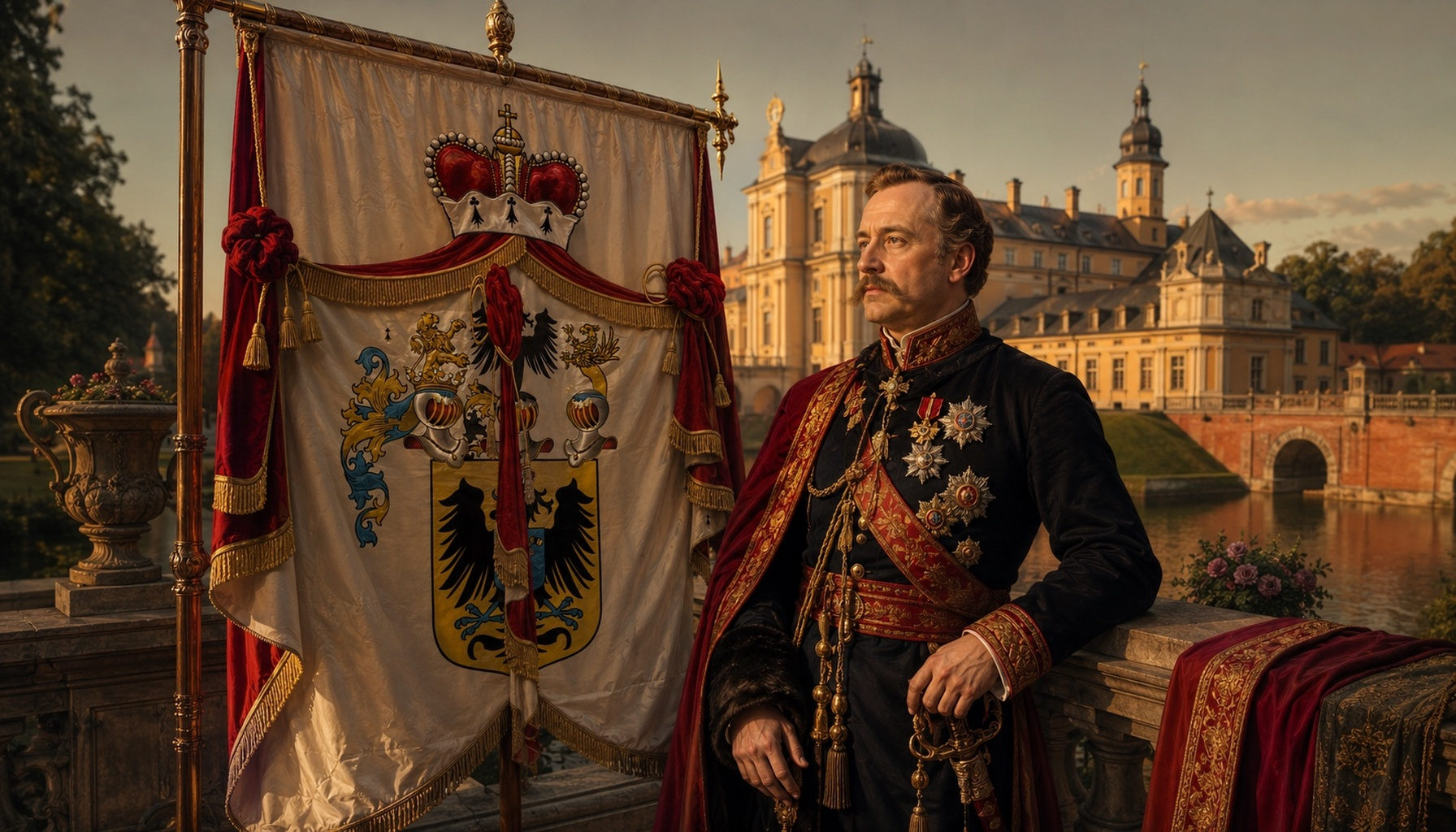
House Radziwill was one of the great magnate dynasties of the Grand Duchy of Lithuania and later the Polish-Lithuanian Commonwealth, a family whose power rested not on a single castle or office but on an extraordinary web of estates, marriages, military commands, church patronage, and political influence. Their historical homeland lay in the lands of the Grand Duchy of Lithuania, in that broad eastern European world where Lithuanian, Ruthenian, Polish, and Latin political cultures met and overlapped. The family is linked here with the Y-DNA haplogroup R1b1a1b1a1a1c1a, treated as the primary family haplogroup tag for this heritage profile.
The Radziwills rose in the late medieval and early modern centuries as the Commonwealth developed its famously aristocratic political order, one in which magnates could at times look almost like regional princes. That is precisely why the family remains so memorable. They were not merely nobles with old surnames, but operators on the grand stage of statecraft, religion, and war. Mikolaj the Red Radziwill (1512-1584) stands out as a leading political and military figure in the Grand Duchy of Lithuania, while Barbara Radziwill (1523-1551), whose marriage to King Sigismund II Augustus became one of the most famous love-and-power stories in Polish-Lithuanian history, helped fix the family permanently in popular memory. In the long view, House Radziwill represents the Commonwealth at its most distinctive: princely rank, immense landed wealth, local authority, and dynastic ambition that could rival the crown itself.
Explore the House of Gediminid
One of the family places most closely associated with the Radziwills is Nieborow Palace in central Poland, in the Lodz Voivodeship, not far from Lowicz and within reach of Warsaw. The present palace emerged in the late seventeenth century as a baroque residence, and in later centuries it became strongly tied to the Radziwill family, who turned it into one of those great aristocratic houses that were meant to do several things at once: display lineage, host political society, and frame the landscape itself as an expression of rank. Nieborow is not just a building but a magnate world in miniature, with its formal architecture, interiors, collections, and links to the broader estate culture of the old Commonwealth. Happily, it is still a well-known historic monument and museum site, so it can still be visited today, which is exactly as it should be. Families like the Radziwills were never only names in a genealogy; they left rooms, gardens, chapels, libraries, and walls thick with memory.
Read more about the Czartoryski family
From a DNA perspective, the Radziwill profile is tagged to haplogroup R1b1a1b1a1a1c1a. That does not mean the ancient individuals below were direct Radziwill ancestors; rather, they are related or linked comparative samples belonging to the same broader paternal line. What is striking is the geographical and chronological spread of that lineage: Lombard Warrior Elite samples from Collegno in northern Italy such as COL_069, COL_069b, and COL_069x; the Hungarian knight Ferenc Bathory from Pericei, sample PER03-1; Bronze Age Unetice Leubingen sample LEU007 from Thuringia; Roman and post-Roman individuals from Serbia, Austria, Croatia, and Italy including I15527, R10659, R11121, and OSIJ003; medieval and early modern samples from Belgium, England, Germany, and Denmark such as ST0024, ST2969, ST1232, ST0323, ST0786, ATP_PSN_412, SWG001, and CGG106724; and still deeper prehistoric links including Late Neolithic and Battle Axe or Corded Ware associated individuals like I12902 and RISE98. There are also linked samples from Viking Age Sigtuna, Anglo-Saxon England, Saxony-Anhalt, Lower Saxony, the Netherlands, Iron Age France, Hallstatt Austria, and beyond. In plain English, this is the sort of lineage that appears again and again across the long archaeological story of Europe, from Bronze Age chiefs to migration-period warriors to medieval elites. That broad spread suits the Radziwills rather well: a dynasty rooted in eastern Europe, but part of a much older and wider European paternal story.
Explore the Princely House of Bathory
If House Radziwill catches your imagination, the next step is the fun one: compare your own DNA with the family profile and with related ancient samples from across medieval, Roman, migration-period, and Bronze Age Europe. Upload your DNA to MyTrueAncestry and see whether you match the Radziwill-associated haplogroup R1b1a1b1a1a1c1a or any of the linked ancient individuals that help illuminate the deeper history behind this famous noble house.

Comments