The House of Wynne
– 3 min read


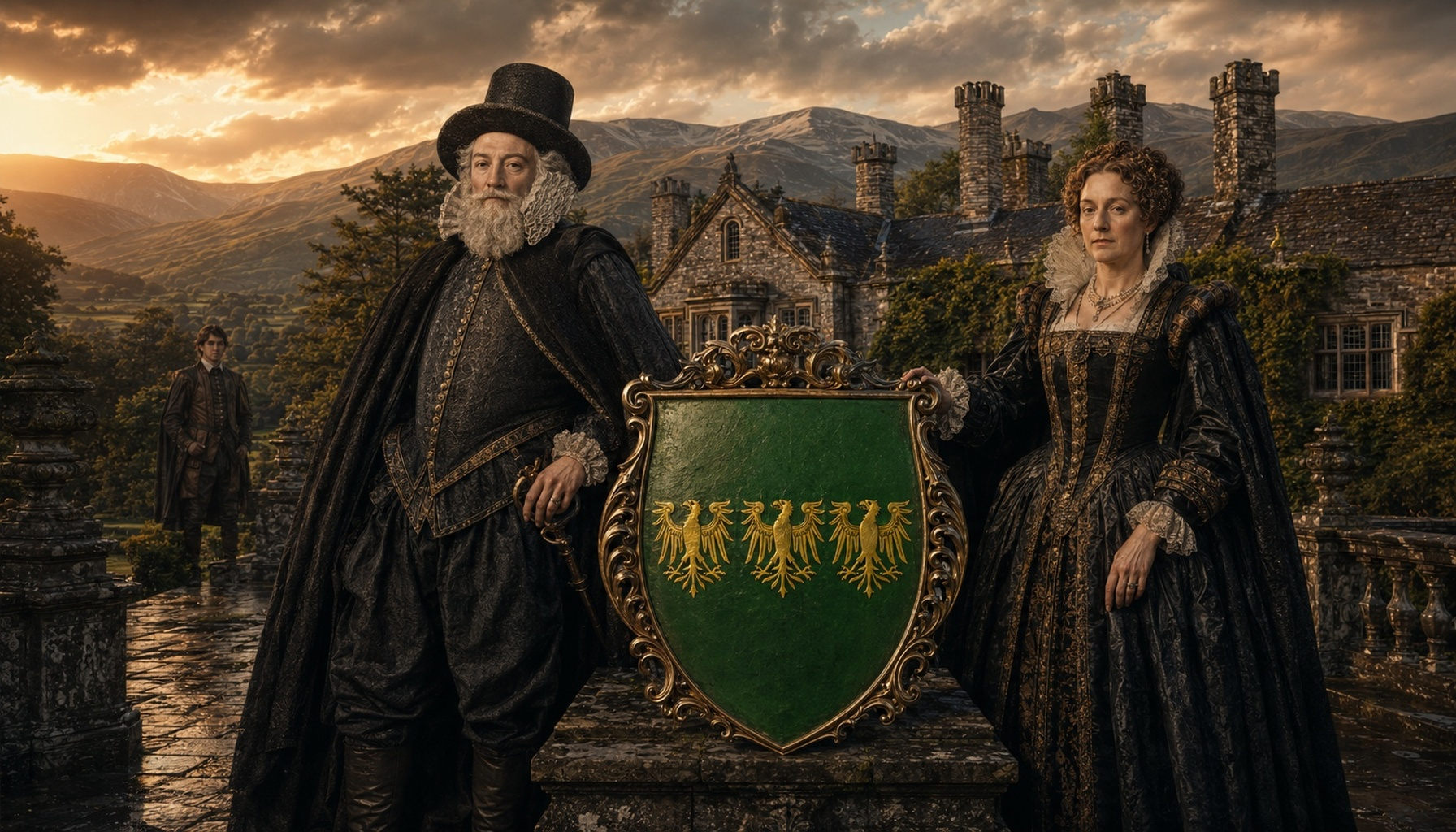
The House of Wynne was one of the notable Welsh gentry families of North Wales, rooted above all in the old county world of Caernarfonshire and Denbighshire, where lineage, land, and local standing mattered enormously. The name Wynne belongs to that distinctly Welsh historical pattern in which family identity was built from remembered ancestry, estate possession, regional influence, and service in public life. In haplogroup terms, the primary family association here is I1a2b3a1b1a2, a paternal line linked more broadly to deep northern European genetic history.
What makes the Wynnes interesting is that they were not simply landowners in the flat modern sense. They emerged from a society where genealogy was practically a political language. In Wales, to know who your forebears were was to know where you stood. The family that came to be known as Wynne developed out of this late medieval and early modern world, when native Welsh lineages were adapting to the institutions of the Tudor and Stuart state while still preserving their own heraldic memory and ancestral pride. Meredith ap Ieuan ap Robert, recorded in 1490, stands among the named figures connected with this family story, and he belongs to exactly that moment when old patronymic Welsh descent and the more fixed forms of gentry identity were coming together.
Explore the Princely House of Powys
The great location anchor of the Wynne family is Gwydir Castle, near Llanrwst in the Conwy valley of North Wales, on the edge of the landscape that leads into Snowdonia. This was not some decorative afterthought to the family story; it was the physical expression of their status, ambition, and continuity. The house developed from the late medieval period onward, with substantial building in the 16th and 17th centuries under the Wynn family of Gwydir. It became one of the most important gentry houses in North Wales, known for its striking mixture of fortified character, Tudor rebuilding, later additions, and rich interior associations including panelling and family memorial culture. Gwydir also sits in a region dense with historical meaning: upland lordship, river access, church patronage, and the long negotiation between Welsh inheritance and British state power. Happily, Gwydir Castle has been restored in modern times and is known as a heritage site that can still be visited.
Read more about the Morgan family
From an ancient DNA perspective, the Wynne haplogroup association I1a2b3a1b1a2 is best understood through related or linked samples rather than any claim of direct descent. Among the relevant linked finds are GOX287 from the Gallic Triboci context at Goxwiller in the Grand Est region of France, I20638 from Post-Roman North Yorkshire in the Vale of Pickering, CGG106702 from Neolithic Denmark at Karlstrup, I20639, I20646, I20661, and I20656 from the Early Anglo-Saxon cemetery at West Heslerton in Yorkshire, and I20637 from the Post-Roman era at Worth Matravers in Dorset. Taken together, these samples hint at a long and rather tangled northern European story, stretching from Neolithic Scandinavia through Iron Age and post-Roman western Europe into early medieval England. They do not prove a line straight to the Wynnes, but they do place the family's haplogroup within a historically meaningful web of movement, settlement, and continuity around the North Sea world.
Explore ancient DNA in post-Roman Britain
The House of Wynne offers a vivid glimpse of how Welsh family history works at its richest: ancestry remembered, estates defended, offices held, marriages arranged, and identity carried forward through place and heraldry. If you have Wynne roots, North Wales connections, or simply an interest in how family stories meet archaeology and genetics, you can upload your DNA to MyTrueAncestry and see whether you match the House of Wynne or any of these related ancient DNA samples.



Comments