The House of Willoughby
– 3 min read


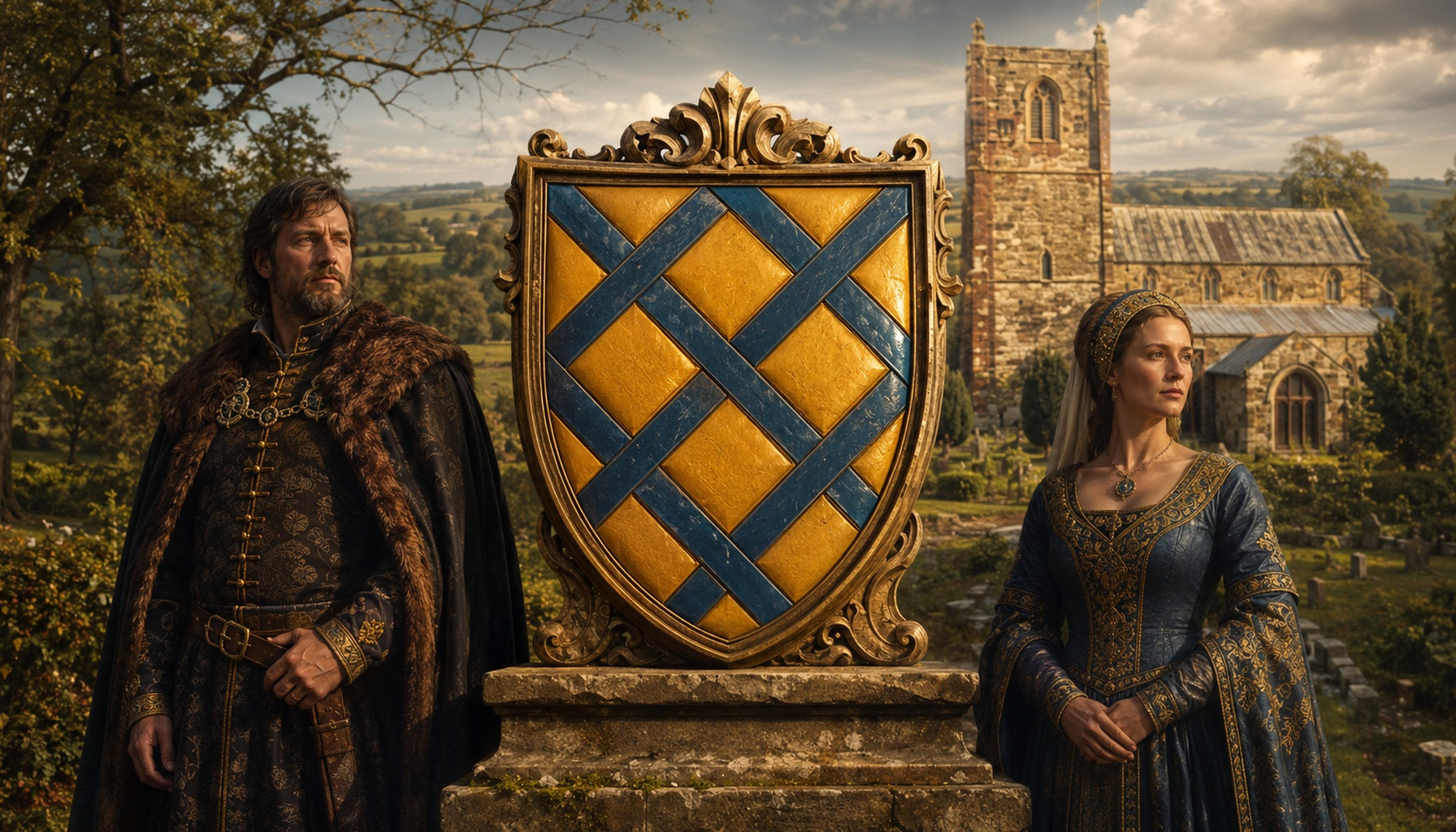
The House of Willoughby was one of those durable English noble families whose story is written not just in titles, but in land, office, service, and local influence. Rooted above all in Lincolnshire and the east Midlands, the Willoughbys grew in the classic manner of the English landed aristocracy: by holding estates, marrying well, serving the Crown, and turning county standing into national importance. In this case, the family is linked with the Y-DNA haplogroup R1b1a1b1a1a2c1a1k, a branch within a wider paternal line long found across Britain and western Europe.
Their name belongs to the landscape itself, coming from places called Willoughby, from Old Norse and Old English elements that point to a settlement or farm among willows. That matters, because it places the family in the deeply layered world of medieval eastern England, a region shaped by Anglo-Saxon kingdoms, Scandinavian settlement, Norman lordship, and the slow accumulation of estate power. Over generations the Willoughbys became a family of baronial rank and real county weight, preserving prestige through heraldry, inheritance, officeholding, and careful management of property. Figures such as Sir Richard Willoughby, active in the 14th century and associated with the year 1362, show the family already established in royal and legal service, while Sir Robert Willoughby, 1st Baron Willoughby de Eresby (1452-1502), stands out as a major Yorkist and then Tudor nobleman, soldier, and court figure in the unsettled politics of late medieval England.
Read more about the House of Neville
One of the most striking places associated with the Willoughbys is Wollaton Hall in Nottingham, a splendid Elizabethan prodigy house built between 1580 and 1588 for Sir Francis Willoughby. If you have seen it, you will know it does not so much sit in the landscape as announce itself to it. Designed by Robert Smythson, it is one of the great showpieces of English Renaissance architecture, with a high central hall, corner towers, and that wonderfully theatrical silhouette which seems to combine ambition, learning, and a touch of aristocratic swagger. It stands in what is now Wollaton Park, with deer park surroundings that still preserve something of the old relationship between house, status, and landed display. Today the hall survives as a major historic building in Nottingham, housing a natural history museum, and it can indeed still be visited, which is rather marvellous because it allows modern visitors to walk straight into a world that the Willoughbys helped shape.
Explore the House of Cavendish
From a DNA perspective, the Willoughby-associated haplogroup R1b1a1b1a1a2c1a1k sits within a paternal network that appears across a wide spread of ancient and historic samples. These are not claims of direct descent from the Willoughby family, and should not be read that way, but they do offer a fascinating backdrop for the deeper population history behind an English noble house. Linked or related examples include multiple Celtic Durotriges samples from Duropolis at Winterborne Kingston in Dorset, such as WBK12, WBK20, WBK29, WBK41, WBK05, WBK30, WBK43, WBK06, WBK08, WBK18, and WBK191; Iron Age and Celtic Briton samples from East Kent, Oxfordshire, Somerset, Hampshire, Bedfordshire, Yorkshire, Cornwall, Scotland, and Wales; Saxon and early medieval individuals from Hinxton, Eastry, Buckland Dover, Hatherdene Close, and Lakenheath; and further related cases reaching into Roman Croatia, Belgium, Ireland, Iberia, Italy, Austria, and beyond. In broad terms, what emerges is not a single family trail, but a long paternal story stretching from Bronze Age and Iron Age Britain through Roman, early medieval, and later European populations. That is exactly the sort of deep background one might expect behind an old English landed line whose recorded history begins in the medieval world but whose biological roots, like everyone else's, disappear into much older human landscapes.
Explore Ancient DNA in Post-Roman Britain
The Willoughbys are a fine example of how English noble history worked in practice: local roots, estate continuity, public office, marriage alliances, and the steady conversion of land into influence and memory. If you have Willoughby ancestry, or simply want to see whether your DNA matches this family or any of the related ancient samples connected with haplogroup R1b1a1b1a1a2c1a1k, you can upload your DNA to MyTrueAncestry and explore the deeper story behind your own past.
Comments