The House of Meerscheidt-Huellessem
– 2 min read



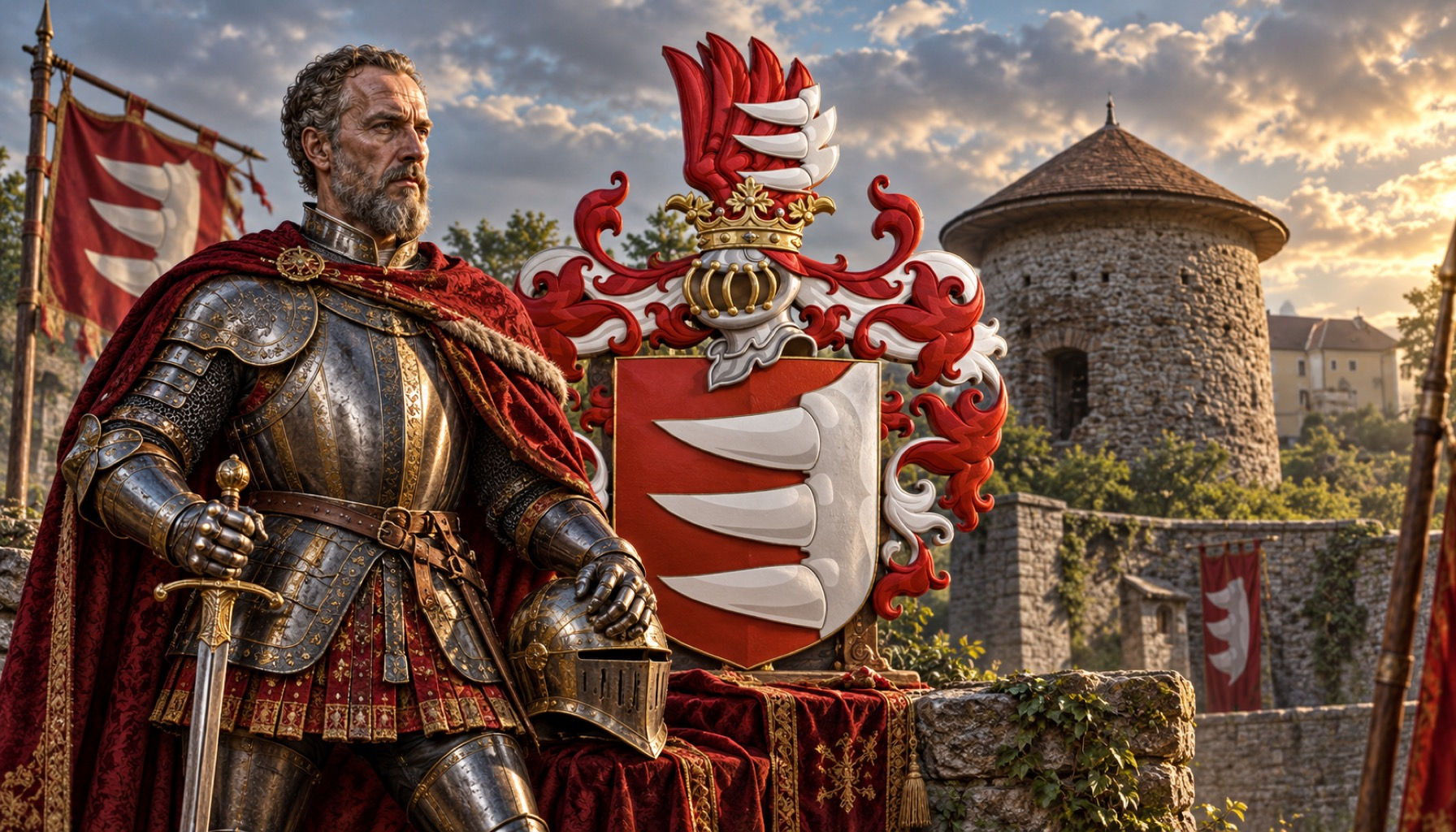
The House of Meerscheidt-Huellessem was a German noble family rooted in the world of regional aristocracy, landed identity, and heraldic memory, and it is here tagged with the primary family haplogroup I1a2a1a1a2b1a. The double name itself tells an old German story. Families of this kind were not just surnames in the modern sense, but houses tied to place, inheritance, branches of kin, and the social authority that came from holding land and serving larger political powers. In that respect, the Meerscheidt-Huellessem family fits a very recognisable pattern in the history of the German nobility: local roots, estate culture, service, and continuity across generations.
The family emerged from the Rhineland world of lordship, castles, and territorial politics, where noble identity was built as much through possession and recognition as through bloodline alone. Medieval and early modern German noble houses were made in charters, marriages, offices, military obligations, and careful remembrance of lineage. Among the named figures associated with the family are Henricus de Merenscede, recorded in 1325, and Anton von Meerscheidt, who lived from 1440 to 1498. Even these scattered names are enough to place the house firmly inside that long-running aristocratic landscape of the Holy Roman Empire, where a family might be modest on the grand imperial stage but deeply significant in its own region.
A useful anchor for understanding the setting of the House of Meerscheidt-Huellessem is Schloss Burg in today's North Rhine-Westphalia, one of the most important reconstructed castles in Germany and historically linked with the Counts of Berg. Perched above the Wupper, Schloss Burg was not simply a picturesque stronghold but a political center in the medieval county of Berg, a place from which regional authority was projected through administration, defense, ceremony, and noble networks. Its origins go back to the 12th century, and over the centuries it grew, declined, and was later restored, becoming a powerful monument to Rhineland medieval identity. For families such as Meerscheidt-Huellessem, this was precisely the kind of landscape that mattered: a world where castles, estates, feudal ties, and heraldic display defined status. Yes, Schloss Burg can still be visited today, which makes it a rare chance to stand inside the physical setting that shaped the lives and ambitions of the region's noble houses.
Explore the Noble House von Eltz
From an ancient-DNA perspective, the haplogroup tag I1a2a1a1a2b1a places the family within a wider north and central European paternal story rather than proving any direct line to a specific excavated individual. Related or linked samples with this haplogroup branch include Migration Period Hungary at Rakoczifalva, sample RKO002; Merovingian-period Frankish Buettelborn in Germany, sample Btb71; medieval Belgium at Sint-Truiden Groenmarkt, sample ST2819; post-medieval Finland at Tavastia Paelkaene, sample PKN013; a Saxon settler context in Frisii, Netherlands, at Hogebeintum, sample CGG024694; and Viking Age Denmark at Odense Norrebjerg, sample CGG105541. Taken together, these do not identify the Meerscheidt-Huellessem family as descendants of any one burial, but they do sketch the broader historical corridor in which related paternal lineages moved: from the North Sea world into Frankish, Saxon, German, Low Countries, and Scandinavian settings across late antiquity and the medieval centuries.
Read more about the House of Moltke
If you are exploring the heritage of the House of Meerscheidt-Huellessem, the real fascination is not just in names and coats of arms, but in how family memory, regional history, and deep ancestry sometimes overlap. Upload your DNA to MyTrueAncestry to see whether you match the House of Meerscheidt-Huellessem or any of the related ancient DNA samples linked to haplogroup I1a2a1a1a2b1a.


Comments