The House of Koreiva
– 3 min read


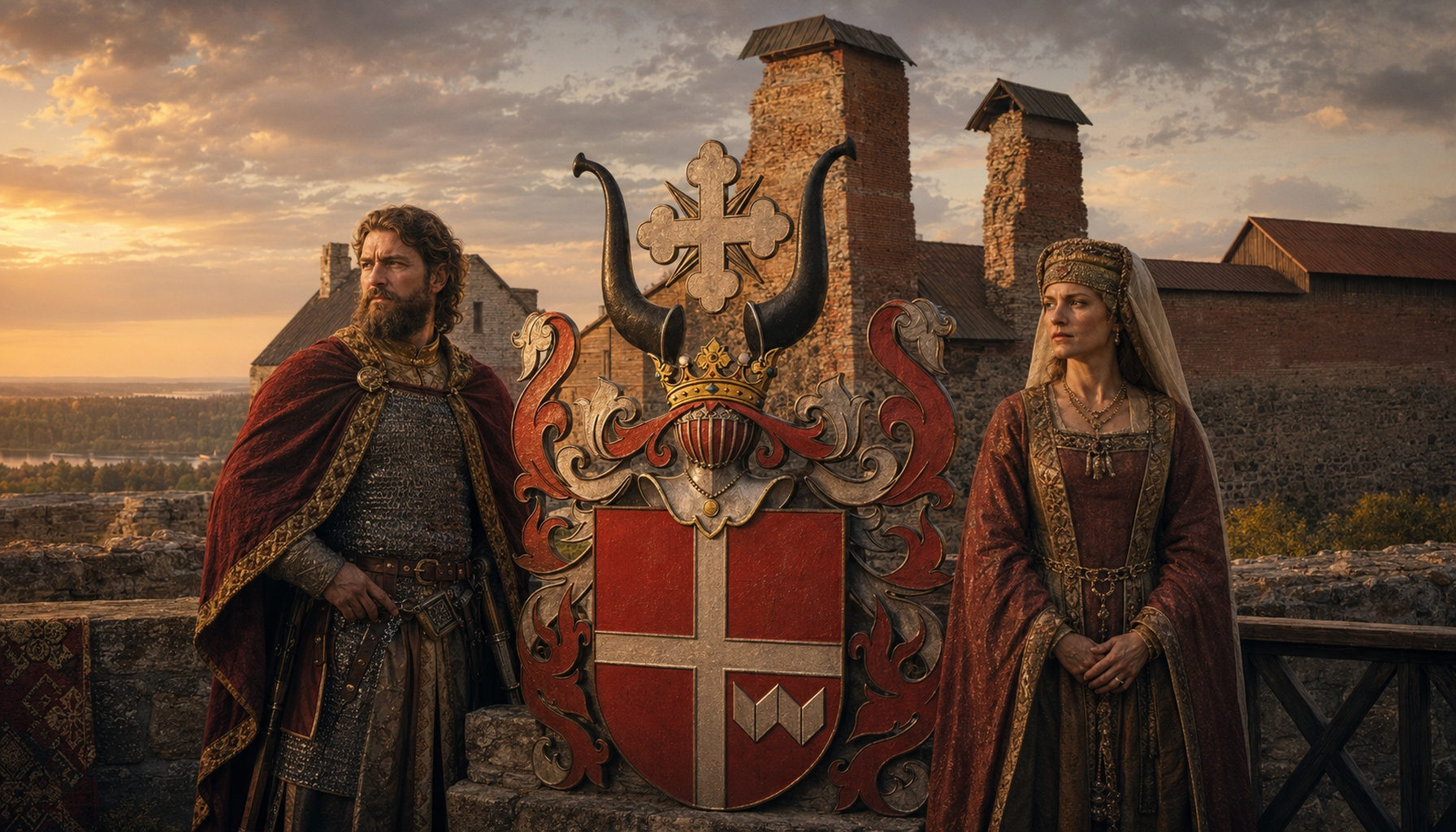
The House of Koreiva can be understood as a Lithuanian and wider Eastern European noble-style lineage rooted in the old Baltic borderlands, remembered through land, heraldic identity, service, and the stubborn continuity of family name across centuries of political change. In that world, a house was not simply a surname. It was a claim to place, to obligation, and to memory: estates held, alliances made, arms borne, offices served, and ancestors recalled long after frontiers shifted around them. The primary family haplogroup linked with this heritage profile is R1a1a1b1a2b3a1d, a paternal line with a strong presence across parts of Central and Eastern Europe.
Seen in historical terms, House Koreiva fits a recognisable pattern from the Grand Duchy of Lithuania and its neighbouring regions: local authority grounded in territory, loyalty expressed through military or civic duty, and prestige reinforced by noble culture. The family tradition reaches back into a deeper Baltic imagination as well, with remembered figures such as the Koreiva King of the Ancient Baltics standing at the legendary edge of lineage memory, and later noble names like Prince Mikolaj Korewa in 1550 and Prince Jan Korewa in 1650 showing how such houses were carried forward into the documented early modern world. One should not read every title too literally, but one should take seriously the way families used them to tell the story of who they were.
The strongest location anchor for the House of Koreiva is Kreva Castle, in present-day Belarus, within the historic zone where Lithuanian, Ruthenian, and Polish political worlds overlapped. Kreva Castle was one of the major early stone castles of the Grand Duchy of Lithuania, built in the 14th century and associated with some of the most important power struggles of the age. It is especially famous for its link to Grand Duke Kestutis, who was imprisoned there and died within its walls, and for the Union of Krewo of 1385, the agreement that helped draw Lithuania and Poland into a new dynastic relationship under Jogaila. In other words, this was no obscure country ruin. It stood at the heart of a region where noble identity, state formation, and family ambition were all being hammered out together. The ruins of Kreva Castle still survive and can be visited today, making it a rare place where the landscape of Baltic noble memory remains physically present.
Read more about House Radziwill
From an ancient DNA perspective, the Koreiva haplogroup tag R1a1a1b1a2b3a1d sits within a broad and fascinating network of related or linked male-line samples across Central, Eastern, and parts of Southeastern Europe. These include Avar elite graves in Hungary such as Rakoczifalva RKC052 and RKC051 and Kunpeszer KUP015, Bronze Age individuals like Somogyvar-Vinkovci S9 in the Balaton region, Late Antique Pannonia at Arrabona GYS058, Piast-era and medieval Polish samples from Santok including PCA0404, PCA0520, PCA0381, PCA0382, and PCA0198, Western Slav settler burials in medieval Sachsen-Anhalt such as NDW036, NDW071, NDW017, NDW025, NDW038, NDW039, NDW043, SDN028, and SDN029, as well as Duchy of Sandomierz samples PDH011 and PDH012, early medieval Croatian samples VEM035 and VEM049, and still deeper finds from Bronze Age Romania I6185, Bronze Age Estonia X15, Iron Age Ingria VII15, and Dark Ages Hungary SEI-5. These do not prove direct descent from any named Koreiva ancestor, and it would be quite wrong to pretend otherwise. What they do show is that the paternal line associated with this family belongs to a long-lived historical landscape stretching from Bronze Age northeastern Europe through Slavic and Baltic medieval worlds into noble society.
Explore the medieval Piast DNA story
If the House of Koreiva speaks to your own family story, the next step is not fantasy but evidence. Upload your DNA to MyTrueAncestry and see whether you match the House Koreiva profile or any of the related ancient DNA samples linked with haplogroup R1a1a1b1a2b3a1d across Baltic, Polish, Hungarian, and medieval Slavic contexts. It is one of the most intriguing ways to test whether family memory and deep population history might meet.


Comments