The House of de Lannoy
– 3 min read


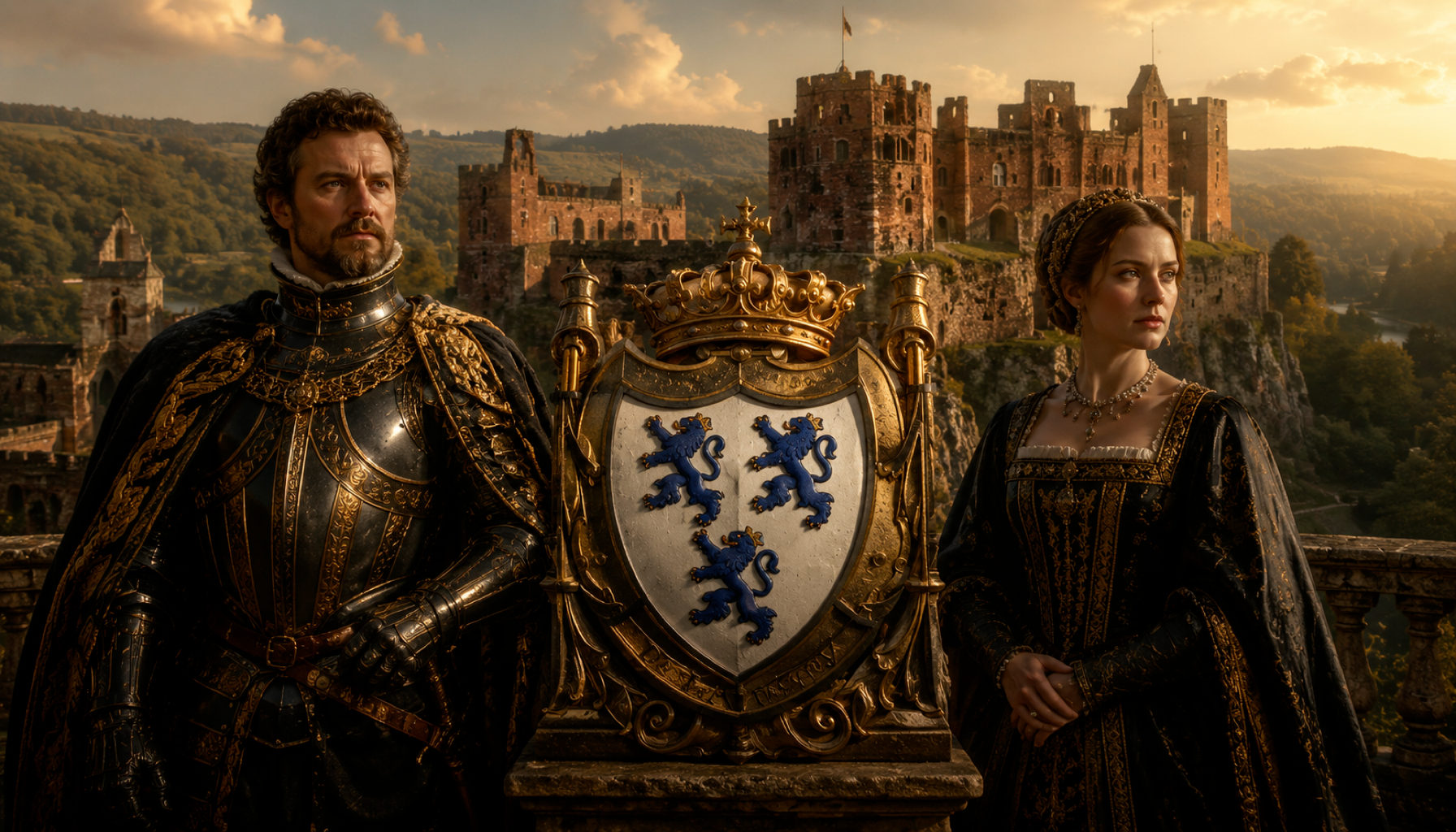
The House of de Lannoy was one of the old noble houses of the Low Countries, with roots in the borderlands of Flanders and Hainaut, a region where French-speaking lordship, Flemish urban power, and feudal politics met face to face. In genealogical and historical terms, the family belongs to that distinctive aristocratic world of the medieval and early modern Netherlands: landed, martial, well connected, and deeply invested in service to greater princes. Their primary linked haplogroup here is R1b1a1b1a1a1c2b3c2a, a branch associated with wider western European paternal lineages. Haplogroups: R1b1a1b1a1a1c2b3c2a.
What makes the de Lannoys interesting is not simply that they were noble, but the sort of noble they were. This was a house formed through lordship, marriages, military command, court office, and long memory. In the Burgundian and later Habsburg Low Countries, families like this did not survive by sitting still in one tower polishing a coat of arms. They thrived by serving dukes, kings, governors, and imperial networks while keeping hold of local prestige. The name itself points back to place, and from that place the family spread into wider European politics. Named figures help anchor the long timeline: Gillion de lAnnoit is recorded in 1250, while Philip De La Noye, born in 1602 and dying in 1681, carried the family name across the Atlantic into the colonial history of New England.
Explore the House of de Crombrugghe
A key location anchor for the family story is the chateau associated with Anvaing, often discussed in connection with the de Lannoy inheritance sphere and aristocratic footprint in Hainaut. The Chateau d'Anvaing, in present-day Belgium, stands in a landscape that tells the real story of noble continuity better than any romantic legend does. The site developed from a medieval seigneurial base and was reshaped over centuries, reflecting exactly how houses like de Lannoy lived: not frozen in one moment, but constantly rebuilt as fortunes, political loyalties, and styles changed. This was the sort of residence that mattered because it joined land, jurisdiction, memory, and display. A chateau was not just a house. It was a public statement that a lineage belonged to the region and expected to remain there. The Chateau d'Anvaing is still known as a historic monument, and the site and its surroundings can be visited in the sense that the village and exterior heritage setting remain accessible, though visitors should check current local access arrangements before planning a dedicated trip.
Explore medieval Sint-Truiden DNA
For the DNA angle, it is important to be careful and precise. We should not claim direct descent from ancient samples without specific evidence. But the de Lannoy paternal line is linked here with haplogroup R1b1a1b1a1a1c2b3c2a, and related or linked ancient samples from western and northern Europe help sketch the deeper backdrop into which such a lineage fits. These include Medieval Belgium Sint-Truiden Onze-Lieve-Vrouwekerk (ST1237), Belgic Suessiones Iron Age France Bucy-le-Long (CGG022456, CGG022425, CGG022419), Carolingian Era Groningen Netherlands (GRO013), Early Anglo Saxon Cemetery West Heslerton Yorkshire (I20644, I20671, I20677), Norman Invasion Medieval Lincolnshire Lincoln Castle (S3044), Longobard Haeven Mecklenburg-Vorpommern (HVN005), Lombard Warrior Elite Collegno Northern Italy (COL_069 and COL_069x) and Lombard Era Collegno Northern Italy (COL_069b), as well as deeper-time examples such as Middle Bronze Age Westwoud-Binnenwijzend Netherlands (I11972) and Bell Beaker De Tuithoorn North Holland (I4070). Taken together, these do not prove a family tree for the de Lannoys, but they do place the family's linked paternal signature within a broad historical arc stretching from Iron Age Belgic populations through medieval populations of the Low Countries and neighboring regions.
Read about Bell Beaker ancestry in the Low Countries
If the House of de Lannoy speaks to your own family story, the next step is not guesswork but comparison. Upload your DNA to MyTrueAncestry and see whether you match the de Lannoy family profile or any of the related ancient DNA samples from medieval Belgium, Iron Age Gaul, the Low Countries, or the wider northwestern European world. That is where heraldry, paper genealogy, and archaeogenetics suddenly become much more personal.



Comments