The House of de Crombrugghe
– 3 min read


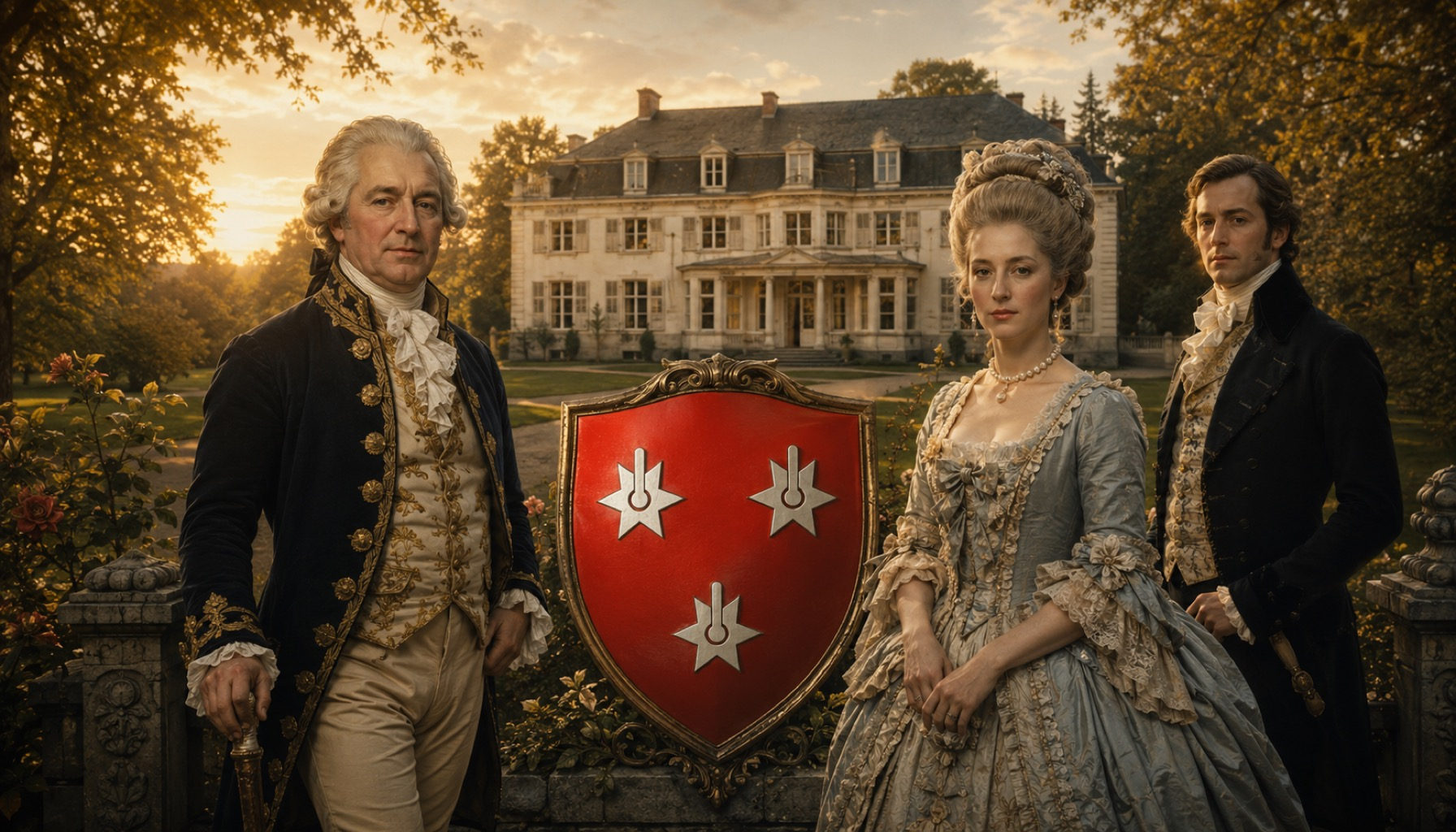
The House of de Crombrugghe was one of the noble families of the Low Countries, rooted in the old Flemish and later Belgian aristocratic world of land, office, heraldry, and long family memory. Their story belongs to that very characteristic landscape of the region: market towns and church institutions, seigneurial estates and local jurisdictions, princely power and shifting overlordship, all tied together in one of Europe's most densely connected societies. In that setting, the de Crombrugghes built and preserved status through property, service, alliances, and continuity across generations. The primary haplogroup linked with the family here is R1b1a1b1a1a2c1a2a1, a branch within the great western European R1b lineages.
The family background is best understood not as a single dramatic rise, but as a durable noble pattern of the Low Countries. Houses such as de Crombrugghe mattered because they were locally anchored and publicly useful. Their identity was shaped by coats of arms, inherited rights, administrative and civic roles, military obligations when required, and close connection to local institutions. Under changing Burgundian, Habsburg, Spanish, Austrian, French, Dutch, and Belgian frameworks, noble families in this region often survived by adapting while keeping their lineage visibly intact. A named figure such as Gilles de Crombrugghe (1348-1411) places the family firmly in the late medieval world, when urban power, seigneurial influence, and regional politics met in particularly vivid ways across Flanders and the wider Low Countries.
A useful location anchor for the family's later heritage is Castle Stas de Richelle, in Richelle in the province of Liege, today within the municipality of Vise in eastern Belgium. The present castle is a country-house style residence associated with the 19th century, built in a landscape that perfectly suits the history of families like de Crombrugghe: not isolated feudal wilderness, but a cultivated noble setting close to villages, roads, ecclesiastical centers, and the Meuse corridor, one of the great historic arteries of the region. It stands as a reminder that Belgian noble life was as much about residence, estate management, sociability, and regional standing as about warfare or court display. The castle and its park are known as a real historic site, and it is often noted as a place that can still be seen from the outside; depending on ownership, access conditions may vary, so visiting is best checked locally in advance.
From a DNA perspective, the de Crombrugghe family's primary lineage, R1b1a1b1a1a2c1a2a1, sits within a wider northwest European story rather than a single family-only trail. Related or linked ancient samples connected with this branch include a striking spread of individuals from different periods and regions: Celtic Durotriges burials from Duropolis, Winterborne Kingston in England such as WBK12, WBK20, WBK29, WBK41, WBK05, WBK30, WBK43, WBK06, WBK08, WBK18, and WBK191; Imperial Roman Era Zadar in Croatia I26776; Bronze Age Orkney, Westray Links of Noltland KD061; Bronze Age Calabria, Grotta della Monaca Sant Agata di Esaro GMO015; Early Medieval Belgium Sint-Truiden Groenmarkt ST2025; Medieval Belgium Outsider Sint-Truiden Onze-Lieve-Vrouwekerk ST1308; Gallic France Parancot CGG023699; Post Roman Worth Matravers, Dorset I11580; Merovingian Alt-Inden in North Rhine-Westphalia IND013; Late Roman Klosterneuburg R10656; Late Roman Conimbriga R10488; Celtic Briton East Kent I13730; Iron Age Worlebury I11991; Iron Age Orkney roundhouse sample I2982; Battlesbury Bowl I21309; Bronze Age Trumpington Meadows I3256; Amesbury Down I2417; Bell Beaker Upavon I4950; medieval Sandoy Church in the Faroe Islands VK27; Bronze Age Bedfordshire I7576 and I7577; Boatbridge Quarry South Lanarkshire I5473; Hinxton Iron Age HI2; Early Bronze Age Thames I5377; and Rathlin2B from Copper Age Ireland. These do not demonstrate direct descent from any one ancient individual to the de Crombrugghes. What they do show is that the haplogroup belongs to a deep and mobile western European paternal landscape stretching from Bell Beaker and Bronze Age communities through Iron Age Celtic populations, Roman and post-Roman worlds, and into the medieval societies from which Low Countries noble houses eventually emerged.
If you are curious about whether your own family history connects to lineages like R1b1a1b1a1a2c1a2a1 and the wider world of medieval and ancient Europe, upload your DNA to MyTrueAncestry and explore the historical populations linked to your results.
Comments