The House of Audley
– 3 min read


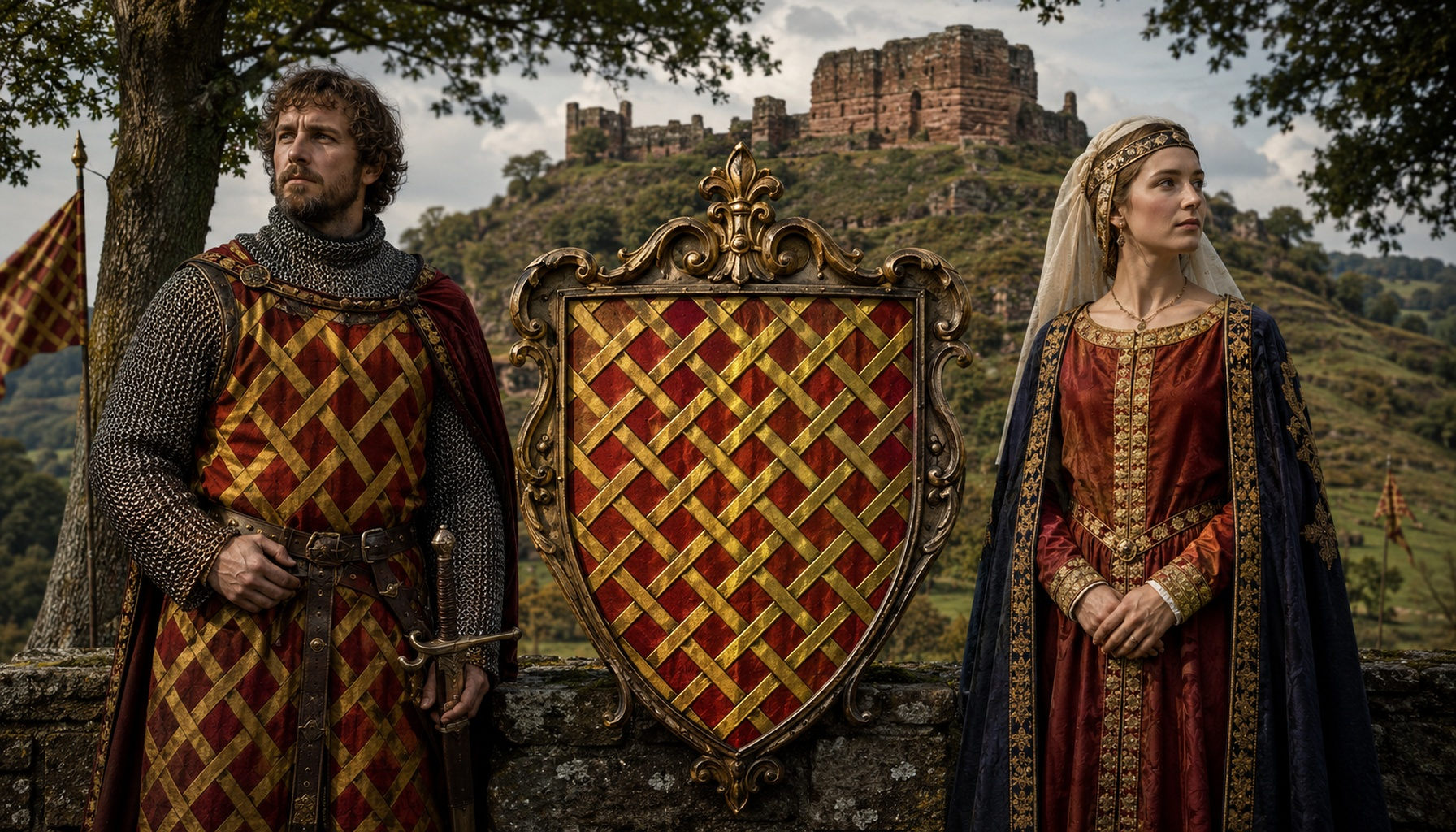
The House of Audley was an English noble family rooted in the medieval lordly world of Staffordshire and the Welsh borderlands, a family whose name is usually traced to Aldithley, now Audley, in north Staffordshire. In genealogical and Y-DNA terms, the primary family haplogroup associated here is R1b1a1b1a1a2b1, a branch within the great western European R1b line. Historically, the Audleys belong to that recognisable English aristocratic pattern: land, castles, crown service, marriage strategy, heraldic display, and a reputation built as much in local authority as in national politics.
The family emerged in the Anglo-Norman and Angevin world, when power in England was not simply inherited but constantly negotiated through royal favour, military duty, feudal obligation, and advantageous alliances. That is the proper setting for understanding the Audleys. They were not just owners of estates, but participants in the machinery of medieval England. One early and important figure was Henry de Aldithley, or Henry de Audley, c.1175-1246, a royal servant and landholder whose career helped establish the house on a firmer baronial footing. Through men like him, the Audleys translated local landed influence into wider political standing, leaving behind titles, armorial identity, and a memory that lasted well beyond the Middle Ages.
One of the great location anchors for the family is Heighley Castle in Staffordshire, near Madeley, dramatically placed above the River Lyme. Built in the early 13th century, probably by Henry de Audley, it was both a statement and an instrument of lordship. Medieval castles were not simply romantic piles of stone; they were engines of control, symbols of status, and very practical reminders of who held power in the surrounding countryside. Heighley was constructed in stone and occupied a strong defensive site, but its story was not one of endless grandeur. It was slighted after the baronial unrest of the mid-13th century, reportedly following the conflict around the Second Barons' War, and much of it fell into ruin. Even so, the remains still matter because they preserve the physical footprint of Audley ambition in the landscape. The ruins of Heighley Castle do survive and, as a historic site with visible remains, it can still be visited, which is rather marvellous: a direct encounter with the place where noble identity, fortification, and local governance once met in stone.
From a DNA perspective, the Audley-associated haplogroup R1b1a1b1a1a2b1 links into a very wide and very old west European story. It appears in related or linked ancient samples from Iron Age and medieval Britain, Iberia, and continental Europe rather than in any proven direct line to the Audley family itself. Among useful comparisons are Celtic Durotriges individuals from Duropolis at Winterborne Kingston in England such as WBK106 and WBK36, medieval northern Spain samples from Las Gobas including ldo066, ldo037, ldo046, ldo048, ldo040, and Dark Ages ldo062, Gallo-Celtic individuals from Pont de Cornaux-Les-Sauges in Switzerland such as 3434x, 3429, 3431, and 3434, and later British examples including Roman-era Fenstanton FEN008, Medieval England Cherry Hinton ATP_PSN_944, Cambridge St Johns Hospital ATP_PSN_36 and ATP_PSN_116, and Late Medieval Clopton ATP_PSN_1217. Taken together, these linked samples suggest a haplogroup with deep roots across Bell Beaker, Bronze Age, Iron Age Celtic, Roman, and medieval populations of western and central Europe. That does not prove descent from any one ancient individual, of course, but it does place the Audley genetic signature within a long and unmistakably European paternal continuum.
Read about Ancient DNA in Post-Roman Britain
The Audleys are a fine example of how family history, landscape, and genetics can be read together: a Staffordshire place-name becoming a noble house, a ruined castle preserving baronial memory, and a haplogroup pointing into a much older European past. If you have tested your DNA, you can upload it to MyTrueAncestry and see whether you match the House of Audley or any of the related ancient DNA samples linked with haplogroup R1b1a1b1a1a2b1.
Comments