The House of Arrazola
– 2 min read


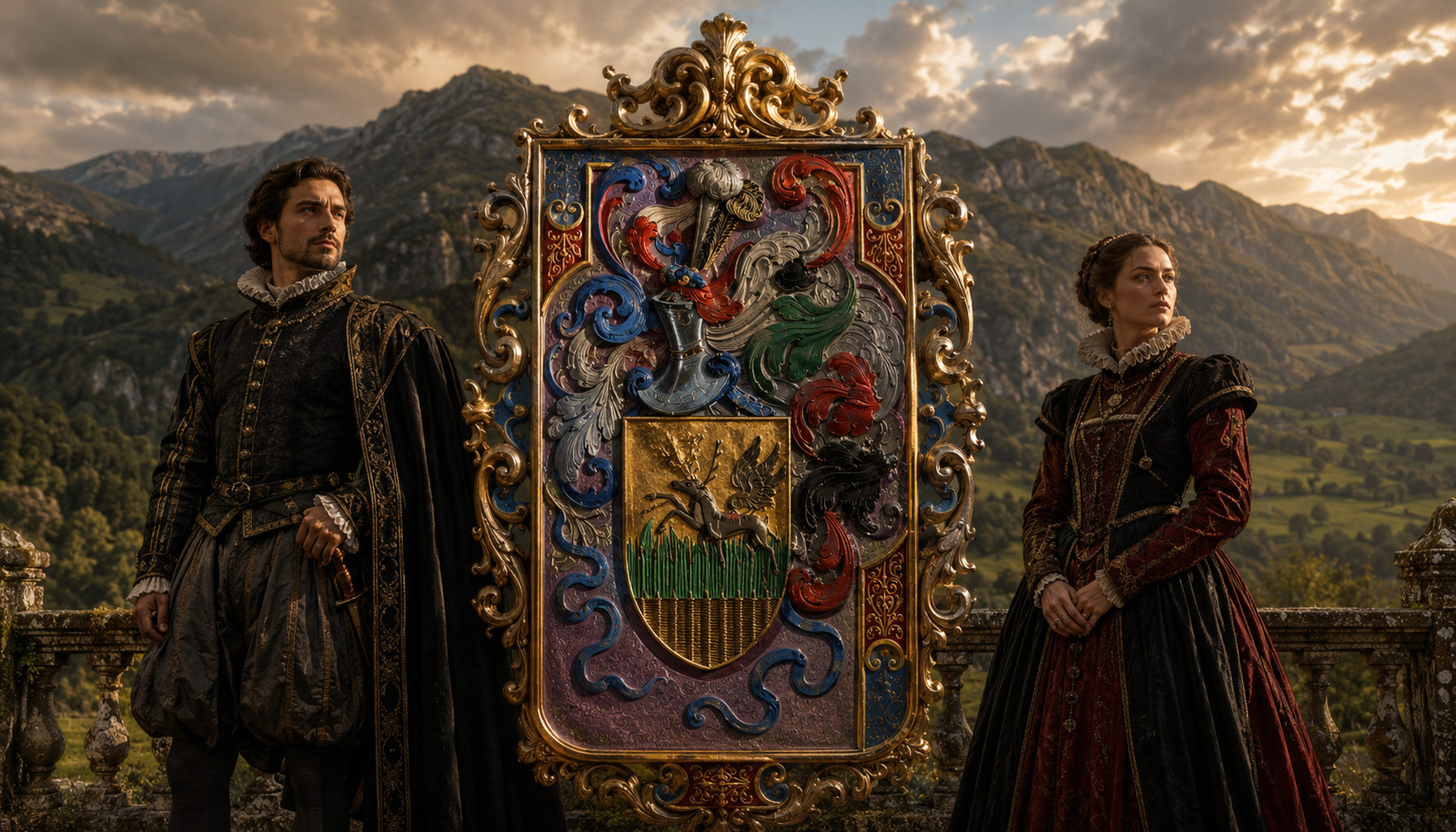
The House of Arrazola was an Iberian noble family of Basque and Spanish character, rooted in the world of northern Spain where land, lineage, and public service shaped noble identity for centuries. Its story belongs to that older Iberian pattern in which a family name was not simply a label, but a statement of place, authority, kinship, and remembered duty. Linked here with the primary family haplogroup J1a2a1a2d2b2b2c4d2a2, the Arrazola name evokes a house grounded in regional lordship, estate continuity, and the careful preservation of heraldic memory across generations.
Like many noble houses of the Basque country and the wider Spanish north, the Arrazola family would have drawn strength from local standing as much as from royal connection. These were societies in which legal privilege, service to crown or province, marriage alliance, and the defense of inherited reputation all mattered enormously. The family tradition fits that landscape well: a house defined by origin, continuity, and visible status. Named figures associated with this line include Fabio Arrazola de Mondragone (1525-1586) and Jean-Jacques Arrazola de Onate (1615-1688), both names suggesting the sort of cross-regional reach, alliance building, and service culture that so often marked noble families of Iberian background in the early modern world.
A striking location anchor for the family memory is Chateau d Hougomont, better known as Hougoumont, in present-day Belgium. Today it is famous above all for its dramatic role in the Battle of Waterloo in 1815, when the fighting around the walled farm and chateau became one of the best-known episodes of the campaign. But Hougoumont was already an old and substantial site long before Waterloo: a fortified farm complex with a chapel, gardens, orchards, and defensive walls, reflecting the layered life of landed Europe where noble, agricultural, and military histories so often overlapped. It is exactly the sort of place that helps us picture how aristocratic identity attached itself to stone, landholding, and continuity. The site has been restored and is part of the Waterloo battlefield area, so it can still be visited by the public.
Explore the House of de Lannoy
From the ancient DNA side, the haplogroup J1a2a1a2d2b2b2c4d2a2 links the Arrazola profile to a much wider historical map than any one family archive could show on its own. Related or linked ancient samples include Medieval Ukraine Zaporizhzhia Mamay-Gora (UKR020), Imperial Roman Era Mursa Croatia (I26749), Medieval Syria under the Umayyad Caliphate at TellQarassa (syr005), Early Avar Hungary Szeged-Fehert (SZF-26), Bronze Age Baqah Jordan (I3705), and Ancient Alalakh (ALA026). These do not prove direct descent from any one of those individuals, and it is important not to pretend otherwise. What they do show is that this paternal line belongs to a deep and remarkably wide historical network stretching across the Mediterranean, the Balkans, the Near East, and the steppe-connected world. That is one of the pleasures of archaeogenetics: a noble house that looks firmly local in the records can also sit inside a far older and broader human story.
Read about Roman Mursa in Croatia
If the House of Arrazola speaks to your own family story, the next step is to test that connection properly. Upload your DNA to MyTrueAncestry and see whether you match the Arrazola family profile or any of the related ancient DNA samples linked to haplogroup J1a2a1a2d2b2b2c4d2a2. It is a fine way to move from surname and tradition into the deeper archaeology of ancestry.


Comments