The House of de Lannoy

– 2 min read


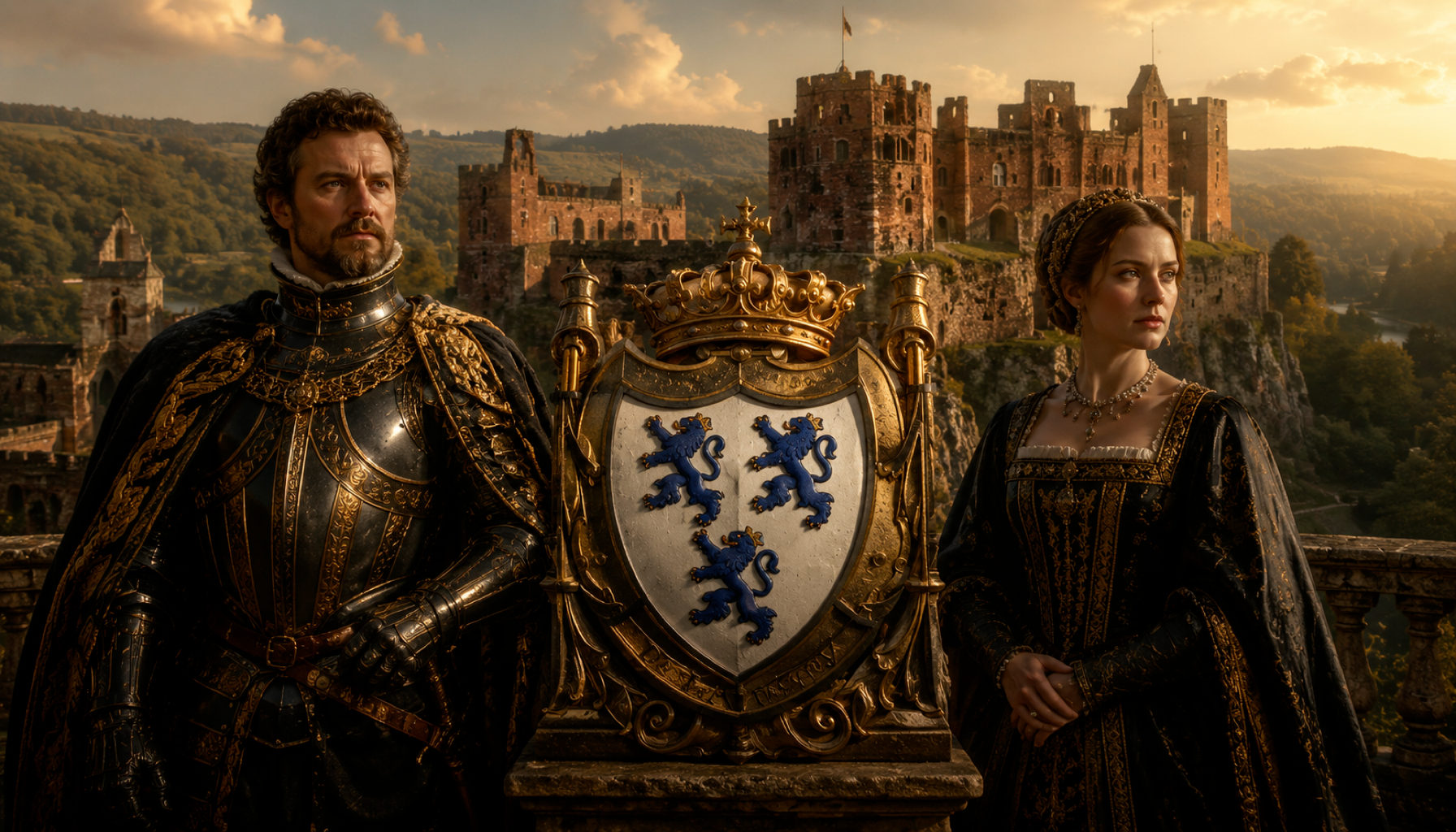
The House of de Lannoy was one of the old noble families of the Low Countries, rooted in the borderlands of Flanders and Hainaut and shaped by the political world of northern France, the Burgundian Netherlands, and later Habsburg power. In that landscape, noble identity was not simply a matter of owning land. It was built through lordship, military service, court office, careful marriage alliances, and a fierce sense of lineage. The family name belongs to that wider aristocratic culture which linked French-speaking chivalric society with the urban, princely, and dynastic networks of the Low Countries. Haplogroup tag: R1b1a1b1a1a1c2b3c2a, the primary family haplogroup associated here.
The family background is richer than a mere list of titles. The de Lannoys belonged to a world where castles, heraldry, and dynastic loyalty mattered deeply, but so too did adaptability. They emerged from a regional noble setting and endured because they served larger powers without losing their local standing. One early figure, Gillion de lAnnoit, recorded in 1250, points to the family in its medieval formative stage, when landed authority and knightly reputation went hand in hand. Much later, Philip De La Noye, born in 1602 and dying in 1681, carried the name into a very different Atlantic age, becoming a reminder that families of this sort were not locked inside one province but could become part of much broader European and colonial stories.
A useful anchor for the heritage of the house is the Chateau d'Anvaing, often connected with the de Lannoy story and the wider seigneurial geography in which the family moved. Located at Anvaing in present-day Belgium, in the old County of Hainaut, the chateau stands in a region where noble houses balanced rural authority with service to greater princely states. The site, in its long architectural life, reflects exactly the kind of continuity associated with families such as the de Lannoys: medieval roots, later rebuilding, aristocratic adaptation, and the preservation of memory through estate culture. It is not just a picturesque building. It represents the material backbone of noble identity in the Low Countries, where lineage was expressed in stone, land, chapel patronage, and controlled landscapes. The chateau is known today and can still be visited in at least some form through the local heritage landscape, making it a rare and tangible bridge between medieval family history and the modern public.
From a DNA perspective, the de Lannoy haplogroup tag R1b1a1b1a1a1c2b3c2a sits within a wider northwestern European and historically mobile genetic landscape. Ancient samples linked or related at this branch include Lombard Warrior Elite Collegno Northern Italy samples COL_069, COL_069b, and COL_069x; Medieval Belgium Sint-Truiden Onze-Lieve-Vrouwekerk ST1237; Iron Age and Gallic era individuals from Bucy-le-Long in France such as CGG022456, CGG022425, and CGG022419; Early Anglo-Saxon cemetery samples from West Heslerton in Yorkshire including I20644, I20671, and I20677; Carolingian Groningen in the Netherlands GRO013; Longobard Haeven Mecklenburg-Vorpommern HVN005; Norman Invasion era Lincoln Castle S3044; Middle Bronze Age Westwoud-Binnenwijzend in the Netherlands I11972; Post-Medieval Ellwangen ELW003; Bell Beaker De Tuithoorn North Holland I4070; and Medieval Upper Bavaria Petersberg. These do not prove direct descent from the House of de Lannoy, and it would be quite wrong to pretend they do. But they do place the family's haplogroup in a deep historical corridor stretching across the Low Countries, northern France, the North Sea world, and the military aristocratic networks of medieval Europe.
If you want to explore whether your own paternal line connects with this wider historical DNA landscape, upload your DNA to MyTrueAncestry and see which ancient and medieval populations your results may align with.

Comments