The Hough Family
– 3 min read


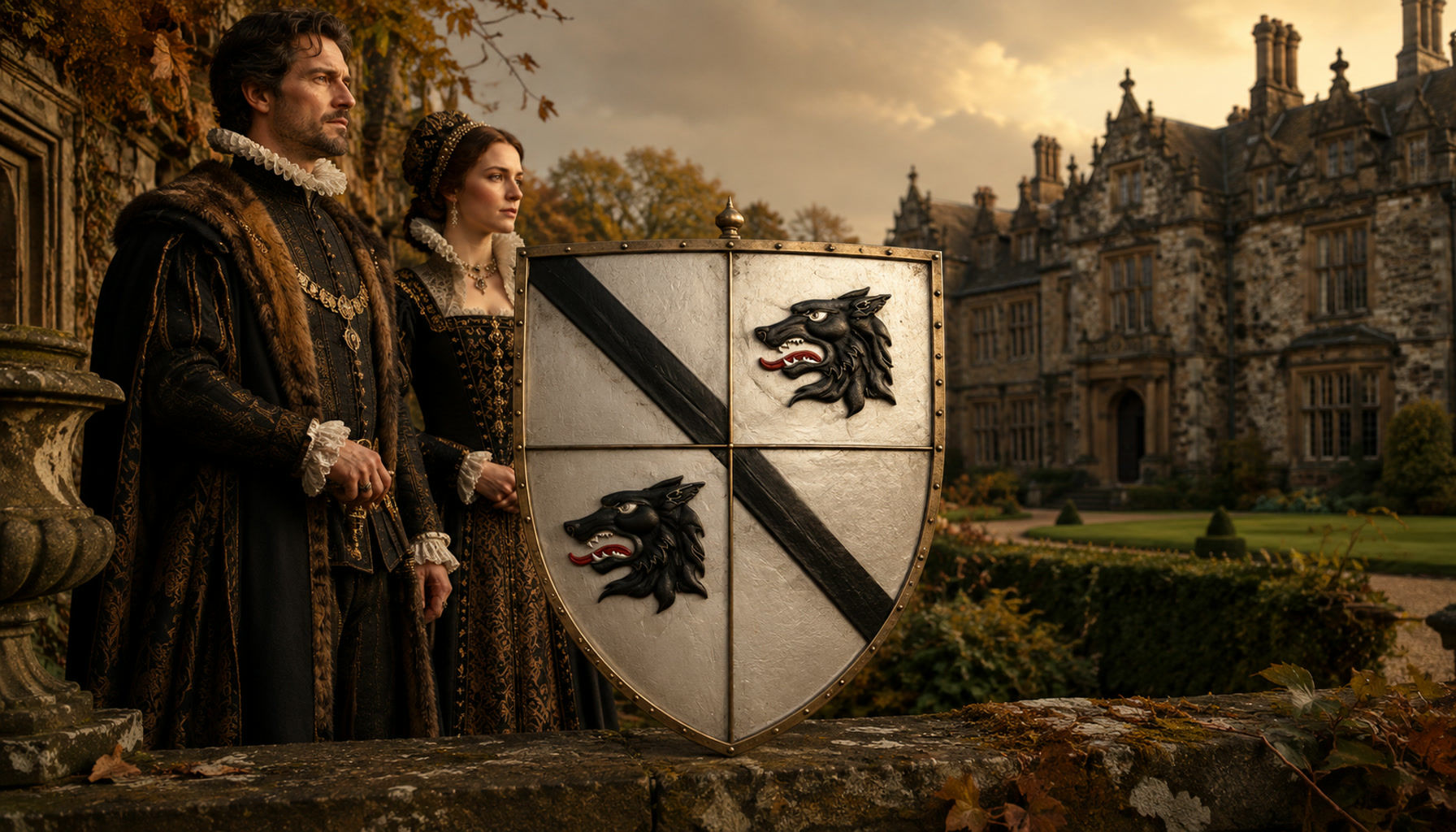
The Hough family belongs to that recognisably English world of family houses, local standing, and inherited memory: not a princely dynasty blazing across all Europe, but a surname rooted in place, continuity, and the long habits of landholding society. The name Hough is generally linked to topography and settlement, often deriving from places named for a hill, hollow, or spur of land, and it fits the old English pattern by which families became known through the landscape they occupied and the communities in which they endured. In this sense, House Hough represents a classic English lineage, shaped by estate culture, marriage alliances, parish life, office-holding, and the stubborn importance of being known locally over generations. Primary family haplogroup: I1a1b1a1e2e1b1.
What makes families like the Houghs historically interesting is precisely that they sit in the grain of English history. Their significance rests less on crowns and conquests than on continuity: who held land, who served church or county, who married into neighbouring families, and who preserved the family name as a badge of belonging. Among the best-known figures is John Hough, Bishop of Oxford (1651-1743), a formidable churchman remembered for his resistance to James II at Magdalen College, Oxford, and for the kind of moral and institutional stubbornness that has often attached itself to English ecclesiastical and gentry tradition. The Hough story is therefore not simply about one bloodline, but about a wider historical pattern in which name, place, property, and memory reinforced one another across centuries. Haplogroups linked with the family tradition include I1a1b1a1e2e1b1 as the primary line marker.
A fitting location anchor for the Hough family story is Worcester Cathedral, one of the great historic churches of England and a place where local identity, religion, memory, and regional prestige all meet. Standing above the River Severn in Worcester, the cathedral is a building with deep chronological layers: its origins go back to the 7th century, while much of the present structure reflects Norman rebuilding after 1084 and later medieval development. Architecturally it is famous for its mixture of Norman crypt, early Gothic work, fine central tower, cloisters, and chapter house; historically it is tied to saints, bishops, the medieval church, the English Civil War, and royal commemoration, not least through the tomb of King John. For a family-house tradition such as the Houghs, a cathedral like Worcester matters because it shows how English lineages were anchored not only in manor and field but also in parish, diocese, monument, and public memory. And yes, it can still be visited today, which is part of its charm: this is not a vanished world, but one still standing in stone.
From the ancient DNA side, the Hough family's primary haplogroup I1a1b1a1e2e1b1 sits within a broader northern European paternal story, and related or linked ancient samples help give that deeper backdrop. These include Iron Age Pommerania Gdansk Wielbark (PCA0480), Viking Age Sweden Uppsala Enbacken (enb200), Viking Age Hessum Funen Denmark (VK295), Early Viking Age Hundstrup Sealand Denmark (VK296), Vendel Age Saaremaa Salme II-J (VK549), and Vendel Age Saaremaa Salme II XXVIII (VK511). These individuals should not be presented as direct ancestors of the Hough family without specific evidence, but they are useful linked reference points for understanding the wider ancient distribution of related I1 lineages across the Baltic, Scandinavian, and North Sea world. In other words, they illuminate a genetic horizon that later fed into the historical populations from which many English surname families emerged.
Read about Anglo-Saxon genetic legacy
If you carry the Hough name, or think your family may connect to this kind of English regional surname heritage, the most exciting next step is to test the story against both records and DNA. Uploading your results to MyTrueAncestry can help you see whether you match the Hough family pattern or show connections to related ancient DNA samples from the Iron Age and Viking Age world. That is where family memory meets archaeology in the most enjoyable way: not as fantasy, but as a fresh way of asking where your people may have stood in the long human story.
Comments