The House of Croft
– 3 min read


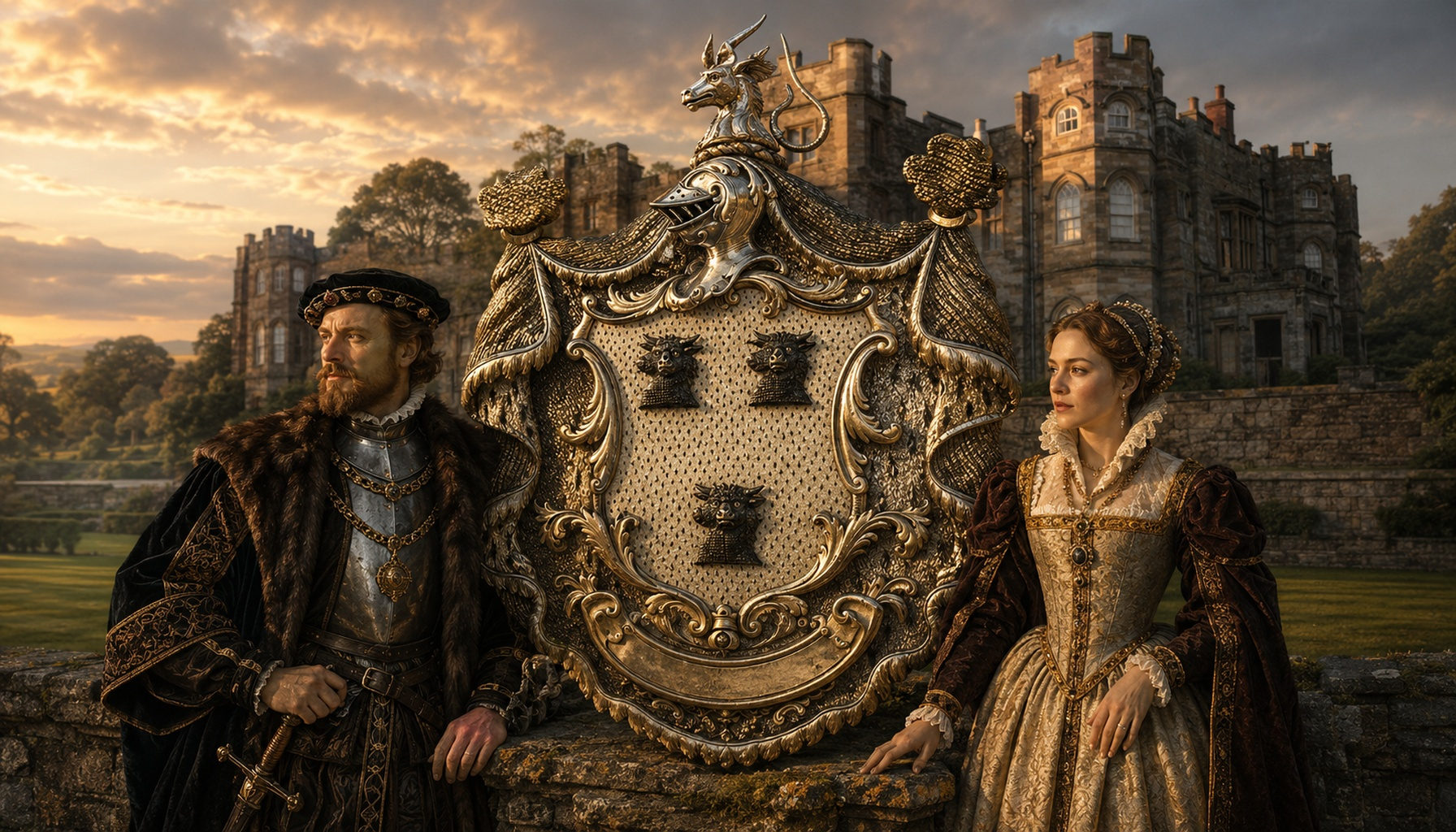
The House of Croft was a historic English landed family rooted in Herefordshire, with its identity closely tied to the county world of estates, heraldry, office, and long local memory. Their name comes from place, from Croft in the north of Herefordshire near the Welsh border, and that matters because families like this were not abstract noble houses floating above the map. They were anchored in a specific landscape of manors, churches, tenants, kin alliances, and county obligations. The primary haplogroup linked with the family is R1b1a1b1a1a1c2b3b, a branch within the wider R1b paternal line that appears again and again across the deep history of western and northwestern Europe.
The Crofts fit a very recognisable English pattern: a family that rose and endured through landholding, careful marriages, royal service, military duty, and participation in county society. This is the world of sheriffs, MPs, household officers, estate managers, and men whose reputation was built as much in local governance as at court. Sir Richard Croft (1429-1509) belongs to that long late medieval phase when local power, loyalty, and property defined family standing, while Sir James Croft (1518-1590) shows the house operating on a larger Tudor stage, serving as a soldier, administrator, and statesman. Across generations, the Crofts represent continuity rather than flamboyance: the steady English art of remaining important.
The great geographical and emotional anchor of the family is Croft Castle in Herefordshire, near Yarpole, not far from the borderlands where England and Wales have so often rubbed uneasily against one another. The site has deep roots, with an earlier castle replaced and altered over centuries, and the present house is largely a substantial stone residence shaped by medieval origins and later rebuilding. It sits within parkland, with church, gardens, and estate landscape all helping to tell the story that one building alone never can. In other words, Croft Castle is not just a house but a statement of hereditary presence: a place where lineage, architecture, and memory were made visible. Happily, it is still visitable today, with the property under the care of the National Trust, so this is one of those family seats that remains very much part of the living historical landscape rather than a vanished name in a pedigree.
Read more about the House of Howard
From a DNA perspective, the Croft-linked haplogroup R1b1a1b1a1a1c2b3b belongs to a paternal story spread across a striking sweep of European history. Related or linked ancient samples include Bell Beaker De Tuithoorn North Holland (I4070), Middle Bronze Age Westwoud-Binnenwijzend Netherlands (I11972), Belgic Suessiones Iron Age France Bucy-le-Long (CGG022456, CGG022425, CGG022419), Early Anglo Saxon Cemetery West Heslerton Yorkshire (I20644, I20671, I20677), Lombard Warrior Elite Collegno Northern Italy (COL_069, COL_069x), Lombard Era Collegno Northern Italy (COL_069b), Longobard Haeven Mecklenburg-Vorpommern (HVN005), Carolingian Era Groningen Netherlands (GRO013), Medieval Belgium Sint-Truiden Onze-Lieve-Vrouwekerk (ST1237), Norman Invasion Medieval Lincolnshire Lincoln Castle (S3044), Medieval Upper Bavaria Germany (Petersberg), and Post Medieval Plague Victim Ellwangen Germany (ELW003). These do not prove direct descent from any one buried individual, and we should be careful not to pretend otherwise. What they do show is that the Croft family haplogroup sits within a long western European paternal continuum that touches Bronze Age communities, Iron Age Belgic groups, early Anglo-Saxon England, Lombard and Carolingian populations, and the medieval world from Belgium to Bavaria.
Explore Anglo-Saxon DNA in England
If the House of Croft catches your imagination, that is probably because it brings together all the good historical ingredients: a border-county setting, an enduring estate, named figures in late medieval and Tudor politics, and a paternal line with deep European echoes. Upload your DNA to MyTrueAncestry to see whether you match the House of Croft or any of the related ancient DNA samples linked with haplogroup R1b1a1b1a1a1c2b3b.


Comments