The Eure Family
– 2 min read


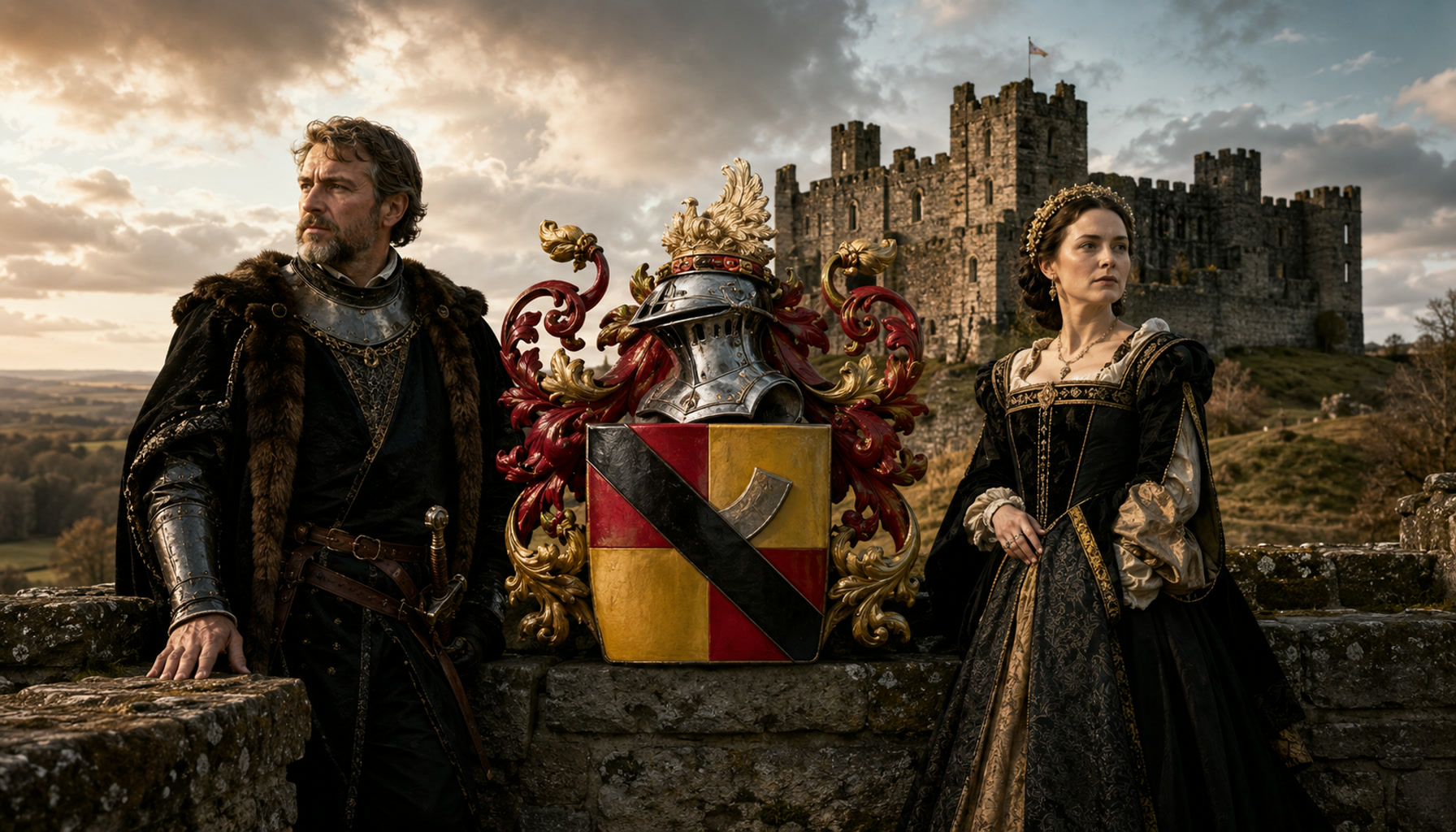
The Eure family was one of those northern English lineages for whom power was never just about pedigree on parchment. It was about land, riders, retainers, service, and survival in a region where England met Scotland in a long and often violent frontier. Rooted in Yorkshire and Durham, and deeply tied to the politics of the Anglo-Scottish borderlands, the Eures grew in importance through military duty, royal office, and local influence. Their primary family haplogroup is linked here as I1a1b1a1e2a, a paternal line often associated with northern European populations. Haplogroups: I1a1b1a1e2a.
The family name is generally connected to the place-name Eure in Normandy, which fits the wider story of post-Conquest England, when families of continental origin established themselves through landholding and crown service. But like so many noble houses in the north, the Eures became unmistakably English in character, and specifically northern English at that: practical, martial, and entangled in county government and border war. Men such as William Eure, 1st Baron Eure (1483-1548), Ralph Eure, 3rd Baron Eure (1558-1617), and William Eure, 4th Baron Eure (1579-1652) stand out in that story. They were not ornamental aristocrats drifting about court life alone; they belonged to a hard political landscape of wardenship, administration, raiding, defence, and crown loyalty in one of the most unstable regions of the kingdom.
Read more about the Noble House of Percy
A key location anchor for the family is Witton Castle in County Durham, near Bishop Auckland. The site began as a fortified manor house in the medieval period, with the licence to crenellate granted in the 15th century, and it became closely associated with the Eures as part of their northern estate world. What is striking about Witton is that it sits exactly in that zone where aristocratic residence, local authority, and defence overlapped. This was not merely a grand house for display. It was a statement of position in a county where noble families had to project control as much as comfort. Over time the building was altered, damaged, and restored, so what survives reflects a long and layered history rather than one frozen medieval moment. The castle and its grounds still exist today, and the site can still be visited, making it one of those rare places where the landscape of the Eure family is not just readable in records but still physically present.
From a DNA perspective, the Eure family's tagged paternal line I1a1b1a1e2a belongs to a wider northern European story that appears in several ancient samples linked to related branches of I1. These include Iron Age Pommerania, Gdansk Wielbark (PCA0480), Viking Age Sweden, Uppsala Enbacken (enb200), Early Viking Age Hundstrup, Sealand, Denmark (VK296), Vendel Age Saaremaa, Salme II-J (VK549), and Vendel Age Saaremaa, Salme II XXVIII (VK511). These are not evidence of direct descent from any one ancient individual, and it would be wrong to pretend otherwise. What they do offer is a useful genetic backdrop: they place this paternal line within the broad world of Iron Age and early medieval northern Europe, the same deep reservoir of ancestry that later fed into Scandinavian, Germanic, and North Sea connected populations, all highly relevant to the peopling of early medieval England.
Explore Anglo-Saxon migration DNA
If you are researching the Eure family, or simply fascinated by the northern English border world of castles, heraldry, warfare, and service, DNA can add another layer to the story. Upload your DNA to MyTrueAncestry to see whether you match the Eure family line or related ancient DNA samples from the wider I1a1b1a1e2a world.
Comments